

Ebook Info
- Published: 1988
- Number of pages: 396 pages
- Format: PDF
- File Size: 20.55 MB
- Authors: William Aspray and Philip Kitcher
Description
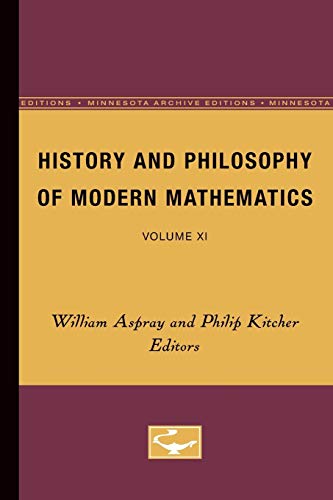
History and Philosophy of Modern Mathematics was first published in 1988. Minnesota Archive Editions uses digital technology to make long-unavailable books once again accessible, and are published unaltered from the original University of Minnesota Press editions.The fourteen essays in this volume build on the pioneering effort of Garrett Birkhoff, professor of mathematics at Harvard University, who in 1974 organized a conference of mathematicians and historians of modern mathematics to examine how the two disciplines approach the history of mathematics. In History and Philosophy of Modern Mathematics, William Aspray and Philip Kitcher bring together distinguished scholars from mathematics, history, and philosophy to assess the current state of the field. Their essays, which grow out of a 1985 conference at the University of Minnesota, develop the basic premise that mathematical thought needs to be studied from an interdisciplinary perspective.The opening essays study issues arising within logic and the foundations of mathematics, a traditional area of interest to historians and philosophers. The second section examines issues in the history of mathematics within the framework of established historical periods and questions. Next come case studies that illustrate the power of an interdisciplinary approach to the study of mathematics. The collection closes with a look at mathematics from a sociohistorical perspective, including the way institutions affect what constitutes mathematical knowledge.
User’s Reviews
Editorial Reviews: From the Back Cover Minnesota Archive Editions uses digital technology to make long-unavailable books once again accessible to scholars, students, researchers, and general readers. Rich with historical and cultural value, these works are published unaltered from the original University of Minnesota Press editions. The books offered through Minnesota Archive Editions are produced in limited quantities according to customer demand and are available through select distribution partners. About the Author Philip Kitcher is a professor of philosophy at Columbia University.
Reviews from Amazon users which were colected at the time this book was published on the website:
⭐Goldfarb, “Poincaré against the Logicists.” Poincaré complained that attempts to define arithmetic formally actually presupposed it, for example in using the concept “in no case” when defining zero. Goldfarb claims to “defeat” this objection as follows. “Poincaré is … construing the project of the foundations of mathematics as being concerned with matters of the psychology of mathemtics and faulting logicism for getting it wrong.” (p. 67). But “it is a central tenet on antipshychologism that such conditions are irrelevant to the rational grounds for a proposition. Thus the objection is defeated.” (p. 70). But what about the question, central to Poincaré and many others, of whether it is possible to reduce arithmetic to logic? Goldfarb is apparently happy to dismiss this as an “irrelevant” matter of “pshychologism.”Dauben, “Abraham Robinson and Nonstandard Analysis.” I have only read the incompetent section on Lakatos (section 2) of this chapter. Here Dauben offers a groundless and ideologically motivated attack on Lakatos’ paper on Cauchy. First there is the nonsense about Robinson’s non-standard analysis. Dauben writes correctly that: “There is nothing in the language or thought of Leibniz, Euler, or Cauchy (to whom Lakatos devotes most of his attention) that would make them early Robinsonians” (p. 180). This is all true, but it is also true that Lakatos never claimed otherwise, which is why Dauben must resort to underhand insinuations like this. Leaving this straw man aside, Lakatos wrote correctly that: “The downfall of Leibnizian theory was not due to the fact that it was inconsistent, but that it was capable only of limited growth. It was the heuristic potential of growth—and explanatory power—of Weierstrass’s theory that brought about the downfall of infinitesimals” (p. 181). Dauben foolishly claims that “Lakatos apparently had not made up his mind” and “even contradicts himself” (p. 182) in acknowledging that Leibnizian calculus is inconsistent. This makes no sense. There is no contradiction. The inconsistency of Leibnizian calculus is even referred to as a fact in the first quotation. Dauben also claims that Lakatos is wrong because “the real stumbling block to infinitesimals was their acknowledged inconsistency” (p. 181). Why, then, did the calculus “stumble” only after two hundred years? If Dauben thinks that classical infinitesimal calculus “stumbled” before it had dried up, I suggest that he shows us what theorems it could have reached were it not for this obstacle.Askey, “How can mathematicians and mathematical historians help each other?” Most of this article deals with haphazard and obscure notes regarding Askey’s own historical research and does nothing to answer the title question. Askey’s basic perspective is that mathematicians are well-meaning saints who do nothing wrong but that mathematical historians are incompetent and prejudiced in various ways. For example, Askey amuses himself with finding errors in Kline’s history, and concludes that “it is clear that mathematical historians need all the help they can get” (p. 212). But it makes no sense to blame historians, for Kline was a mathematician. He obtained his Ph.D. in mathematics and was a professor of mathematics at a mathematics department all his career. Elsewhere Askey writes: “One cannot form an adequate picture of what is really important on the basis of current undergraduate curriculum and first-year graduate courses. In particular, I think there is far too much emphasis on the emergence of rigor and the foundations of the mathematics in much of what is published on the history of mathematics.” (p. 203). The obvious lesson is for mathematicians to stop teaching lousy courses that trick students into thinking that rigour is a huge deal, etc. But no. That would entail admitting a flaw among the glorified mathematicians that Askey loves so much. So instead he nonsensically blames historians without further discussion.
⭐
Keywords
Free Download History and Philosophy of Modern Mathematics (Volume XI): Minnesota Studies in the Philosophy of Science in PDF format
History and Philosophy of Modern Mathematics (Volume XI): Minnesota Studies in the Philosophy of Science PDF Free Download
Download History and Philosophy of Modern Mathematics (Volume XI): Minnesota Studies in the Philosophy of Science 1988 PDF Free
History and Philosophy of Modern Mathematics (Volume XI): Minnesota Studies in the Philosophy of Science 1988 PDF Free Download
Download History and Philosophy of Modern Mathematics (Volume XI): Minnesota Studies in the Philosophy of Science PDF
Free Download Ebook History and Philosophy of Modern Mathematics (Volume XI): Minnesota Studies in the Philosophy of Science