

Ebook Info
- Published: 1975
- Number of pages: 352 pages
- Format: PDF
- File Size: 9.79 MB
- Authors: Paul the Deacon
Description
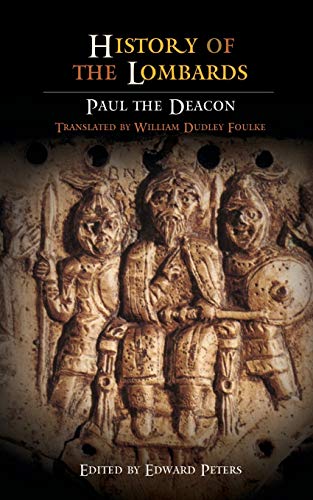
History of the Lombards, by Paul the Deacon (c. 720-c. 799), is among the most important and oldest accounts of the Germanic nation. The book preserves many ancient myths and popular traditions and draws from sources that are now lost. The history traces the changing fortunes of the Lombards, the last of the migratory Germanic peoples to enter the western part of the old Roman Empire, from their first appearance in the West in the sixth century to the middle of the eighth century. The popularity of Paul the Deacon’s book has endured over the centuries and, although there have been numerous translations and editions, this remains the only one in English.
User’s Reviews
Editorial Reviews: Review This account of his own people by one of the most learned of medieval historians will be a pleasant surprise to the English reader who has had no opportunity to put this vivacious chronicle . . . on the shelf with Herodotus. ― Independent Book Description “The History of the Lombards constitutes one of the most important literary sources for the early history of Europe, and the vision and energy of its author make it . . . the most complex of the histories of the Germanic peoples between the sixth and the ninth centuries.”—from the Introduction About the Author Edward Peters is Henry Charles Lea Professor of History at the University of Pennsylvania. His publications include Heresy and Authority in Medieval Europe, The First Crusade, and, with Alan C. Kors, Witchcraft in Europe, 400-1700: A Documentary History, all available from the University of Pennsylvania Press. Read more
Reviews from Amazon users which were colected at the time this book was published on the website:
⭐A national history of the Lombards by one of their own. Paul the Deacon was a Lombard with inside knowledge of their history. The Lombards are easily forgotten because they soon merged into the native population of Italy and lost their distinctiveness.The Lombards invaded Italy in 568 (reversing the gains made by Justinian) and had a free reign until Charlemagne conquered them in 774. For much of this period the Lombards were Arians so they were in conflict with the Catholic majority that they had conquered. The Lombards were not a united tribe but a series of ‘war bands’ led by chiefs (eventually they took the term of ‘duke’) that often came into conflict with the ‘kings’ as they tired to assert their authority.As an added bonus this book includes the earlier ‘Origo Gentis Langobardorum’ that was used as a source by Paul the Deacon and the ‘Codex Gothanum’, another Lombard historical source.It is annoying that this book doesn’t have an index. Despite the translation being more than a century old I found it very readable.
⭐I’m researching the story of the Lombards and, as is so often the case when dealing with the Early Middle Ages, there are few contemporary sources of information. This renders invaluable Paul the Deacon’s account of the invasion of Northern Italy by Germanic tribes such as the Lombards. Though writing two-hundred years after the victory of the Lombard King Alboin and the resulting years of Lombard rule (568-744), Paul the Deacon not only supplies valuable factual information, but charms with his style. I would suggest taking the writer of the Introduction seriously when he warns that part of Paul’s history is the result of traditional recounting of events two centuries before he began to write. Also, I found it helpful to scan the footnotes of each chapter before reading the text. This allowed me gain insight into the mind of Paul the Deacon himself. Here was a man who lived in dangerous times, his brother a man of power significant enough to challenge that of Charlemagne himself. His fate was always open to the whims and actions of others, yet he wrote as if he was his own man, perhaps escaping happily into his own world, one in which he could openly be himself. It’s a terrific read even if you’re not searching for facts.
⭐This is a must read for anyone wanting to learn more about life during the time of the Lombards. It also touches on events in Byzantium and gives some perspective of the communication the Lombards had with other powers in the area. For a book that was originally written before the 9th century, it is an easy read. However it does start off rather vague as Paul is guessing to his best ability about the beginnings of the Lombards. When the history gets closer to his lifetime, it is better grounded with interesting perspectives. A must read for early middle ages enthusiasts.
⭐Paul the Deacon doesn’t get the press that Gregory of Tours or Anna Comnena get, but Paul is actually one of the more readable and enjoyable of medieval historians. No great insights, here, just amusing stories (some more likely to be factual than others) that help you rough in a background to the period of the Great Migrations. Yeah, there are a lot of long footnotes, as some other reviewer complained. You might find them useful because they provide a context that Paul the Deacon does not, but guess what, it’s a free country! If you don’t want to read the footnotes, YOU DON’T HAVE TO READ THE FOOTNOTES!
⭐This is a lively history written by a sympathetic Lombard cleric following the fall of the Lombard kingdom. Chronology tends to break a straight narrative line, but the book is excellent for showing how the foundation was laid for later Italian politics and small political units.
⭐It was great to finally find a copy of this history that wasn’t an arm and a leg. Unfortunately it is not the easiest read.The story goes into the world of post Roman and Pre-Carolingian Italy, as told by a Lombard himself!BUT, the commentary is atrocious. Most of the information is either inaccurate or antiquated. If these were in end notes it would be OK, but because it is all footnoted the text is badly broken up. The footnotes consume whole pages leaving only one or two lines of actual text, making it nearly impossible to avoid them. I would recommend Paul the Deacon, but pass on this edition
⭐Have heard of this book for years, and when I needed it for a project, I was delighted to have the opportunity to read it. Very interesting stuff about those Lombards from the earliest Middle Ages.
⭐:)
⭐It’s been years since I first became aware of this work by Paul The Deacon. After two quick reads front to back and back to front, I see the reasons for my years-long reluctance to purchase it. Too often its significance is overwhelmed by concerns of historians about several of Paul’s anecdotal comments.
⭐An updated, to the 1970s, reprint from an early 1900s translation nicely done but lacking an index.
⭐great
Keywords
Free Download History of the Lombards (The Middle Ages Series) in PDF format
History of the Lombards (The Middle Ages Series) PDF Free Download
Download History of the Lombards (The Middle Ages Series) 1975 PDF Free
History of the Lombards (The Middle Ages Series) 1975 PDF Free Download
Download History of the Lombards (The Middle Ages Series) PDF
Free Download Ebook History of the Lombards (The Middle Ages Series)