Ebook Info
- Published:
- Number of pages:
- Format: Epub
- File Size: 0.50 MB
- Authors: Mike Brown
Description
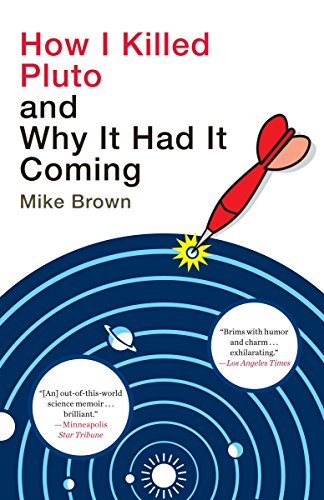
The solar system most of us grew up with included nine planets, with Mercury closest to the sun and Pluto at the outer edge. Then, in 2005, astronomer Mike Brown made the discovery of a lifetime: a tenth planet, Eris, slightly bigger than Pluto. But instead of adding one more planet to our solar system, Brown’s find ignited a firestorm of controversy that culminated in the demotion of Pluto from real planet to the newly coined category of “dwarf” planet. Suddenly Brown was receiving hate mail from schoolchildren and being bombarded by TV reporters—all because of the discovery he had spent years searching for and a lifetime dreaming about.A heartfelt and personal journey filled with both humor and drama, How I Killed Pluto and Why It Had It Coming is the book for anyone, young or old, who has ever imagined exploring the universe—and who among us hasn’t?
User’s Reviews
Editorial Reviews: Review “Brims with humor and charm . . . exhilarating.”—Los Angeles Times“[An] out-of-this-world science memoir . . . brilliant . . . brings clarity and elegance to the complexities of planetary science. Brown is also a surprisingly self-effacing and entertaining genius.”—Minneapolis Star Tribune“Brown’s brisk, enjoyable How I Killed Pluto and Why It Had It Coming chronicles the whole saga [of the demotion of Pluto] and, in the process, makes [its] sad fate easier to take. If we’ve lost a planet, we’ve gained a sprightly new voice for popular science.”—The Wall Street Journal“Eminently readable and entertaining . . . blends elements of sleuthing, international intrigue, and the awe and wonder intrinsic to the exploration of space.”—The Oregonian “An unlikely hybrid of Dennis Overbye’s Lonely Hearts of the Cosmos and Anne Lamott’s Operating Instructions.”—The New York Times Book Review “[Brown] might be the finest scientist alive today. . . . We’re all better off for this man’s breathtaking commitment to science.”—The Boston Globe About the Author Mike Brown is the Richard and Barbara Rosenberg Professor of Planetary Astronomy at the California Institute of Technology. In 2006 he was named one of Time magazine’s 100 People Who Shape Our World as well as one of Los Angeles magazine’s Most Influential People in L.A. He lives in Southern California with his wife and daughter. Excerpt. © Reprinted by permission. All rights reserved. Chapter OneWhat Is a Planet?One December night in 1999, a friend and I were sitting on a mountaintop east of San Diego inside a thirteen-story-tall dome. Only a few lights illuminated the uncluttered floor of the cavernous interior, but above you could vaguely see the bottom half of the massive Hale Telescope at Palomar Observatory. The Hale Telescope was, for almost fifty years, the largest telescope in the world, but from where we sat, with the weak yellow incandescent lighting being swallowed in the darkness above, you would never have guessed where you were. You might have thought you were deep in the interior of a pristine Hoover Dam, with cables and wire and pipes for directing the flow of water around. You might have believed that the steel structures around you were part of the far underground support and control of a spotlessly clean century-old subway system. Only when the entire building gently rumbled and a tiny sliver of the starry sky appeared far over your head and the telescope began to move soundlessly and swiftly to point to some new distant object in the universe, only then would you be able to make out the shadowy outline of the truss all the way to the top of the dome and realize that you were but a dot at the base of a giant machine whose only purpose was to gather the light from a single spot beyond the sky and focus it to a tiny point just over your head.Usually when I am working at the telescope I sit in the warm, well-lit control room, looking at computer screens showing instrument readouts, staring at digital pictures just pulled from the sky, and pondering meteorological readings and forecasts for southern California. Sometimes, though, I like to step out into the cold, dark dome and stand at the very base of the telescope and look up at the sky through the tiny open sliver high overhead and see—with my own eyes—exactly what the giant machine is looking at. This December night, however, as I was sitting with my friend inside the dark dome, there was no sky to see. The dome was fastened closed, and the telescope was idle because the entire mountain was covered in cold, dripping fog.I tend to get quite glum on nights when I’m at a telescope with the dome closed and the precious night is slipping past. An astronomer gets to use one of these biggest telescopes only a handful of nights per year. If the night is cloudy or rainy or snowy, too bad. Your night on the telescope is simply lost, and you get to try again next year. It’s hard not to think about lost time and lost discoveries as the second hand very slowly crawls through the night and your dome stays closed. Sabine—my friend—tried to cheer me up by asking about life and work, but it didn’t help. I instead told her about how my father had died that spring, and how I felt unable to really focus on my work. She finally asked me if there was anything that I was excited about these days. I paused for a few minutes. I momentarily forgot about the freezing fog and the closed dome and the ticking clock. “I think there’s another planet past Pluto,” I told her.Another planet? Such a suggestion would have generally been scoffed at by most astronomers in the last days of the twentieth century. While it is true that for much of the last century astronomers had diligently searched for a mythical “Planet X” beyond Pluto, by about 1990 they had more or less convinced themselves that all that searching in the past had been in vain; Planet X simply did not exist. Astronomers were certain that they had a pretty good inventory of what the solar system contained, of all of the planets and their moons, and of most of the comets and asteroids that circled the sun. There were certainly small asteroids still to be discovered, and occasionally a bright comet that had never been seen before would come screaming in from the far depths of space, but certainly nothing major was left out there to find. Serious discussions by serious astronomers of another planet beyond Pluto were as likely as serious discussions by serious geologists on the location of the lost continent of Atlantis. What kind of an astronomer would sit underneath one of the biggest telescopes in the world and declare, “I think there’s another planet past Pluto”?…Almost a decade earlier, in the late summer of 1992, I was in the long middle years of my graduate studies at Berkeley (the place where I was taught that Planet X certainly did not exist and that we already knew pretty much everything we needed to know about what there was in the solar system). I didn’t think much about Planet X those days. I was midway through a Ph.D. dissertation about the planet Jupiter and its volcanic moon Io. When you’re midway through a Ph.D. dissertation, your mind acquires narrow blinders, so I didn’t think much about anything other than Io and how its volcanoes spewed material into space and affected Jupiter’s powerful magnetic field. I had so few thoughts to spare for most of the quotidian universe that I had fallen into a pattern of every day eating the same lunch at the same coffee shop right next to the Berkeley campus and having dinner at the same burrito stand a block away. At night I would ride my bicycle back down toward the San Francisco Bay to the marina where I lived on a tiny sailboat. The next morning I would start all over again. Less time thinking about what and where to eat and sleep meant more time thinking about Io and volcanoes and Jupiter and how they all fit together.But, occasionally, even obsessive Ph.D. students need a break.One afternoon, as on many times previous, after spending too much time staring at data on my computer screen and reading technical papers in dense journals and writing down thoughts and ideas in my black bound notebooks, I opened the door of my little graduate student office on the roof of the astronomy building, stepped into the enclosed rooftop courtyard, and climbed the metal stairs that went to the very top of the roof to an open balcony. As I stared at the San Francisco Bay laid out in front of me, trying to pull my head back down to the earth by watching the boats blowing across the water, Jane Luu, a friend and researcher in the astronomy department who had an office across the rooftop courtyard, clunked up the metal stairs and looked out across the water in the same direction I was staring. Softly and conspiratorially she said, “Nobody knows it yet, but we just found the Kuiper belt.”I could tell that she knew she was onto something big, could sense her excitement, and I was flattered that here she was telling me this astounding information that no one else knew.“Wow,” I said. “What’s the Kuiper belt?”It’s funny today to think that I had no idea what she was talking about. Today if you sat next to me on an airplane and asked about the Kuiper belt, I might talk for hours about the region of space beyond Neptune where vast numbers of small icy objects circle the sun in cold storage and about how, occasionally, one of them comes plummeting into the inner part of the solar system to light up the skies like a comet. I might talk about the very edge of the solar system, where millions of little icy bodies never quite got gathered up into one big planet but instead stayed strewn in the disk surrounding the solar system. And I might tell you a little history, about how in the early 1990s no one had seen such a thing as this Kuiper belt, but a small group of astronomers who had predicted its existence had named the region the Kuiper belt after Dutch American astronomer Gerard Kuiper, who had speculated about its existence decades earlier. And finally, if you were still listening and the plane had not yet landed, I would tell you how this Kuiper belt was finally seen, for the first time, in the late summer of 1992, and how I first learned about it on the roof of the Berkeley astronomy building a day before it appeared on the front page of The New York Times.But when Jane told me she had just found the Kuiper belt, I didn’t know any of this. Jane explained. She had not found this vast collection of bodies beyond Neptune, exactly, but simply a single small icy body circling the sun well beyond the orbit of Pluto. The body was tiny—much, much smaller than Pluto—and as far as anyone knew for sure, it might have circled the sun all alone at the edge of the solar system. But still, exciting, right?Cute, I thought. But it’s just one tiny object, and it’s farther away than Pluto. How could that matter?So I nodded and listened and, like any diligent Ph.D. student midway through a dissertation, eventually walked back down the stairs, stepped into my office, and reentered the world of Jupiter and Io and volcanoes, where I actually resided.I was wrong, of course. Even though the object discovered was only a lonely, relatively tiny ball of ice orbiting beyond Pluto, it showed that astronomers had been wrong: They didn’t actually know everything; there were things still to be found at the edge of our own solar system. Some astronomers were reluctant to consider this new possibility seriously, and they dismissed the discovery as nothing more than a fluke that presaged absolutely nothing. But soon, as more and more astronomers became excited about the possibility of discovery and started searching the regions beyond Pluto, more and more of these small bodies began to be found.By the end of 1999, on the foggy December night when Sabine and I were sitting underneath the Hale Telescope at Palomar Observatory and I was proclaiming that I thought there were new planets to be found, astronomers around the world had already discovered almost five hundred of these bodies in a vast disk beyond the orbit of Neptune in what looked very much indeed like the Kuiper belt. From being something that most astronomers had perhaps heard of once or twice, the Kuiper belt had become the hottest new field of study within the solar system.Of the five hundred bodies that were then known in the Kuiper belt in 1999, most were relatively small, maybe a few hundred miles across, but a few moderately large objects had also been found. The largest known at the time was somewhere around a third the size of Pluto. A third the size of Pluto! Pluto had always enjoyed a somewhat mythical status as a lonely oddball at the edge of the solar system, but it turned out that it had more company than astronomers had originally thought.Over the years since I had dismissed the entire Kuiper belt as not quite interesting enough to pull my mind away from Jupiter, I had actually been thinking a bit about Pluto and about those five hundred small icy bodies recently discovered in the distant solar system. By now it seemed to me inevitable that, whether anyone realized it or not, astronomers were on an unstoppable march that would eventually lead to a tenth planet. It seemed to me obvious that it was there, slowly circling the sun, just waiting for the moment when someone somewhere pointed a telescope at the right spot, noticed something that hadn’t been there earlier, and suddenly announced to an unsuspecting world that our solar system had more than nine planets. Read more
Reviews from Amazon users which were colected at the time this book was published on the website:
⭐Incredibly interesting!!! This book explains a lot about objects in the Kuiper belt, and why Pluto is like them and unlike the rest of the planets. It tells us about an astronomer’s day-to-day work and life (or lack of one until he meets the right woman). I still say, “Poor Pluto,” and feel bad that it was demoted from “planetdom”, but then, Pluto isn’t a person, is it?Check out a free class on Coursera that Mike Brown is teaching at Cal Tech on Solar System science — he has me interested in the Solar System again, just when I was thinking we already knew all about it.
⭐I grew up being told Pluto was the 9th planet, and because of this, seeing it downgraded in 2006 felt like a personal loss, but I can’t control these things, so I kept Pluto in my heart and even smiled because it’s an icy rock 4 billion miles away and has no emotional feelings about its status, or anything else. Upon reading Dr. Brown’s smart, funny and personal memoir, I still hold Pluto in high regard, (especially after seeing it courtesy of New Horizons) but I understand the logic behind its current classification. The story makes for excellent reading in 5 minute segments (if you get my drift) and I have nothing but respect for the the scientists who dedicate such a large part of their lives to expanding the knowledge of humankind and still manage to remain human. It was also an eye opener that backstabbing is alive and well in the fields of Astronomy and Astrophysics.
⭐The bad thing first: I wish this book come with photos and illustrations. For example, how are the telescopes mentioned in the book, big or small, look like? Can we see the discovery photo of Eris? What about a comparison chart of the dwarf planets? Of course you can find all the information online but why don’t just include them here? The author surely holds all the rights. That could make the reading a lot more fun.All the rest is good about this book. It chronicled in detail the few years surrounding the discoveries of new planet sized objects that eventually lead to the “demotion” of Pluto, a decision spearheaded none other than the author himself. The pacing of the story is handled well. We started right off when Dr. Brown joined Caltech and started working at Paloma. There was minimal “when I was young I dreamed to be a scientist” stuffs (except for his early encounter with planetary conjunction). No one cares. So that’s good. Some reviewers complained that he devoted too much time writing about the birth of his daughter. I think that’s totally fun to read. The event occurred at the crucial time of the discovery so it’s not easy to separate them. Plus, this perfectly shows the person side of scientists. How they (actually “we”) are no different from any other human being.Overall, despite the obvious short-coming, this is a very fun read. You will find yourself hooked to the subject and pay more attention to science news after this.And I hope a new “illustrated” edition could find its way to the publisher.
⭐Mike Brown is a planetary scientist who, along with others, has discovered several dwarf planets, which, it turns out, are not planets at all — they’re something lesser and not necessarily only lesser in size.What is a planet, anyway? That’s a tough question, one that’s boggled great minds and those of us who are simply curious about planets in general. The latest controversy (and, no, it’s not the only one in history) came about not so very long ago when the experts began to wonder if Pluto really was a planet. The world certainly knew it as one but it had fallen on hard times when it was discovered over a number of years that it’s just not very big. In fact, it’s smaller than our own moon. In fact there are a number of moons that are larger than our own moon and yet no one calls them a planet. Well, that’s simple: they’re orbiting planets so they’ve got to be moons, right?Maybe, kinda, well, hmmmm. The problem here is how to classify planets or moons for that matter. All of the planets are different. There are different kinds of planets — terrestrial planets are named after Earth (terra) and include Mercury, Venus, Earth & Mars; then there are the Jovian ones, named after Jupiter (Jove). Terrestrial planets are rocky ones, Jovians are the gasbags — Jupiter, Saturn, Uranus and Neptune — and yet all of them are very different. Earth has oceans, the other terrestrials don’t. Jupiter is bigger than all the other planets combined.And now we have Dwarf Planets, but they decided that they are NOT really planets, though the word is included.Very puzzling indeed. Real planets, like the original 8 (NOT Pluto, not anymore!) are the ones that have a “dominant effect” on the solar system. I would never argue that Jupiter is anything but a major player around here what with its powerful gravitational field and all. But Mercury? It’s small, hard to see oftentimes, and poses very little threat. The lesser stuff, those non-planets like asteroids and such that may get hurled in our direction to cause mass destruction (if and when they hit us) or joy (like when they run into Jupiter) seem a much more dominant effect to me.I could go on and on and on but I wouldn’t help you understand. But I’m happy to report that this book is not only good at explaining these problems but is very readable and even well-rounded — we hear a lot about his young daughter who was a newborn baby when he got involved with the Pluto controversy and who actually communicated through sign language before she could speak. And she likes planets. Now THAT’s a good kid! And you’ll also learn about just how hard it is to find out about those faraway bodies that Dr. Brown and his colleagues are discovering — we still really don’t know how big Pluto truly is (though we’ll get a better handle on it New Horizons spacecraft has just reached it).A very good book, indeed! Another related one is “The Pluto Files” by Neil deGrasse Tyson.
⭐I’ve read many books, but I can honestly say that this is the first book about astronomy that I’ve ever read, and I thoroughly enjoyed every bit of it. I loved the scientific explanations and I love the heartfelt joys of a new father. It make me curious, it made me laugh, it made me nostalgic, and it made me want to go outside and stare at the night sky. Which isn’t nearly as exciting when you live in the middle of the city lights. However, I will be planning a trip to an observatory in the very near future because Mr. Brown’s enthusiasm makes me want to see it for myself.
⭐This really is a good book – please do not be put off by the terrible, rather immature title as I nearly was. If you are at all interested in the life of experimental science of astronomy today then this is very much the book for you. It rather brings up to date the account given in the first chapters of Fred Hoyle’s ‘the black cloud’ – only this time it’s real life not fiction. This account centres on the discovery in recent years by Mike Brown and his team of the large Kuiper Belt objects – in particular Eris, which is slightly larger than Pluto and in a previous era would undoubtedly been hailed as the fabled tenth planet. It details the tremendous amount of hard work involved and alongside this, Mike’s love life, his marriage and birth of his daughter. An intriguing account is given of an attempt (by a very cunning subterfuge) of a foreign astronomer to steal and claim for himself one of Mike’s discoveries. This well illustrates the perennial problem in science of getting results published without them being stolen by someone else – which must nearly always involve a certain amount of initial secrecy. In respect of this he also mentions the case of Bell-Burnett who is often regarded as having her contribution to the discovery of Pulsars rather underplayed by her supervisor. The last chapter is a account of the demotion of Pluto (and hence Eris) to the status of dwarf planets by the IAU – a move strongly supported (with very full and drawn out reasons) by the author despite the fact that the decision is not to his advantage. Overall this really is very interestingly written with the personal nicely intermingled with the practical and the description of astronomical practices at just the right level for a layman to the subject. I wish there had been more of it. Good luck in the future Mike!
⭐Well, the title is deliberately provocative, and isn’t going to enamour the book to stick-in-the-muds who still think there should be nine planets (there are rational numbers other than eight, but nine isn’t one of them). Part of me thinks that’s a shame, because this is a wonderful tale, a delightfully told autobiography interleaving Mike Brown’s professional and personal life, with the emphasis on the former but the latter being interesting and moving too. I loved his scientific and statistical approach to fatherhood – a refreshingly different approach.It’s a shame that the decision to correct the 1930 classification of Pluto as the ninth planet has created publicity of the wrong sort, all focussed on Pluto rather than on the rich story that the discoveries have shown of the complexity and variety of the Solar System which is hidden by the old schoolbook nine-planet model.The book’s core story of planet-hunting and the successes in finding trans-Neptunian objects both big and small, is well told, and is entertaining, funny and informative as well as emotional too: it’s a personal account and so one needs to be prepared to read it with that in mind and question objectivity when it comes to the contention surrounding Haumea in particular, but Mike Brown seems to have gone out of his way to seem be initially accepting and then open-minded about the role of the alternate discoverers, when the evidence and the failure of the Spaniards to be equally open leaves me at any rate in little doubt that it is Brown’s team that deserve the credit that has at least partially come with the naming of 2003 EL61 as Haumea.
⭐I couldn’t put this down. Read it over two days. Delightful. Would make a wonderful gift for anyone with the remotest interest in astronomy or science.
⭐First impression from the title – The rotter! This is a little gem of a book that should appeal to astronomers and non-astronomers alike.It is a tale of hard work spotting tiny objects in the dark reaches of the solar system and even the rather under hand tactics some use to steal people’s thunder. This book lifts the veil on the detection of incredibly distant objects in our solar system and given the recent images of Pluto by New Horizons does make the title sound a bit premature. However, his discoveries of an impressive 16 Trans-Neptunian objects have shown that maybe Pluto is not the most distant object in the solar system and there needed to be a proper definition of what a planet is as the old definition would have resulted in there being perhaps hundreds of planets still all we need to know is Many Very Educated Men Just Screwed Up Nature.
⭐Beautifully written account of a momentous period, the consequences of which are very much in the news today, with the recent New Horizons Pluto discoveries. Mike Brown is a quirky guy with a sense of fun, and masses of knowledge which he shares in a fantastically accessible and interesting way. He tells the story simply and honestly. I loved this book!
Keywords
Free Download How I Killed Pluto and Why It Had It Coming in Epub format
How I Killed Pluto and Why It Had It Coming Epub Free Download
Download How I Killed Pluto and Why It Had It Coming Epub Free
How I Killed Pluto and Why It Had It Coming Epub Free Download
Download How I Killed Pluto and Why It Had It Coming Epub
Free Download Ebook How I Killed Pluto and Why It Had It Coming