

Ebook Info
- Published: 2013
- Number of pages: 119 pages
- Format: PDF
- File Size: 0.97 MB
- Authors: Pimsleur
Description
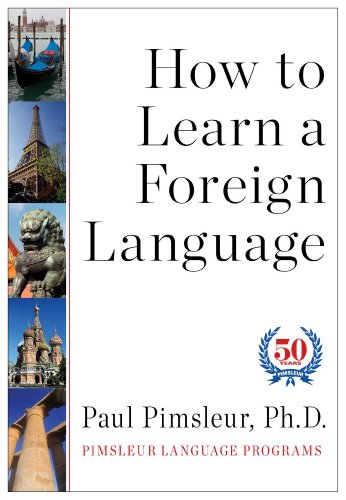
In this entertaining and groundbreaking book, Dr. Paul Pimsleur, creator of the renowned Pimsleur Method, the world leader in audio-based language learning, shows how anyone can learn to speak a foreign language.If learning a language in high school left you bruised, with a sense that there was no way you can learn another language, How to Learn a Foreign Language will restore your sense of hope. In simple, straightforward terms, Dr. Pimsleur will help you learn grammar (seamlessly), vocabulary, and how to practice pronunciation (and come out sounding like a native). The key is the simplicity and directness of Pimsleur’s approach to a daunting subject, breaking it down piece by piece, demystifying the process along the way. Dr. Pimsleur draws on his own language learning trials and tribulations offering practical advice for overcoming the obstacles so many of us face.Originally published in 1980, How to Learn a Foreign Language is now available on the 50th anniversary of Dr. Pimsleur’s publication of the first of his first audio courses that embodied the concepts and methods found here. It’s a fascinating glimpse into the inner workings of the mind of this amazing pioneer of language learning.
User’s Reviews
Reviews from Amazon users which were colected at the time this book was published on the website:
⭐I am behavior analyst by trade who has a particular interest in putting that science to work on teaching foreign languages. I first sampled the Pimsleur Method about two years ago, fell in love with it, later recognized some of its weaknesses, picked this book up not expecting to be fully satisfied with it, and joyously found myself to be very, very wrong.If there’s one principle that every person learning a foreign language should learn from Day One, it’s that language is contextually functional. We learn to use it because it has a satisfying effect on our environment, given our particular situation. Part of the problem with most foreign-language classrooms is that teachers frequently ignore this principle and get sidetracked in rational-theoretical analyses of the *structure* of language. What they end up teaching is, in fact, how to talk about Spanish grammar *in English*, not how to actually talk in Spanish.It doesn’t really come across very well in the audio tracks Paul Pimsleur ultimately produced; but upon reading this book, it is crystal clear to me that he understood the principle of functional contextualism. Those of you who have sampled the Pimsleur Method will know that it basically consists of three techniques: (1) presenting phrases and sentences in the student’s native language, then asking the student to translate orally within a few seconds; (2) practicing new phrases and sentences en masse; and (3) spaced repetition, the technique of reviewing previously taught targets according to a schedule that systematically increases the time until the next review. The biggest criticisms I’ve ever had with that method are that (a) it trains the student to translate rather than think in the foreign language, and (b) it doesn’t help the student very much in roleplaying the actual social situations in which the language must be used. Knowing that, I expected to be disappointed with what I would read. What I found instead was a concise handbook of maxims that acknowledges those weaknesses and encourages the student to take steps to counteract them.Where others waste pages of type trying to explain psychological theory and trying to oversell you on the effectiveness of the techniques advised, Pimsleur is straight and to the point. He briefly critiques traditional methods, tells a short story illustrating the problems they create, makes his argument for what works instead (sometimes with only a single simple graph or table), and then tells you in practical terms what to do to direct your own learning. You may get this book and think, as I did initially, “Wow. Twenty dollars retail for 100 pages of advice and a dinky little appendix? This looks like hero worship on the scale of a preface to an L. Ron Hubbard book.” However, you’d be wrong. There is more packed into those 100 pages than I have been able to extract out of the entirety of the 282-page “An Introduction to Applied Linguistics” (Norbert Schmitt, ed.), and it’s infinitely more readable. It comes across very clearly that Pimsleur was a compassionate teacher who believed that ANYBODY could learn a foreign language, who wanted everybody to have the tools to do it. The book has really renewed my respect for him as one of the greats, probably second only to B. F. Skinner in terms of the level of insight for this field. I highly recommend it.
⭐Firstly I would like to say something about the Pimsleur Method Of Learning A New Language.For almost 1 month, I have been using Pimsleur Greek Langauge Set and honestly I have to say that Pimsleur mentality has an extraordinary approach to learn a language especially to a language that you haven’t studied before.After a long time desire, I decided to learn Greek, one of the most difficult languages in the world. When I started to learn it myself, honeslty I was so much discouraged. Because the grammer ingredient is the matter of mathematical intelligence in Greek. Then I met with Pimsleur set and also Michel Thomas set but I decided to study with Pimsleur. So I humbly would like to express my thoughts about this set and the book I read last week.Firstly Pimsleur Set doesnt teach you grammer but it helps you encourage you to learn the language u want to learn and it takes u almost Pre-Intermediate Level (Maybe A-1) on pronounciation, speaking and fluency. But doesnt help for vocabulary except the basic structures like “What would you like to eat?” “Do you speak English” or “I don’t know what to drink” etc… Very basic but this is for starter set. For second set, you become more confidence. This is what Pimsleur provides you in the process of a learning the language.But after you finish the set, you start to think “Oh my God, why dont u continue for Advanced set or vocabulary set…” This is what I am thinking this days because to learn a new language is very serious process that you have to consider is a matter of your life.All I can suggest you with all my confidence and honesty, don’t pay for hundreds usd for language courses for beginner level before to start up it with Pimsleur Set. It deserves much more than language courses.I suggest to start with Pimsleur, for 2 months. Without anything else. For example dont go over the books, dont try to read anything else except the scripts that is provided by Pimsleur. After 2 months, start for grammer on your own for 4-5 months. It wont be easy ofcourse but this is the matter. In this 6-7 months struggle, believe me you can achieve about Pre Intermediate level that any language course is able to take u there in 5-6 months (4 hours in week). Then you can improve it at course or private lessons maybe.REGARDING THE BOOK.It’s not more different than the mentality of the set. Interesting approach to vocabulary for instance is weird but succesful. Dont memorize the words it says and direct you to break them down into syllables and start to pronounce and learn it by heart from the end of syllable. Like : “Nationalism”. Na-Ti-O-Na-Li-Sm and it says to memorize it by heart from the end like “Sm-Lism-Nalism-Onalism-Tionalism-Nationalism” and minimum 3-4 times each syllable and entire word. It sounds plausible to me.Consequently, I can reccommend to use that set and ofcourse u can read the book with trust and confidence because it works. Ofcourse not like private lessons but for fluency and speaking in confidence at all you learn.Thank you Pimsleur…
⭐Paul Pimsleur was a true language genius. It’s obvious to me that he truly loved people and adored teaching them languages. I have used his programs and find them to be very effective. While his memory technique is amazing and even legendary and has worked well for me, I also use Mark Frobose’s Automatic Fluency and Language Audiobooks programs too. The difference between the two lies in the intensity and the amount of vocabulary that is taught. Paul Pimsleur was clearly on the right track, and he was the major language teaching pioneer of his time. I believe that the more modern Mark Frobose, who I believe is still alive, has a greatly improved means of teaching languages because his programs are “vocabulary rich” as he puts it, as well as “pattern rich” with a great interval memory technique. I think Mark Frobose is sincere and never “guarantees” fluency. He merely insists that his programs truly “build fluency”. I appears that Frobose also has the added advantage of always using his “original sentence building” techniques and claims to have the only true “fluency building” programs on the market. I wholeheartedly agree with him that if one would practice diligently with his programs, one would definitely build fluency.Pimsleur’s programs are still a joy to use, and “How to Learn a Foreign Language” is a must read.I read Frobose’s “Automatic Fluency” when I bought my first Automatic Fluency program on conversational Spanish. Awesome book too, but apparently not available separately as I received it with my Spanish program.
⭐Short but well-written and informative.
⭐Descrive una serie di trucchi molto efficaci per imparare le lingue, particolarmente utili per i principianti.Il limite del libro (ma anche la sua forza) é che non si focalizza su un linguaggio in particolare.Per l’ inglese, ad esempio, la ricetta va adattata un poco per massimizzarne l’ efficacia.La parte più utile é dove racconta qual’é il punto di svolta, quello che permette di proseguire autonomamente nell’ apprendimento della lingua, per le varie lingue considerate. Sorprendentemente, per il tedesco é molto più basso di quanto mi aspettassi !!
⭐Not found.
⭐There were some good tips in here such as breaking down foreign words into syllables from the end of the word backwards to the beginning. That actually helped me. However I am disappointed that the author seemed to focus on languages that share the same romanised alphabet as English. I am trying to learn Hindi, which has a totally different alphabet and I would have liked some tips on how to approach learning this type of language. Should I get to grips with the alphabet before anything else as otherwise I have to translate twice! I have to translate into the romanised version of Hindi then try to ‘convert’ it into the Devengari script – it’s double the work!
⭐実はピンズラー方式で中国語を学習中で、これを終えたらこの方式でフランス語にも挑戦したい。
⭐Not found.
⭐I’m Japanese,even to me,this book is very interesting.
Keywords
Free Download How to Learn a Foreign Language in PDF format
How to Learn a Foreign Language PDF Free Download
Download How to Learn a Foreign Language 2013 PDF Free
How to Learn a Foreign Language 2013 PDF Free Download
Download How to Learn a Foreign Language PDF
Free Download Ebook How to Learn a Foreign Language