

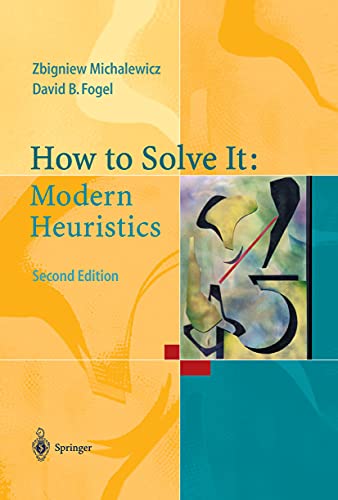
Ebook Info
- Published: 2013
- Number of pages: 584 pages
- Format: PDF
- File Size: 26.75 MB
- Authors: Zbigniew Michalewicz
Description
No pleasure lasts long unless there is variety in it. Publilius Syrus, Moral Sayings We’ve been very fortunate to receive fantastic feedback from our readers during the last four years, since the first edition of How to Solve It: Modern Heuristics was published in 1999. It’s heartening to know that so many people appreciated the book and, even more importantly, were using the book to help them solve their problems. One professor, who published a review of the book, said that his students had given the best course reviews he’d seen in 15 years when using our text. There can be hardly any better praise, except to add that one of the book reviews published in a SIAM journal received the best review award as well. We greatly appreciate your kind words and personal comments that you sent, including the few cases where you found some typographical or other errors. Thank you all for this wonderful support.
User’s Reviews
Reviews from Amazon users which were colected at the time this book was published on the website:
⭐Having read a couple of very positive reviews, I was looking forward to this, but now that it is here, and I’ve had a chance to read it, I’m very disappointed. It strikes me as pretty shallow, and it definitely takes the name of Georg Polya in vain. (Michalewicz also writes ‘business-oriented’ books on decision support – you can tell). It certainly has little, conceptually, to do with Polya’s ‘How to solve it’ (in fact, given the complete lack of any formal theoretical development, the authors are lucky that the man is safely dead). A more accurate title would be ‘a bunch of stuff on optimisation, mostly about genetic algorithms and traveling salesman problems, but with a bit on neural nets and fuzzy logic thrown in’. These three technologies used to get sexy articles in the popular computer press about 10 to 20 years ago. It is interesting that the three always seem to crop up together, but they do – or at least they did.Anyway, the core agenda, which is not heuristics, does poke out at various points. On page 190 there is a revealing passage bout the elusive ‘Holy Grail’ of ‘a perfect evolutionary algorithm for the TSP [Travelling Salesman Problem]’. Now, the world in general would be fascinated by a polynomial solution to the TSP, but the world in general – sorry to say – doesn’t actually give a toss if that solution is evolutionary.*As I said, I was unhappy about the complete lack of real theoretical background which would put any of the discussed methods in perspective/context. The discussion of simulated annealing, for instance, is absent any of the underlying (and powerful) intuitions from statistical physics which, if nothing else, makes the technique much richer, and not conceptually comparable to, tabu search, with which it is discussed in parallel. As far as I can see, the latter is an isolated hack – empirically it may be effective in some applications, but it is not part of a larger conceptual framework. At least if it is not an isolated hack, then the authors provide no evidence – I note that it gets all of three lines in Russell and Norvig.More seriously, there isn’t even any well-founded discussion of mathematical models of evolution. All that I could find was essentially a citation – not even a discussion – of the ‘no free lunch’ theorems. No Maynard-Smith, no Kondrashov, not even Hopfield’s ’78 paper – though other later stuff by Hopfield is cited. And without this – and without a lot of other formal theory stuff as well, if I were being honest – there is no hope of a methodological framework. After all, computers are, unavoidably, formal machines. In the end, the evolutionary models that are discussed are not a lot more than a bunch of gadgets, and the authors are reduced to saying that for your own problems, you are going to have to think up your own gadgets. This, to be blunt, is why evolutionary computing remains a niche research area.A separate problem is the lack of any perspective w.r.t. other, today more commonly used, technologies that address similar problems. The discussion of neural networks and pattern classification does not mention, e.g., that the benchmark classifier technology today is vector support machines, which substantially outperform neural networks. Or that the standard technology for exploring complex function spaces is Monte-Carlo analysis (strictly, a lot of the techniques that are discussed in the book _are_ actually Monte-carlo methods of one sort or another). This does not mean that the methods discussed are _not_ interesting, just that without a perspective, it is difficult to say whether they are appropriate tools for a job.In the end it was not clear to me who this book is really aimed at. It is certainly not aimed at me. Senior undergraduates in something like operations research might be a target, but I personally would not use it for a CS or applied math class. And I cannot, honestly, forsee it being a lot of use to me outside the classroom.*Which anyway, a priori, seems unlikely, since idealised recombinatory evolutionary strategies show rapid information gain (N^1/2) in the size of the genome in suboptimal situations, but near the optimum, parthenogenesis with mutation is a better strategy.
⭐The authors have updated their successful first edition, though the latter, printed in 99, was scarcely obsolete. A heuristic can be basically a rule of thumb, dressed up in fancier language. What the authors intend is for you to develop an intuition about when to use modern algorithms. Where is almost every case, these are actually implemented on a computer; a reflection of the cheap availability of computing power to most readers.The book is a good complement to various standard algorithm texts, like those by Sedgewick, Aho and Knuth. You can consider this book as standing a level above those. [Though Knuth’s books also do an excellent job of suggesting when to use or modify algorithms. ]The level of discussion here is not of a strict, heavy mathematical approach. It can be read as informal guidelines, that discuss the gist of such ideas as simulated annealing and evolutionary methods. There is a wide range of example problems, to motivate you in understanding what might be used to solve them.
⭐Very easy to read, inspiring, and provides a great introduction to heuristics and optimization. I borrowed it at my library and had to purchase it. Thank you for writing this book!
⭐If you’re working on any engineering, this is the must-read.
⭐I use it as the main text book for my Computer Heuristic course in Colombia. It is clear and show the main techniques that optimization and problem solving enthusiasts should know.
⭐Technical, Philosophical and re-readable. A must for any autodidact.If I could have only 10kgs of book, this would make the cut.
⭐thank u
⭐I read this book while taking an advanced class in heuristics. I found the book to be extremely well written and very compelling to read. Although dealing with advanced topics, the authors’ friendly and clear writing style makes it accessible to anyone with a CS background.The first half of the book is on search heuristics, covering methods such as traditional searches (exhaustive search, greedy algorithms, divide and conquer, dynamic programming, A*, etc), methods to escape local optima (simulated annealing, tabu search), and, perhaps most interesting of all, evolutionary algorithms. I later found out that these topics are typically taught in undergraduate artificial intelligence courses, an elective I never took. The second half of the book covers even more advanced areas, such as contraint-handling, neural networks, and fuzzy systems.The authors use three recurring example applications to demonstrate each search technique: the boolean satisfiability problem (SAT), travelling salesman (TSP), and a nonlinear programming problem (NLP). I really liked the consistent use of these three examples, as they give a sense of continuity throughout the book that helps the reader compare search techniques clearly. I had of course studied the TSP problem in my undergraduate algorithms class but never in the context of such interesting approximation algorithms. In my heuristics class we had assignments to implement the TSP search problem using the Lin-Kernighan method, dynamic programming, and an evolutionary algorithm.The written English in this book is simply outstanding and crystal-clear, which was something of a shock since I was unable to even pronounce the first author’s name. The writing is in a very friendly tone with elements of humour dispersed throughout. Interestingly, in the summary chapter, there is an anecdote on the 1980s TV show Magnum PI (I even remember the mentioned scene myself), further revealing the friendly, plain-English tone of the book. Perhaps the best part of the book is that the numerical mathematical discourse is kept at a minimum (used largely for the NLP problems), so people who haven’t taken calculus in ages (like me) can easily enjoy the book.As an added bonus(!), between each chapter is a brain-teaser problem like those found in those legendary Microsoft interview questions.My only complaint is that there is no simple analysis of the running time complexity of each algorithm, which even in its simplest form would have been a great thing to read about.In summary, this book is an excellent read if you enjoy the topics covered. Highly recommended.
⭐A lot of ideas of how to get the solution of your problem. Really good book.
⭐okay
⭐The best book I have ever got on Heuristics.If someone is interested in problem solving methods then they should buy this book. This book gives better as well as different approaches to solve a problem in Artificial Intelligence.
⭐Muito bom e divertido. Leitura fluida.
⭐
Keywords
Free Download How to Solve It: Modern Heuristics in PDF format
How to Solve It: Modern Heuristics PDF Free Download
Download How to Solve It: Modern Heuristics 2013 PDF Free
How to Solve It: Modern Heuristics 2013 PDF Free Download
Download How to Solve It: Modern Heuristics PDF
Free Download Ebook How to Solve It: Modern Heuristics