

Ebook Info
- Published: 2011
- Number of pages: 179 pages
- Format: PDF
- File Size: 3.11 MB
- Authors: I.L. Kantor
Description
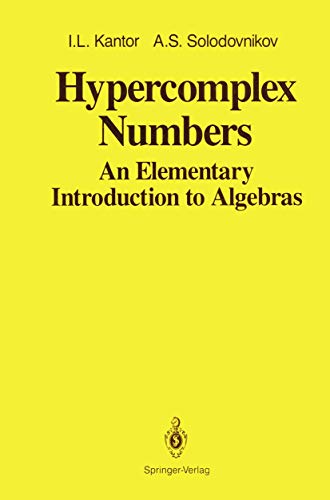
This book deals with various systems of “numbers” that can be constructed by adding “imaginary units” to the real numbers. The complex numbers are a classical example of such a system. One of the most important properties of the complex numbers is given by the identity (1) Izz’l = Izl·Iz’I· It says, roughly, that the absolute value of a product is equal to the product of the absolute values of the factors. If we put z = al + a2i, z’ = b+ bi, 1 2 then we can rewrite (1) as The last identity states that “the product of a sum of two squares by a sum of two squares is a sum of two squares. ” It is natural to ask if there are similar identities with more than two squares, and how all of them can be described. Already Euler had given an example of an identity with four squares. Later an identity with eight squares was found. But a complete solution of the problem was obtained only at the end of the 19th century. It is substantially true that every identity with n squares is linked to formula (1), except that z and z’ no longer denote complex numbers but more general “numbers” where i,j, . . . , I are imaginary units. One of the main themes of this book is the establishing of the connection between identities with n squares and formula (1).
User’s Reviews
Reviews from Amazon users which were colected at the time this book was published on the website:
⭐This book was written for students at a fairly low level of mathematics education – the author states that chapters 1 and 2 are accessible to high school seniors. It does a fantastic job of explaining the topic to people without much college math – an elementary course in linear algebra is all that’s needed and, even there, the author covers the prerequisite material, so that a diligent reader could do without the linear algebra. It is a very accessible book.After complex numbers appeared as an extension of the real number system, the question arose as to whether further extensions might be made and what would they look like. To do an extension of the complex numbers involves introducing additional symbols and forming polynomials from the new symbols and the complex numbers. Such an extension is a vector space over the complex numbers. When a product of such polynomials is introduced, the resulting structure is called an “algebra”. During the nineteenth century, it was shown that (1) normed (norm means a magnitude, such as the absolute value, is defined) algebras, with an identity and (2) alternative (a weak version of the associate property) division (means can divide = reciprocal of a number is defined) algebras over the reals must be of dimension 2 to the n power. For n=1, we have the complex numbers, n = 2 are the quaternions and n = 3 are the octonions or Cayley numbers. There are none for n = 4 or greater. These results ( (1) is Hurwitz’s Theorem and (2) is Frobenius’ Theorem) are of great significance in a wide range of mathematical disciplines (topology, number theory, geometry, etc.)Quaternion products are the origin of dot and cross products in vector analysis and, indeed, of almost all vector analysis, itself. Quaternions are used for calculations for orbital mechanics of space vehicles and for computer vision develpoment.This book covers these systems well enough to give the reader a good start on such systems. Clifford algebras, a series of hypercomplex number systems, are increasingly being used as the proper way to express physics – Maxwell’s equations are much more naturally expressed in this form and subatomic particle “spin” is best expressed as “spinors”, which are intimately associated with Clifford algebra.The author also discusses hypercomplex systems in general and the “doubling” process which produces the complex numbers from the reals, the quaternions from the complex numbers and the octonions from the quaternions. “Doubling” can be continued indefinately, but the results beyond octonions are difficult for the less experienced reader to understand.If you have only a modest mathematics background, but want to learn about quaternions and octonions, read this book.
⭐Some years since I read it, but I remember it as one of the pedogogical masterpieces to be found here and there in the mathematical literature. Absolutely clear and reads olmost like a novel. I wish someone could do a similar job on Clifford Algebras.
Keywords
Free Download Hypercomplex Numbers: An Elementary Introduction to Algebras in PDF format
Hypercomplex Numbers: An Elementary Introduction to Algebras PDF Free Download
Download Hypercomplex Numbers: An Elementary Introduction to Algebras 2011 PDF Free
Hypercomplex Numbers: An Elementary Introduction to Algebras 2011 PDF Free Download
Download Hypercomplex Numbers: An Elementary Introduction to Algebras PDF
Free Download Ebook Hypercomplex Numbers: An Elementary Introduction to Algebras