

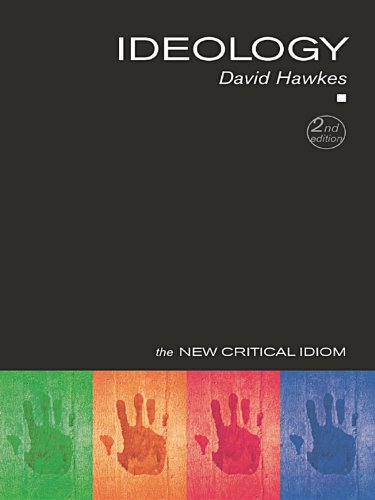
Ebook Info
- Published: 2004
- Number of pages: 228 pages
- Format: PDF
- File Size: 3.21 MB
- Authors: David Hawkes
Description
Any literary student who is new to the terminology and uses of critical terms will welcome David Hawkes’ Ideology, a comprehensive and concise overview. In refreshingly clear and jargon-free prose, Hawkes: * Considers the myriad definitions and meanings of ideology * Traces the history of the term and the debates which surround it, from Martin Luther and Machiavelli to present-day debates in feminism and psychoanalysis * Provides literary examples and illustrations to illuminate and clarify his argument * Asks whether, in the face of post-war capitalism and postmodernism, the ideology debate is obsolete, or is still very much relevant in contemporary debates
User’s Reviews
Reviews from Amazon users which were colected at the time this book was published on the website:
⭐David Hawkes takes on not just capitalism but the notion of money itself as well as all the institutions that remove us from reality. In this book the point is that we have changed the very nature of who we are as human beings by organizing our society around something (money) that is not only a symbol for something else but it is a representative of a symbol of a substitute for — what? We are so far removed from the question of what it means to be a human being that we forgot the question.The book was originally written in 1996 and revised in 2003 Post-911. I’d like to see another revision Post-Economic Meltdown, which he has been addressing in recent interview. Altogether fascinating but not for pessimists.
⭐I’m not sure why this isn’t more well-known. Hawkes’ examination of ideology from the Old Testament to Descartes to Zizek is wildly interesting. This is NOT you dry academic tome, but an elegant piece of writing with a sharp and distinct point of view. I rarely pick up an academic book and feel riveted. But in this case, you should buckle your seat belts.
⭐I have to concur with the other two reviewers, though ten stars seems a bit exaggerated. Only a bit. In this brilliant work, Hawkes looks at ideology and its discontents starting with the Old Testament and going right up to the Post-Modernists: Foucault, Baudrillard, Negri and Hardt. Hawkes takes a dialectical approach to his subject, maintaining that ideology is the result of the denial of the binary between materialism and idealism, object and subject, respectively, that goes back to the early Greek philosophers. Nevertheless, in the introduction, Hawkes leads us to believe that the “main argument of the book is that the postmodern sign, whether financial or linguistic, is epistemologically false and ethically degenerate,” and while he provides a convincing case, it doesn’t seem to me to be the “main argument” of the book, but one conclusion drawn from what seems to me to be the real argument: that dialectical logic is a preferred tool for understanding and ordering reality as well as a necessary corrective for philosophical systems (ideologies) that rest on half-truths or denied binaries. In a related theme, Hawkes traces back to Aristotle the problem of use versus exchange value, showing the latter to be the basis for “false consciousness” and this leads him to his conclusions about “false and ethically degenerate” postmodernism. He must have really taken a hit for those views in academia, but he makes a great, respectfully executed — and I would say, also, convincing– case for his view. My only real criticism of the book is the ending. I recognize that he’s dealing with ideology here, and he needs to end on that note, but after defining “ideology” as the denial of one element of a binary, and then reading his ending where he says that the “real site of political struggle is the human mind” and that the “external struggle between social classes has, in our time, reverted to an ideological conflict manifested internally,” I’m quite annoyed and perplexed. While I’m delighted he’s affirmed the subjective and ideal, on the other hand, after two hundred pages, here we are again affirming only one side of the binary and repressing the other, in this case, the “external objective material” in favor of the internal, subjective ideal. One would hope that a writer who has made such a strong argument in favor of contending with binary oppositions, contradictions and dialectics, would in the end demonstrate that argument with a closing statement that was dialectical. After all, couldn’t the “real site of political struggle” also be in the external objective, material reality of the streets and the struggle between social classes? Like say, between the bankers and the people?Still, that being said, this is a fabulous work and well worth reading.
⭐This is one of the best introductory books to ideology. Hawkes deftely succeeds in providing a review of the history of the term and in the process the evolution of modern philosophy and thought. I recommend to my students all the time especially those still grappling with the intricate concept of ideology.
Keywords
Free Download Ideology (The New Critical Idiom) 2nd Edition in PDF format
Ideology (The New Critical Idiom) 2nd Edition PDF Free Download
Download Ideology (The New Critical Idiom) 2nd Edition 2004 PDF Free
Ideology (The New Critical Idiom) 2nd Edition 2004 PDF Free Download
Download Ideology (The New Critical Idiom) 2nd Edition PDF
Free Download Ebook Ideology (The New Critical Idiom) 2nd Edition