Ebook Info
- Published: 2020
- Number of pages: 166 pages
- Format: PDF
- File Size: 0.00 MB
- Authors: Bertrand Russell
Description
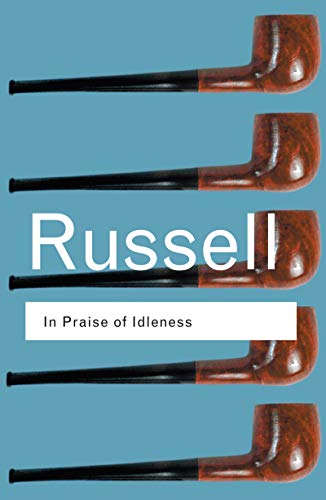
Intolerance and bigotry lie at the heart of all human suffering. So claims Bertrand Russell at the outset of In Praise of Idleness, a collection of essays in which he espouses the virtues of cool reflection and free enquiry; a voice of calm in a world of maddening unreason. From a devastating critique of the ancestry of fascism to a vehement defence of ‘useless’ knowledge, with consideration given to everything from insect pests to the human soul, this is a tour de force that only Bertrand Russell could perform.
User’s Reviews
Reviews from Amazon users which were colected at the time this book was published on the website:
⭐Reading Bertrand Russell’s books is always a pleasure. This book collects a number of articles Bertrand Russell wrote more than 50 years ago. It does not make any difference: most of the articles have not aged at all, a very sad reflection. There is only one section (on the future of architecture) where Russell’s proposals and predictions are outdated. But the cruelty and folly of mankind that brought us to the horrors of World War 2 are still with us. In addition, the writing is always witty and entertaining. Pay attention especially at Russell’s article on financial interests. It seems that it has been written after the crash of Wall Street of last year. It also proposes remedies…..
⭐This book is very interesting. A very challenging book. I have recommended this to many friends.
⭐I love bertie!
⭐A very clever man, Russell. One wonders what he might have written and what his opinions would have been had he known all we know now…
⭐russell on his hobbyhorse. Very tedious after 80 pages; you have to be very interested in socialism and its beauties to read the whole thing.
⭐In this book, Bertrand Russell shows himself to be the embodiment of a stereotype: a man so reasoned and logical that he is credited with advancing the developing of formal logic itself who at the same time had no connection or understanding of human nature and the world that he lives in. I have long been a strong fan of his clear, precise writing and logical arguments, but this book is, quite frankly, absolutely bananas.In the first essay, In Praise of Idleness, he argues that if people were to work only four hours a day instead of eight, everyone would be happier, healthier, more productive members of society, and we would eradicate unemployment. Those who are currently unemployed would have jobs and those who currently work too hard would have more leisure. When people have this extra leisure, naturally they will not spend it in “frivolity.” The “passive entertainments” they currently enjoy, such as movies, sports, and listening to the radio, are engaged in only because their work tires them so much. If their working hours were reduced, they would spend their leisure inventing sciences and writing books.In the second essay, Useless Knowledge, Russell argues in favor of broad-based education rather than more focused learning. This proposition is unobjectionable, of course, but his arguments verge on farce. He claims that focusing one’s energies in a particular area, causes “for most people, a lack of balance accompanied by some form of nervous behavior.” He claims that a broader education would lead all men to have contemplative minds which no longer mind trivial annoyances or become enraged. Apparently, according to Russell, an expanded knowledge base will alter personality. And learning makes everything more enjoyable. To quote, “Curious learning makes pleasant things more pleasant. I have enjoyed peaches and apricots more since I have known that they were first cultivated in China in the early days of the Han dynasty; that Chinese hostages held by the great King Kaniska introduced them into India….that the word ‘apricot’ is derived from the same Latin source as the word ‘precocious’ because the apricot ripens early. All this makes the fruit taste much sweeter.” It is Kafka-esque, but it is clear from further reading that Russell actually means all of this. I’m fairly sure that Shakespeare would have said that a rose by another name smells as sweet. His overwhelming naivety about human nature and ultimately self-centered view that everyone who was properly educated would be just like him is surprising.There is room for compassion toward Russell here. The book was originally published in 1935. It is filled with references to Germans, warfare, and the notion that “life is more painful in our time than in the two centuries that preceded it.” Clearly Russell was deeply troubled by the horrific events sweeping Europe and what it revealed about human nature. He appears to have been struggling for some solution. Unfortunately this book reveals his profound lack of understanding of the world and the humans that inhabit it.
⭐Bertrand Arthur William Russell (1872-1970) was an influential British philosopher, logician, mathematician, and political activist. In 1950, he was awarded the Nobel Prize in Literature, in recognition of his many books such as
⭐,
⭐,
⭐,
⭐,
⭐,
⭐,
⭐, etc.[NOTE: page numbers below refer to a 231-page paperback edition.]He wrote in the Preface, “This book contains essays on such aspects of social questions as tend to be ignored in the clash of politics. It emphasizes the danger of too much organization in the realm of thought and too much strenuousness in action. It explains why I cannot agree with either Communism or Fascism, and wherein I dissent from what both have in common. It maintains that the importance of knowledge consists not only in its practical utility but also in the fact that it promotes a widely contemplative habit of mind; on this ground, utility is to be found in much of the knowledge that is nowadays labelled ‘useless.’ There is a discussion of the connection of architecture with various social questions, more particularly the welfare of young children and the position of women.”In the title essay, he observes, “Whenever a person who already has enough to live on proposes to engage in some everyday kind of job, such as school-teaching or typing, he or she is told that such conduct takes the bread out of other people’s mouths, and is therefore wicked. If this argument were valid, it would only be necessary for us all to be idle in order that we should all have our mouths full of bread. What people who say such things forget is that what a man earns he usually spends, and in spending he gives employment. As long as a man spends his income, he puts just as much bread in people’s mouths in spending as he takes out of other people’s mouths in earning. The real villain, from this point of view, is the man who saves.” (Pg. 10)He continues, “The wise use of leisure… is a product of civilization and education. A man who has worked long hours all his life will be bored if he becomes suddenly idle. But without a considerable amount of leisure a man is cut off from many of the best things. There is no longer any reason why the bulk of the population should suffer this deprivation; only a foolish asceticism, usually vicarious, makes us continue to insist on work in excessive quantities now that the need no longer exists.” (Pg. 19)He goes on, “When I suggest that working hours should be reduced to four, I am not meaning to imply that all the remaining time should necessarily be spent in pure frivolity. I mean that four hours’ work a day should entitle a man to the necessities and elementary comforts of life, and that the rest of his time should be his to use as he sees fit… education should be carried further than it usually is at present, and should aim, in part, at providing tastes which would enable a man to use leisure intelligently. I am not thinking of the sort of things that would be considered ‘highbrow.’ … The pleasures of urban populations have become mainly passive: seeing cinemas, watching football matches, listening to the radio, and so on. This results from the fact that their active energies are fully taken up with work; if they had more leisure, they would again enjoy pleasures in which they took an active part.” (Pg. 25-26)In another essay, he notes, “The advantage of gold, in theory, is that it affords a safeguard against the dishonesty of Governments. This would be all very well if there were any way of forcing Governments to adhere to gold in a crisis, but in fact they abandon gold whenever it suits them to do so. All the European countries that took part in [World War I] depreciated their currencies, and in so doing repudiated a part of their debts… The pound sterling is worth only about three-quarters of its former value in gold. The Russians frankly said that they would not pay their debts, but this was thought wicked: respectable repudiation demands a certain etiquette.” (Pg. 70-71)In another essay, he asks, “what is civilization? It first essential character, I should say, is FORETHOUGHT. This, indeed, is what mainly distinguishes men from brutes and adults from children. But forethought being a matter of degree, we can distinguish more or less civilized nations and epochs according to to the amount of it that they display.” (Pg. 158)In still another essay, he states, “It is generally thought that, because Christianity urges altruism and love of one’s neighbor, it is anti-individualistic. This, however, is a psychological error. Christianity appeals to the individual soul, and emphasizes personal salvation. What a man does for his neighbor, he has to do because that is what it is right for HIM to do, not because he is INSTINCTIVELY part of a larger group. Christianity in its origin, and still in its essence, is not political or even familial, and tends accordingly to make the individual more self-contained than nature made him.” (Pg. 170)Those who love Russell’s more “popular” writing, will likely love this book as well.
⭐This book is surprisingly prescient for having been written in the thirties/interwar years UK, I think perhaps because a lot of Russell writes about in “The Ancestry of Fascism” about reason and unreason would not be amiss today, or what he has to say about contemplative thinking contra vigorous action (a theme of a number of the essays) resembles what Carl Cederstrom, in The Wellness Syndrome, have had to say about life logging neo-liberal self-improv. culture.The principle essay which the book is named for is what might, on the face of it, appear most absurd, until you realize that what Russell is talking about is what has been referred to more recently as being “time poor”. As Russell puts it: “Modern technique has made it possible for leisure, within limits, to be not the prerogative of small privileged classes, but a right distributed throughout the community”, further, “The morality of work is the morality of slaves, and the modern world has no need of slavery” and further (to leave no doubt): “I think that these is far too much work done in the world, that immense harm is caused by the belief that work is virtuous, and that what needs to be preached in modern industrial countries is quite different from what always has been preached”.What Russell suggests is that the “leisure class” has been a boon for civilization, the world is indebted to men of leisure for culture, so this condition should be extended to everyone via the medium of the four hour working day. Russell suggests that the inclusion of women in the workforce and modern technics had actually made for this during the war as it proved necessary to free up a portion of the labour force from their conventional work for fighting and munitions manufacturing. Besides this Russell makes some points about production and saving trumping spending and consuming, something he felt was wrong and largely attributable to superstition and legacies of earlier, out of date, thinking.Russell considers contemplative thinking to be the best way to spend idle time, using examples such as thinking about the origin and history of apricots and peaches enriching the enjoyment of eating one. In this book Russell is writing in contradistinction to such thinking as that of Theodore Roosevelt in “The Strenuous Life”, or communism and fascism’s state of constantly mobilised industry and action.In a number of the succeeding essays in this collection Russell returns to the criticism of fascism, communism, particularly in “The Ancestry of Fascism” and “Scylla and Charybdis, or Communism and Fascism”, in “The Case for Socialism” Russell advocates socialism largely as the alternative to both totalitarian systems, the system most likely to result in a measure of the idleness advocated in the title essay and dealing with issues such as the power of finance and banking (which he deals with in “The Modern Midas”, outlining a situation which sounds a lot like Britain before the “too big to fail” bailout and successive Conservative party victories).The rest of the essays are a little like what you may expect someone who has been at liberty to engage in enough contemplating thinking would come up with, which is a distinctly mixed bag. In addition to idle time Russell’s advocacy of a single world state and world bank feature quite heavily, as the introduction and preface state this does appear a little naive and I do think is largely to do with his rejection of nationalism. While I enjoyed all the essays in the book, enjoying Russell’s unique style of writing for the most part, in particular “Modern Homogeneity”, “Stoicism and Mental Health” and “On Comets” and “What is the Soul?” were my favourites, although this is probably largely a matter of personal taste.
⭐Since the essays in this book were written pre WWII, they address the rise of Fascism and Communism. However, these essays, while being of historical importance, also contain a warning for the people of our age. The economic chaos of our times poses great peril to the political stability of the world. Furthermore, some of his comments on economic matters echo the ideas proposed by John Maynard Keynes (problems caused by gold standard, error of economic austerity and tariff barriers during periods of depression, etc.). In addition to the criticism of the political and economic system of the 1920s and 30s, Russell asks us to question the value of work as an end in itself. Why do we place the notion of “work” on such a moral pedestal? Is it not enough to work to feed oneself, but then allow time for the “higher pursuits” of humanity, like the arts, music, pure sciences, mathematics, sport, etc.? (He apparently has a few choice words to offer about how architecture and city planning have failed humanity.)I recommend this book unreservedly for the clear, concise, beautifully composed prose that is characteristic of Russell’s writing. Some of the ideas appear dated (well, they were written 70-100 years ago, after all!) but there is much that can still speak to our time.
⭐As usual, Russell is very thought provoking and controversial. His work is, also, inspirational. Excellent reading.
⭐Brilliant mind, often the most interesting ideas are ruined by writers inability to express them eloquently. This book is enjoyable, enlightening and persausive.
⭐This is the complete book which has In Praise of Idleness as well as 14 other essays, each of them is brilliant. I am not sure why this book is so expensive, probably because it is not easily available. But the other books available on Amazon by the same name only contain one essay and the price range is between 250-350 so be careful while ordering. This took some time to reach but was nearly within the estimated delivery time.
Keywords
Free Download In Praise of Idleness: And Other Essays in PDF format
In Praise of Idleness: And Other Essays PDF Free Download
Download In Praise of Idleness: And Other Essays 2020 PDF Free
In Praise of Idleness: And Other Essays 2020 PDF Free Download
Download In Praise of Idleness: And Other Essays PDF
Free Download Ebook In Praise of Idleness: And Other Essays