

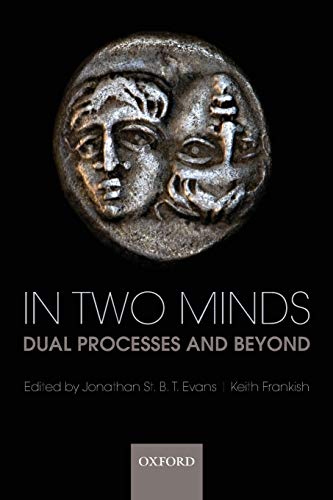
Ebook Info
- Published: 2009
- Number of pages: 369 pages
- Format: PDF
- File Size: 3.68 MB
- Authors: Jonathan Evans
Description
This book explores the idea that we have two minds – one that is automatic, unconscious, and fast, the other controlled, conscious, and slow. In recent years there has been great interest in so-called dual-process theories of reasoning and rationality. According to dual processs theories, there are two distinct systems underlying human reasoning – an evolutionarily old system that is associative, automatic, unconscious, parallel, and fast, and a more recent, distinctively human system that is rule-based, controlled, conscious, serial, and slow. Within the former, processes are held to be innate and to use heuristics which evolved to solve specific adaptive problems. In the latter, processes are taken to be learned, flexible, and responsive to rational norms. Despite the attention these theories are attracting, there is still poor communication between dual-process theorists themselves, and the substantial bodies of work on dual processes in cognitive psychology and social psychology remain isolated from each other. This book brings together leading researchers on dual-processes to summarize the state of the art, highlight key issues, present different perspectives, explore implications, and provide a stimulus to further work. It includes new ideas about the human mind both by contemporary philosophers interested in broad theoretical questions about mental architecture and by psychologists specialising in traditionally distinct and isolated fields. For all those in the cognitive sciences, this is a book that will advance dual-process theorizing, promote interdisciplinary communication, and encourage further applications of dual-process approaches.
User’s Reviews
Editorial Reviews: Review “The edited book In Two Minds: Dual Processes and Beyond brings together scholars from a variety of disciplines to discuss both specific and generic dual process theories. The book details the many ways in which the history of science and of Western thought has characterized the mind as partitioned, providing greatly needed historical and philosophical perspectives…entries do an excellent job of introducing unique perspectives on specific dual or multiprocess theories….The intended audience for n Two Minds includes students and professionals who have an interest in human psychology and behavior.”–PsycCRITIQUES About the Author Jonathan Evans has conducted a major research programme on thinking and reasoning since the 1970’s. His publications include seven authored books and well over 150 scientific papers. His research includes study of cognitive biases in reasoning and judgement, and of the psychology of conditionals. He is one of the founders of the dual-process theory of reasoning and in recent years has extended this interest to broadly based dual-system theories of the mind. Keith Frankish is Senior Lecturer in Philosophy at The Open University. His research spans debates about the nature of belief, the structure of the mind, and consciousness. His publications include two authored books, three co-edited volumes, and numerous journal articles and book chapters. His 2004 book Mind and Supermind argued that a dual-systems perspective is implicit in everyday belief-desire psychology and explored the implications of this view for issues in philosophy of mind.
Reviews from Amazon users which were colected at the time this book was published on the website:
⭐Needed some additional understanding about Dual Processing Theory. Author is thorough in explaining the theory along with the historical development of the theory. Additional discussion of opposing point of views would have been helpful, but enough is included that they can be additionally researched.
⭐Despite more recent evidence which is counter-suggestive, Evans and his colleagues are on a crusade to preserve the fallacious notion that logical thinking is a proxy for inductive thought. His treatment of associative memory as ‘quick’, ‘inaccurate’, and ‘minor’ reflects his biased characterization against the associative. The evidence at present, only suggests the contrary – that associative thinking is a direct mechanism to inductive thought (it is purely inductive), and free from the sort of short-term/working memory intensive processes, that Evans intends to attribute to induction. I would advise the reader (and Evans, himself) to review the works of Caren M Rotello and colleagues. If you buy this book, don’t buy into it.
⭐NO PROBLEMS
⭐
⭐
Keywords
Free Download In Two Minds: Dual Processes and Beyond in PDF format
In Two Minds: Dual Processes and Beyond PDF Free Download
Download In Two Minds: Dual Processes and Beyond 2009 PDF Free
In Two Minds: Dual Processes and Beyond 2009 PDF Free Download
Download In Two Minds: Dual Processes and Beyond PDF
Free Download Ebook In Two Minds: Dual Processes and Beyond