

Ebook Info
- Published: 1989
- Number of pages: 416 pages
- Format: PDF
- File Size: 19.32 MB
- Authors: John H. H. Holland
Description
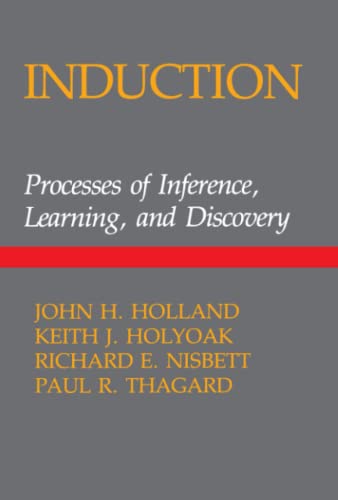
Two psychologists, a computer scientist, and a philosopher have collaborated to present a framework for understanding processes of inductive reasoning and learning in organisms and machines. Theirs is the first major effort to bring the ideas of several disciplines to bear on a subject that has been a topic of investigation since the time of Socrates. The result is an integrated account that treats problem solving and induction in terms of rulebased mental models.Induction is included in the Computational Models of Cognition and Perception Series.A Bradford Book.
User’s Reviews
Editorial Reviews: Review ” A broad, sweeping inquiry of what concepts are, what learning is, and how it can take place at all…. “Induction” is a deep synthesis of epistemology, evolution and computation. This path-breaking treatise will undoubtedly come to be recognized as a major step toward an interdisciplinary explanation of mentality” — Douglas Hofstadter& quot; A broad, sweeping inquiry of what concepts are, what learning is, and how it can take place at all…. Induction is a deep synthesis of epistemology, evolution and computation. This path-breaking treatise will undoubtedly come to be recognized as a major step toward an interdisciplinary explanation of mentality& quot; — Douglas Hofstadter”A broad, sweeping inquiry of what concepts are, what learning is, and how it can take place at all…. “Induction” is a deep synthesis of epistemology, evolution and computation. This path-breaking treatise will undoubtedly come to be recognized as a major step toward an interdisciplinary explanation of mentality”–Douglas Hofstadter Review A broad, sweeping inquiry of what concepts are, what learning is, and how it can take place at all…. Induction is a deep synthesis of epistemology, evolution and computation. This path-breaking treatise will undoubtedly come to be recognized as a major step toward an interdisciplinary explanation of mentality.―Douglas Hofstadter About the Author John H. Holland is Professor of Psychology and Professor of Computer Science and Engineering at the University of Michigan; he is also Trustee and External Professor at the Santa Fe Institute. He is the author of Hidden Order: How Adaptation Builds Complexity and other books.Keith J. Holyoak, Distinguished Professor of Psychology at the University of California, Los Angeles, is a psychologist and poet. He is the coauthor or editor of a number of books on cognitive psychology and has published three volumes of poetry.Paul Thagard is Professor of Philosophy at the University of Waterloo, Ontario. He is the author of The Cognitive Science of Science (MIT Press, 2012) and many other books. Read more
Reviews from Amazon users which were colected at the time this book was published on the website:
⭐In my opinion, verything is wrapped in superflous language that acts as filler, while not getting the point across. It’s very inaccessible and feels like the authors were trying to write a book and couldn’t find the words to express their ideas.
⭐I wish I had read this book years ago. It help in my quest (research) to understand the Recognition process.
⭐This book should be ‘the bible’ for everyone involved in knowledge management processes. Holland, as one of the complexity theory founders, decribes the essentials of how complex adaptive rules, in relation to the variability of the environment, determine knowledge dynamics and learning capabilities.Key message of the book is the way that processes of induction, both cognitive and subcognitive, determine rule making, rule adaptation and environment modeling.With this work Holland (et al.) was the first to close the gap between cognition, complex adaptive systems and knowledge processing. He also provides a sound computational base for the theories presented, opening possibilities for implementation of ‘the induction theory’ in real world applications.
⭐All ok
Keywords
Free Download Induction: Processes of Inference, Learning, and Discovery in PDF format
Induction: Processes of Inference, Learning, and Discovery PDF Free Download
Download Induction: Processes of Inference, Learning, and Discovery 1989 PDF Free
Induction: Processes of Inference, Learning, and Discovery 1989 PDF Free Download
Download Induction: Processes of Inference, Learning, and Discovery PDF
Free Download Ebook Induction: Processes of Inference, Learning, and Discovery