Ebook Info
- Published: 2019
- Number of pages: 389 pages
- Format: PDF
- File Size: 8.55 MB
- Authors: Steven H. Strogatz
Description
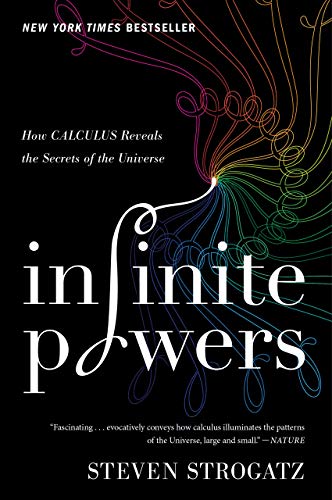
From preeminent math personality and author of The Joy of x, a brilliant and endlessly appealing explanation of calculus—how it works and why it makes our lives immeasurably better. Without calculus, we wouldn’t have cell phones, TV, GPS, or ultrasound. We wouldn’t have unraveled DNA or discovered Neptune or figured out how to put 5,000 songs in your pocket.Though many of us were scared away from this essential, engrossing subject in high school and college, Steven Strogatz’s brilliantly creative, down-to-earth history shows that calculus is not about complexity; it’s about simplicity. It harnesses an unreal number—infinity—to tackle real-world problems, breaking them down into easier ones and then reassembling the answers into solutions that feel miraculous.Infinite Powers recounts how calculus tantalized and thrilled its inventors, starting with its first glimmers in ancient Greece and bringing us right up to the discovery of gravitational waves (a phenomenon predicted by calculus). Strogatz reveals how this form of math rose to the challenges of each age: how to determine the area of a circle with only sand and a stick; how to explain why Mars goes “backwards” sometimes; how to make electricity with magnets; how to ensure your rocket doesn’t miss the moon; how to turn the tide in the fight against AIDS.As Strogatz proves, calculus is truly the language of the universe. By unveiling the principles of that language, Infinite Powers makes us marvel at the world anew.
User’s Reviews
Reviews from Amazon users which were colected at the time this book was published on the website:
⭐This is not intended to be a textbook on calculus. And, like a lot of calculus itself, it is and it isn’t – quite. It is, however, a book about the history of calculus, which is fascinating, and the degree to which the universe seems to have been coded in a way that calculus seems to have an uncanny ability to explain is, well, somewhat inexplicable.But as the author notes in the beginning, “For reasons nobody understands, the universe is deeply mathematical. Maybe God made it that way. Or maybe it’s the only way a universe with us in it could be, because nonmathematical universes can’t harbor life intelligent enough to ask the question.” How often do you hear a Professor of Applied Mathematics, at an Ivy League school no less, say something even remotely so self-reflective?Steven Strogatz is a great communicator who is both a great mathematician and who, it is easy to tell, gets goose bumps every time he thinks about the wonders of calculus. I am not a professional mathematician but have always found mathematics to be both fascinating and, well, not easy, but very relatable. It’s predictable, and that’s comforting once you can see the pattern.If you don’t feel quite that way you may – spoiler alert – find this book to be a bit more like a textbook than advertised. There are plenty of equations and symbols and the like. That is, after all, the alphabet of calculus. But here’s the thing. Unless you are also a math professor, you can ignore all of that. Just go with the prose. It tells the same story, but in a far more relatable form to the average lover of the written word. Just ignore the symbols. If you do you will miss nothing and you will find the professor’s enthusiasm to be quite contagious.The beauty of the book is that it is written from a perspective of humility. Both in terms of the enormity of calculus (Most people will relate to the subject matter simply as science.), and in terms of how far we have yet to go in terms of truly understanding the universe and the reality that defines it. We’ve only explained the tip of the iceberg.Math is a human convention. It’s not hydrogen or oxygen. It’s not even dark matter, which we “know” makes up most of the universe but which no one has ever isolated, although the Chinese are close. It is very accurate at deciphering reality if getting close to the “real” explanation is close enough. But close is only close. It isn’t reality itself. Reality is, after all, by definition, real.That is, ultimately, the problem with the promise of AI. Because AI is ultimately dependent on calculus and other disciplines of mathematics, it will get very smart, but it will never be human. What it will do, however, if we let it, is dumb down what it means to be smart to a standard perfectly suited to its abilities but ignorant of its shortcomings.That’s why, despite the promises of the silicon gods, we are very unlikely to see fully autonomous vehicles for decades to come. The only way that could happen is if we take all human drivers off the road overnight (The AI isn’t the problem; it’s us. We are unpredictable.), switch every vehicle to an autonomous vehicle all at the same time, and rebuild our infrastructure to accommodate the vulnerabilities of the various disciplines of mathematics on which the technology is based. And that’s obviously not going to happen. Nor do we want it to.Pi, as but one example, despite what you were taught in school, is not a number; it’s a range. It’s a small range, to be sure, but it’s a range nonetheless. In other words, it is precise enough for most things, but it is NOT the fabric of the universe.Science is a methodology for understanding reality; it is not, in the most literal sense, reality itself. Reality is not “waiting” to be discovered. It is. And just as an artist can draw a landscape, science can draw reality. Neither, however, IS reality.The history of calculus is truly fascinating. And that, to me, as a reader, makes it entertaining. Newton and Galileo and all the rest were truly amazing people. It boggles the mind to think of what they concluded when they did.Perhaps the book’s greatest contribution, however, is that it will put Silicon Valley in perspective. You may think your smart phone has changed your life in ways that nothing else possibly could. You’re wrong. I am a great admirer of Steve Jobs but James Clerk Maxwell (a Scot in the 1860s) changed your life in ways that Steve did not come close to.And that is why this book is so timely. Calculus is changing our world, and not entirely in good ways. If ever we needed perspective we need it now. Math is elegant. It was designed that way. (Remember that it is not of the universe, like rain or sunshine.) And it does have an uncanny reliability that helps us to understand the world around us.Take GPS. We all use it. We all rely on it. But did you know that GPS is all about time, not navigation. Those GPS satellites don’t “see” you; they time you. It only works because scientists came to understand the mathematics of what we call time at a very precise level. That’s not reality, of course, because time is a concept (time, even as we understand it, varies with altitude), but it is close enough to give us GPS. And isn’t that an amazing thing.I think so. And that’s why I found this to be such an enjoyable book, beyond the fact that I am simply stimulated by really enthusiastic people and Professor Strogatz is one of the most enthusiastic people I have had the privilege to read in a really long time.If, on the other hand, you prefer a good murder mystery, or something with a little romance, at least, you won’t find it in this book. But that’s just my opinion. A little like pi, if you will. Pretty accurate, but not reality itself.Decide for yourself. You won’t be wasting your time.
⭐Infinite Powers is excellent in three respects. First, it provides an excellent history of calculus and its development. Second, it’s probably the best book I’ve read that teaches us calculus. Third, it’s extremely well written and very readable.Infinite Powers is a must read if you like history or math. The book is even better if you like history and math.
⭐The explanation of calculus is neat. Do read the book. *Ignore* the history. If it were left to the west to describe history, the Greeks would have invented the Earth just like Pythagoras discovered musical harmony despite people having discovered flutes from 40,000 years ago.Aside:Western authors have a penchant for writing sloppy history. The history of math in most western books jumps from Euclid, Archimedes, Pythagoras (500-200 BCE) straight to Descartes, Euler, Newton and Leibniz (1500-1900 CE) as if nobody else was doing math on the planet between that period or before that period. I think they simply have a blind spot (or purposeful ignorance) for anything outside Greece (and by extension Europe). For example, even going by the current dating for the Vedas given by western historians to between c. 1500 BCE and c. 800 BCE, which I think may be incorrect, those recitations have infinite progressions in them as well. Pythagoras’ theorem was known to many civilizations around the world yet it is credited to Pythagoras. A lot of “historians” love to stick to the biblical timeline and retrofit chronology for other civilizations to that one conveniently ignoring anything that refutes the narrative. Western history of science is baloney. If you want the real history of mathematics, ask people from other civilizations.
⭐Great book for math enthusiast to take along on vacations
⭐In this book, the author intends to explain everything with the help of pictures, metaphors, and anecdotes. We also get exposed to some of the finest equations and proofs in human history. One of the first things introduced is the “infinity principle,” where things are broken down into infinite simpler parts, analyzed, and then added back together to produce the whole. Calculus can be thought of as a methodological theme consisting of a mystery of curves, the mystery of motion, and the mystery of change.We start with the work of Archimedes from about the 3rd century BCE. We see here the beginnings of integral calculus, where triangles and parabolic regions are apparently and mysteriously equivalent. Eighteen hundred years passed until a new Archimedes appeared, whom we know as Galileo Galilei. It was interesting to learn about the law of odd numbers rule, which led Galileo to conclude that the total distance fallen is proportional to the square of the time elapsed. What Galileo did for the motion of objects, Johannes Kepler did for the motion of the planets. Both channeled the spirit of Archimedes, “carving solid objects in their minds into imaginary thin wafers, like so many slices of salami.”We see the arrival of algebra in Europe around 1200 from Asia and the Middle East. Hindu mathematicians invented the concept of zero and the decimal place system. Algebraic techniques for solving equations came from Egypt, Iraq, Persia, and China. But the study of algebra as a symbolic system began to flourish in Renaissance Europe around the 1500s. Analytic geometry makes its appearance with Pierre de Fermat, and Rene Descartes. Fermat actually invented the ideas that led to the concept of derivatives.From here we delve into functions – power and exponential, for example. There are some interesting basics of the relationship of logarithms to exponents. And then there is the natural logarithm, which grows as a rate precisely equal to the function itself. The author notes that “exponential functions expressed in base e are always the cleanest, most elegant, and most beautiful.” This leads into a more detailed discussion of the derivative. By the time we get to Newton, we see the concept of the fundamental theorem. Newton’s brainstorm was to invite time and motion into the picture and let the area flow. And now we are into integral calculus. The author notes that the reason integration is so much harder than differentiation relates to the distinction between local and global, which he clearly demonstrates in the book. I think the author has done a great job of showing us just how these concepts arose and how to make sense of them. You won’t get this is in your typical calculus book.After this, we delve into differential equations – ordinary and partial. The author gives a clear explanation of what these beasts are and some real-world examples to help us understand. In talking about the future of calculus, the author discusses some applications, such as nonlinearity (biology, sociology) and chaos, where you have an inherent sensitivity to initial conditions. He concludes by taking us to the “Twilight Zone” for three examples of the eerie effectiveness of calculus.
⭐This book is much more than just a history of a branch of mathematics. It’s a framework for thinking about calculus. I was mind blown at how Strogatz explains calculus; like I had been blind all those years and now I saw. His ‘breaking down and reassembling’ analogy may not be the best explanation to the more mathematically inclined, but to me it made perfect sense, at last. This book provided me with a mind model to think about calculus. A gem.”To shed light on any continuous shape, object, motion, process, or phenomenon – no matter how wild and complicated it may appear – reimagine it as an infinite series of simpler parts, analyze those, and then add the results back together to make sense of the original whole.”
⭐I bought this on Kindle a year ago on a whim. I was dabbling with getting back into a math after a couple of decades away from school. I’ve been pretty successful in many fields in which math deeply underlies but doesn’t explicitly require mastery. Nevertheless it always bugged me that, despite mastering these fields, I never had a firm mathematical foundation, and always relied on workarounds and intuition given that my mathematical skills were artificially slowed during my early education.Due to my consistent successes in learning varied topics, I never made much sense to me that math should be looked at as this special field that requires unique skills to understand and be proficient in. Like any other field, it is honed through lots of practice, practical applications, and attention. Steven’s book really inspired in me that that hunch was more than just a hunch, and a year later I have gone well beyond my stunted grade school math education and can see myself learning math for the pure love of it for the rest of my life. Saying nothing of the fact that I know it will improve my hard skills across every domain I work in today and into the future.Steven really has a gift not only for doing math itself, but for expressing exactly how and why learning math is, like any skill or topic worth devoting effort to, one of the deepest and most beautiful struggles. And, regardless of our learning stage or status, that struggle and its rewards belongs to all of us equally.
⭐Me gusta mucho el enfoque del libro donde se tratan los aspectos del cálculo a partir del concepto matemático del infinito, de una manera amena y hasta divertida. Creo que para personas que desean consolidar sus conocimientos en el tema puede ser muy útil, también a los docentes de nivel medio y superior les puede ayudar a dar enfoques más interesantes a sus clases. No soy hablante nativo del inglés, por lo que tuve que recurrir continuamente al diccionario, me parece que al autor le gusta utilizar un inglés elegante con términos no muy frecuentes. Eso puede ser un plus lingüístico, aunque puede hacer perder la continuidad en la lectura. Vale la pena de todas maneras. Muy recomendable
⭐
⭐This book is a must for them who find calculus difficult and not interesting. I am teaching Analysis/Calculus for a while now. I will suggest this book to my students. If you belong to that group then you should give it a read too. This book is very well written with motivations coming from Shrek like animations, not joking, it’s true. It’s a must buy. As for Amazon’s end their delivery is wondeful. Thanks Amazon !
⭐El autor de este libro te explica cálculo diferencial e integral de una manera mucho más clara que mi profesor de primero de carrera en ingeniería.Te deja claro su historia, de donde vienen los conceptos, su utilidad, todo sin usar muchas fórmulas.Este libro no es para aprobar un examen sino para entender de verdad de que va ésta útil herramienta de las matemáticas.Lo recomiendo para cualquiera que quiera comprender de verdad sus bases y no solo memorizar una serie de fórmulas y gráficas, como pasó en mi curso.
⭐
Keywords
Free Download Infinite Powers: How Calculus Reveals the Secrets of the Universe in PDF format
Infinite Powers: How Calculus Reveals the Secrets of the Universe PDF Free Download
Download Infinite Powers: How Calculus Reveals the Secrets of the Universe 2019 PDF Free
Infinite Powers: How Calculus Reveals the Secrets of the Universe 2019 PDF Free Download
Download Infinite Powers: How Calculus Reveals the Secrets of the Universe PDF
Free Download Ebook Infinite Powers: How Calculus Reveals the Secrets of the Universe