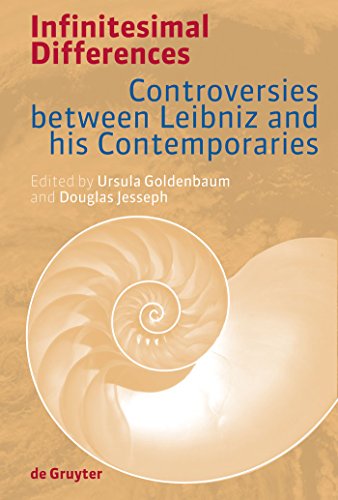
Ebook Info
- Published: 2008
- Number of pages: 633 pages
- Format: PDF
- File Size: 2.69 MB
- Authors: Ursula Goldenbaum
Description
The essays offer a unified and comprehensive view of 17th century mathematical and metaphysical disputes overstatus of infinitesimals, particularly the question whether they were real or mere fictions. Leibniz’s development of the calculus and his understanding of its metaphysical foundation are taken as both a point of departure and a frame of reference for the 17th century discussions of infinitesimals, that involved Hobbes, Wallis, Newton, Bernoulli, Hermann, and Nieuwentijt. Although the calculus was undoubtedly successful in mathematical practice, it remained controversial because its procedures seemed to lack an adequate metaphysical or methodological justification. The topic is also of philosophical interest, because Leibniz freely employed the language of infinitesimal quantities in the foundations of his dynamics and theory of forces. Thus, philosophical disputes over the Leibnizian science of bodies naturally involve questions about the nature of infinitesimals. The volume also includes newly discovered Leibnizian marginalia in the mathematical writings of Hobbes.
User’s Reviews
Reviews from Amazon users which were colected at the time this book was published on the website:
⭐These rather useless essays illustrate the growing danger that more and more scholars approaching historical mathematics are not mathematicians but philosophers. To justify their own existence as analytic philosophers, these people need to produce things that look like analytic philosophy, i.e., incestuous hairsplitting about the meaning and ontology of terms, etc. This perspective is profoundly incongruous with Leibniz’s own thought on infinitesimals, but since the authors’ very existence qua analytic philosophers is predicated upon it they cannot, virtually by definition, afford to look at history through any other lens, even if this means (as it frequently does) that their ostensibly historical articles has nothing to do with actual history. Thus this industry of papers on Leibnizian infinitesimals is a plague that says more about the sociology of modern academia and the doctrinal values of modern analytic philosophy than it does about Leibniz.Leibniz had a rather commonsensical view of infinitesimals. He often alluded to two justifications for them: first that “the error can be made smaller than any assignable magnitude”, and second that it is really just the ancient method of exhaustion in streamlined form. Given that these justifications are available in principle one can proceed in practice to operate with the “convenient fictions” of infinitesimals without worrying about it. Leibniz neither sought nor desired any more elaborate theory of infinitesimals than this commonsensical view. Indeed, in his entire corpus of publications he never takes up the problem of elaborating a more explicit and detailed theory of the foundations of infinitesimals. On the contrary, he is often dismissive of the attempts by others to raise the issue.But this is not good enough for the analytic philosophers. Leibniz is of no use to them except as a proxy onto whom to project this or that elaborate philosophical account of infinitesimals, so that the machinery of analytic philosophy can be engaged, thereby making it possible to churn out the requisite hairsplitting articles.Thus we are told by Arthur that Leibniz in fact had a very precise theory regarding the foundational status of infinitesimals, namely that they were “syncategorimatic” (pp. 20, 27). The fact that such a view is blatantly at odds with virtually Leibniz’s entire corpus is not considered a problem; rather these thousands of pages speaking against Arthur’s interpretation have simply “conspired to produce the impression that Leibniz developed his calculus without much attention to its foundations. But this impression is entirely mistaken.” (p. 20) Arthur, by contrast, bases his entire account on one single proposition in one single unpublished manuscript from Leibniz’s youth. It is surely evident to all who are free of the blinders of modern analytic philosophy what the real “conspiracy” is here.But even if we allow for the sake of argument that this one unpublished proposition contains the key to “Leibniz’s mature interpretation of infinitesimals” (p. 20), even though Leibniz never referred back to it in the remaining 40 years of his life, Arthur’s case is still hopelessly weak.Arthur’s interpretation of the proposition disregards almost all of its content and sees in it only “the foundation of the method on the Archimedean axiom” (p. 20) and its “being effectively equivalent to what is now known as Riemannian Integration” (p. 29). It seems to me that Leibniz considered these two ingredients of his proof as rather trivial and/or well-known, and his actual contribution to be certain complicated constructions that serve no purpose in Arthur’s account. It is puzzling indeed how Arthur can paraphrase Leibniz’s construction at length with detailed figures and elaborate notation, and yet fail to address the fact that virtually all of it is unnecessary as far as simple Riemann sums are concerned, which is an obvious problem for his interpretation.Incidentally, even if one wanted to take the rather far-fetched view that Leibniz’s proof “amounts in modern terms to a demonstration of ‘the integrability of a huge class of functions by means of Riemannian sums'” (p. 24), this “huge class of functions” is obviously mischaracterised by Arthur and Knobloch. For the three conditions given (“continuity, no point of inflection, no point with a vertical tangent”, p. 21) are obviously insufficient: since the construction starts by drawing the tangents to the curve, the existence of these tangents, at the very least, must clearly be added as an assumption.
⭐
Keywords
Free Download Infinitesimal Differences: Controversies between Leibniz and his Contemporaries in PDF format
Infinitesimal Differences: Controversies between Leibniz and his Contemporaries PDF Free Download
Download Infinitesimal Differences: Controversies between Leibniz and his Contemporaries 2008 PDF Free
Infinitesimal Differences: Controversies between Leibniz and his Contemporaries 2008 PDF Free Download
Download Infinitesimal Differences: Controversies between Leibniz and his Contemporaries PDF
Free Download Ebook Infinitesimal Differences: Controversies between Leibniz and his Contemporaries