

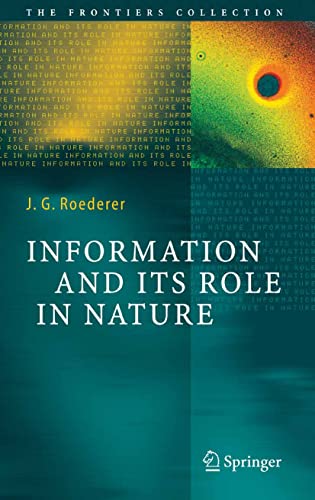
Ebook Info
- Published: 2005
- Number of pages: 247 pages
- Format: PDF
- File Size: 1.92 MB
- Authors: Juan G. Roederer
Description
Presents an in-depth interdisciplinary discussion of the concept of information and its role in the control of natural processes. Reviews briefly classical and quantum information theory.Addresses numerous questions, including: Is information reducible to the laws of physics and chemistry? Does the Universe, in its evolution, constantly generate new information? Or are information and information-processing exclusive attributes of living systems, related to the very definition of life? If so, what is the role of information in classical and quantum physics? In what ways does information-processing in the human brain bring about self-consciousness? Accessible to graduate students and professionals from all scientific disciplines, this stimulating book will help to shed light on many controversial issues at the heart of modern science.
User’s Reviews
Reviews from Amazon users which were colected at the time this book was published on the website:
⭐Like a strenuous workout, Roederer’s book is intense. It requires effort, even repeated effort, but the results are invigorating and stimulating. What separates this book from 90% of all other generally available books addressing the foundations of human nature is its clarity. When Roederer uses literary metaphors, he does so with clearly marked caution signs followed by precise interpretations. In contrast, too many authors, particularly but not limited to descendants of the “New Age” genre, window-dress their claims concerning human nature with science-based vocabulary in order to infer credibility and legitimacy of their claims while ignorant of, or willfully ignoring, the original scientific meaning.Roederer’s background as a physics professor and researcher is evident in his rigorous, concise and precise style. He takes small steps to walk the reader through the nature and limits of stochastic, random system models, to deterministic, mechanistic system models, to deterministic, complex, adaptive system models, the later which most closely mimic biological systems. He does the same to lead the reader through an understanding of classical, quantitative, technically-driven (Shannon) information to evidence that backs his claim for a pragmatic, behavioral-driven definition for information. He addresses system scales and emergent properties from the conservation of multi-generational (genetic) information via DNA to information-driven modifications within an individual’s lifespan via changes in neuronal synaptic architecture (putative knowledge).You have to be self-motivated to reap full benefit of Roederer’s effective reasoning. If you feel somewhat overwhelmed, you might try beginning with Waldrop’s “Complexity” for an introduction to the nature of complex, adaptive systems, and Norretrander’s “User Illusion” for a less rigorous introduction to communication theory and expanded version of Roederer’s last chapter on “Information and the Brain”.
⭐and despite it’s flaws, which I’ll get to, I agree with it’s important conclusion that “natural information-driven interactions are all biological interactions” [as opposed to say computers that require humans to be built]…If there is no recording device involved and no natural mechanism resets the system, no purpose could be identified and we would have a purely force driven interaction- no information would be involved…Life is information at work – information appeared (in its fundamental pragmatic form) when and where life appeared in the Universe. It plays no active role in the inanimate physical world…I would like to conclude with this remark: When it comes to the physical, nonbiological world, the information is only in our heads – it does not actually do anything out there.” This last statment is not quite right, information does not need a mind, there is lots of information at the genetic level with the molecular machines, long before humans came along. Dr Thomas Schneider has shown at his website how an objective measure of information is possible at the molecular level. In this sense it is not ‘in the eye of the beholder’. But I fully agree that information did not arrive before life. Information requires a ‘recognisor’, whether a ribosome or mind etc. This conlusion is so rare I give the book high marks for getting there, though awkwardly.The author makes another common mistake in wrongly defining Shannon information from communication theory as the absolute opposite of entropy adjusted for units. He further confuses them both as order versus disorder. Then with the 2nd law of thermodynamcis which holds that the entropy of the universe is increasing which means under the flawed formula that order increases going back in time until ‘the beginning’ with the ultimate ‘information’ or what creationist Lowenstein calls in his book The Touchstone of Life, “the fountainhead”. The reason this is false is very simple, Shannon’s information or information rate, R, is the reduction of uncertainty to a recognizer after a measurement. Although I have not seen this properly defined in any book there are a number of PhD level sites available with the right formulas including Dr Schneider’s (a molecular biologist) as well as the Principia Cybernetica Web. (And a minority number of articles at the XiV.org site, minority because the physicists almost invariably get it wrong. Most of them are taught that maximum information is randomness, and everything unravels from there as they discuss complexity, which this author gets wrong too. Algorithimic information is of very little use in describing biology, which I have described in other book reviews.) If we need a ‘recognisor’ or molecular machine then information does not exist before life, as it should not. Entropy is not a proper measure of order, it is a measure of the dispersal of energy and did not need ultimate order at the beginning, where there was expected a uniform distribution of particles. The evolution of complexity did not need observers, it required gravity. Without gravitational clumping into stars there are no heavier elements and no life. The beginning was not perfectly ordered wirth infinite information, it was the opposite. K. B. Denbigh gives a good example in his article on the internet. Consider “the spontaneous crystallisation of a super-cooled melt. Under adiabatic conditions the entropy of this system increases” despite the apparent increasing order. Also the “far fetched uses of the entropy concept will not be eradicated until scientists themselves declare them to be mistaken. And indeed they amount to something much more than a mere misuse of words for they have resulted in scientific error as well, notably in biology.”So how did the author get the right conclusion that information requires life? (Though not a mind!) Because he then adopts Kupper’s notion of ‘pragmatic information’, being that information which causes change. However even here he falls into a trap of his own making. He says: When I say ‘pragmatic information’ or just plain ‘information’ I am talking about the objective concept of information that has meaning but which cannot be expressed with a number. [As opposed to a proper definition of Shannon information which can be usefully applied as Dr Schneider has proven. The author might say it has no ‘meaning’ but it can in fact be further usefully applied to such concepts as functionality etc.] Then on page 187 the author says “The unavoidable increase of entropy and uncertainty or loss of information about the microstructure and the concomitant increase of the number of accessible states in a closed system out of equilibrium all point to a clear direction of time…” Here he is presumably referring to Shannon information despite his earlier declaration. He misses the point that all information requires a recognizer, did not precede life and entropy is not uncertainty but a measure of dispersal of energy. His explanations on this page fall right into the creationists’ hands. He is implying that the direction of time is the direction of information loss which is nonsense. (But he incorrectly defined Shannon information as the opposite of entropy!) If entropy is uncertainty who is the observer before life? His definitions don’t really hold together. Information is being generated in an unbounded manner as long as life evolves.However because his conclusion is right or almost right, unlike about 99% of the popular books and most physics articles and is relatively good reading despite the contradictions, I will score it high as a philosophy book that may help to dispel some misunderstandings as opposed to one that teaches any practical science (he confesses pragmatic information cannot be quantified).
⭐
Keywords
Free Download Information and Its Role in Nature (The Frontiers Collection) 2005th Edition in PDF format
Information and Its Role in Nature (The Frontiers Collection) 2005th Edition PDF Free Download
Download Information and Its Role in Nature (The Frontiers Collection) 2005th Edition 2005 PDF Free
Information and Its Role in Nature (The Frontiers Collection) 2005th Edition 2005 PDF Free Download
Download Information and Its Role in Nature (The Frontiers Collection) 2005th Edition PDF
Free Download Ebook Information and Its Role in Nature (The Frontiers Collection) 2005th Edition