

Ebook Info
- Published: 2012
- Number of pages: 408 pages
- Format: PDF
- File Size: 5.62 MB
- Authors: Doyle
Description
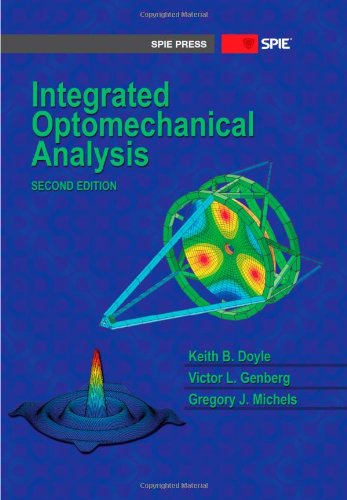
The development of integrated optomechanical analysis tools has increased significantly over the past decade to address the ever-increasing challenges in optical system design, leveraging advances in computational capability. This book presents not only finite element modeling techniques specific to optical systems but also methods to integrate the thermal and structural response quantities into the optical model for detailed performance predictions. This edition updates and expands the content in the original SPIE Tutorial Text to include new illustrations and examples, as well as chapters about structural dynamics, mechanical stress, superelements, and the integrated optomechanical analysis of a telescope and a lens assembly.
User’s Reviews
Editorial Reviews: About the Author Keith Doyle has over 25 years of experience in the field of optomechanical engineering, working on a diverse range of high-performance optical instruments specializing in the multidisciplinary analysis and integrated modeling of optical systems. He is currently a Group Leader in the Engineering Division at MIT Lincoln Laboratory. He previously served in a variety of roles including Vice President of Sigmadyne, Inc., Senior Systems Engineer at Optical Research Associates, and a Structures Engineer at Itek Optical Systems. He received his Ph.D. from the University of Arizona in Engineering Mechanics with a minor in the Optical Sciences in 1993, and he holds a BS degree from Swarthmore College received in 1988. Dr. Doyle is an active participant in SPIE symposia, teaches short courses on optomechanics and integrated modeling, and has authored and coauthored over 30 technical papers in optomechanical engineering. Dr. Victor Genberg PE has over 45 years of experience in the application of finite element methods to highperformance optical structures, and is a recognized expert in optomechanics. He is currently President of Sigmadyne, Inc. Prior to starting Sigmadyne, Dr. Genberg worked at Eastman Kodak for 28 years, serving as a technical specialist for commercial and military optical instruments. He is an author of SigFit, a commercially available software product for optomechanical analysis. Dr. Genberg is also a full professor (adjunct) of Mechanical Engineering at the University of Rochester, where he teaches a variety of courses in finite elements, design, optimization, and optomechanics. He has over 50 publications. He received his Ph.D. from Case Western Reserve University in 1973. Gregory Michels PE has worked for twenty years in optomechanical design and analysis, and is currently Vice President of Sigmadyne, Inc. He received his MS degree in Mechanical Engineering from the University of Rochester in 1994. He specializes in finite element analysis and design optimization of high-performance optical systems. Mr. Michels is also a software developer and technical support engineer for Sigmadyne’s optomechanical analysis software product, SigFit. Prior to co-founding Sigmadyne, he worked at Eastman Kodak for five years as a structural analyst on the Chandra X-Ray Observatory. Mr. Michels has authored or co-authored over 25 papers in the field of integrated optomechanical analysis and teaches short courses on finite element analysis and integrated modeling.
Reviews from Amazon users which were colected at the time this book was published on the website:
⭐A very good book.
⭐This is a fantastic update to an otherwise good book. This book is very relevant if you are an optomechanical structural analyst and need to determine how to analyze structures. It’s a decent first look into the progression from being a mechanical engineer to an optomechanical engineer.A lot of the simple additions that were added such as suggestions on how to model mirrors for improved prediction in Wavefront error performance and even how to interpret ratios of significance in mirror design are very useful. I’m glad they added information on alternative types of ways to fit non circular mirrors too.I got a chance to look at several chapters through an SPIE subscription and if you are choosing between this and the old edition there is enough changes in this book that I would say definitely get this edition. If you’re new to the topic and need an surface treatment on the “need to know”, this is a great book to have.
⭐
⭐
⭐
⭐
Keywords
Free Download Integrated Optomechanical Analysis, Second Edition 2nd Edition in PDF format
Integrated Optomechanical Analysis, Second Edition 2nd Edition PDF Free Download
Download Integrated Optomechanical Analysis, Second Edition 2nd Edition 2012 PDF Free
Integrated Optomechanical Analysis, Second Edition 2nd Edition 2012 PDF Free Download
Download Integrated Optomechanical Analysis, Second Edition 2nd Edition PDF
Free Download Ebook Integrated Optomechanical Analysis, Second Edition 2nd Edition