Ebook Info
- Published: 2018
- Number of pages: 416 pages
- Format: PDF
- File Size: 13.25 MB
- Authors: Roman Jackiw
Description
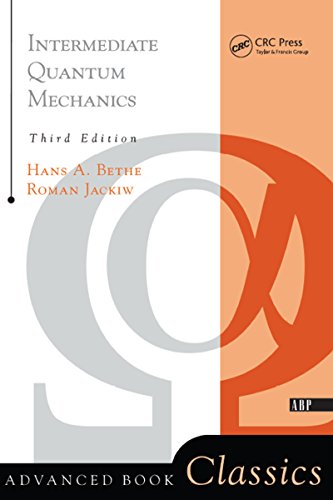
Graduate students in both theoretical and experimental physics will find this third edition of Intermediate Quantum Mechanics , refined and updated in 1986, indispensable. The first part of the book deals with the theory of atomic structure, while the second and third parts deal with the relativistic wave equations and introduction to field theory, making Intermediate Quantum Mechanics more complete than any other single-volume work on the subject.
User’s Reviews
Reviews from Amazon users which were colected at the time this book was published on the website:
⭐Thanks so much for delivering such a great book at an amazing price. Looking forward to buying more books from you. Have a great day!!!!
⭐Assuming you’ve completed a year in quantum mechanics at the level of Messiah, this text proceeds at a leisurely rate. You’ll learn the rudiments of quantum chemistry which entails the Hartree-Fock self consistent field method among other so called density functional methods (Thomas-Fermi). Perturbation methods will also be applied in this setting, for instance the variational method (Rayleigh-Ritz) is used to estimate the helium ground state energy. Scattering theory with the Born approximation and other approximate/perturbative methods is given. You’ll get Fermi’s Golden Rule in the treatment of semi-classical radiation theory.Now for the atypical ideas you’ll find for instance that the probability current density which is used usually only to establish conservation of probability can be used as a model for actual electron current density as a first attempt say in solid state physics. The treatment of relativistic quantum mechanics centers on Klein-Gordon and Dirac equations with field theory reserved for another course. Probability current density ideas here show that particle number is not conserved as in Schroedinger. The structure of the Dirac matrices which arise in a seemingly ad hoc way so as to satisfy the anti-commutation relations(the Clifford Algebra)are shown to have an invariant significance. Remembering your first quantum course these 4×4 matrices were constructed in a block diagonal way from the 2×2 Pauli spin matrices since these satisfied similar relations. An extended representation of the Dirac matrices is constructed from them (the Gamma matrices) which is used to prove Pauli’s Fundamental Theorem. This essentially states that any set of four 4×4 matrices which satisfy the Clifford Algebra arise from the Dirac matrices by a similarity transformation. So the Dirac matrices represent a physical fundamental-electron spin. Now you’ll know that a Clifford Algebra ain’t so bad!
⭐That quantum mechanics must be understood by anyone working in any area of technology is now well accepted. Indeed, semiconductor device physics, proteomics, and computational chemistry are just three of the more modern areas where a through knowledge of quantum mechanics is needed in order to make any kind of significant progress. This book, written by two of the major players in the development of quantum mechanics in the 20th century, is an excellent overview of how to do practical computations in quantum mechanics. The book is addressed primarily to the aspiring atomic physicist and spectroscopist, but it could serve well anyone interested in the applications of quantum mechanics, such as those in the aforementioned fields. Due to space limitations, I will only review the first 8 chapters of the book. Chapter 1 is a brief overview of elementary quantum mechanics, and the authors set down the notation and units to be followed in the book. They state the main goal of the book, which is to solve the Schrodinger equation for an atom with nuclear charge Ze. This problem for one-electron is straightforwardly solved, but for more than one electron approximation techniques must be used, a few of which they mention. Since spin will have to be dealt with throughout the book, the authors include a description of spin 1/2 particles. In chapter 2 the authors discuss the use of symmetry principles in quantum many-particle systems, pointing out the origin of exchange degeneracy and the Pauli exclusion principle. The authors also give an interesting discussion of the experimental determination of symmetry, particularly their argument for the absence of hidden variables. In chapter 3 the authors give an overview of the quantum mechanics of two-electron atoms, pointing out that the calculations give six-figure agreement between theory and experiment. Perturbation and variational methods are used to solve the Schrodinger equation for this system, and show the origin of the triplet and singlet levels for the helium atom. In chapter 4, the authors introduce another approximation technique, the self-consistent field or “Hartree-Fock” method, in order to calculate the excited states for the two-electron atom more efficiently. This approach involves using a variational trial function, called the determinantal wave function, as an ansatz, which because of orthogonality and parity considerations, results in a set of equations, called the Hartree-Fock equations, for the single electron orbitals. The “exchange term” in these equations is discussed in detail, involving a notion of a “nonlocal” potential. The physical significance of the eigenvalue in these equations is also discussed, and related to the famous Koopman theorem. It is proven also that atoms with closed shells leads to a spherically symmetric theory. The periodic table is shown to be a consequence of the Pauli principle and the Hartree-Fock calculation. An improvement to Hartree-Fock, the Thomas-Fermi method, which does not include exchange, is discussed in chapter 5. Classified as a “statistical method”, this method finds the effective potential energy experienced by a small test charge, along with the electron density around the nucleus. The authors show how exchange effects can be included using a procedure due to P.A.M. Dirac, which uses a concept of effective exchange potential, and one due to W. Lenz, which is a constrained optimization procedure, requiring that the total energy be stationary. In order to remove the degeneracy in the atomic shells due to the Hartree-Fock approximation, the authors view it as a perturbation expansion in chapter 6, with the unperturbed Hamiltonian being the Hartree-Fock central field Hamiltonian, and the perturbation being the electrostatic interaction of the electrons minus a suitable average of it. The search for proper linear combinations of zero-order degenerate eigenfunctions to make the total Hamiltonian diagonal entails the use of the total orbital and spim angular momentum of all the electrons in the atom. Hence the authors outline in detail how to perform the addition of angular momenta in this chapter. The reader can see clearly the origin of the famous Clebsch-Gordon coefficients. This program is carried out in more detail in chapter 7, wherein the authors considers and atom which has an electron configuration distributed over several complete and one incomplete shell. The incomplete shell gives several different degenerate solutions, and this degeneracy can be removed by the assignment of angular momentum and spin quantum numbers to the orbitals in the shell. This chapter is characterized by a considerable amount of arithmetic in computing matrix elements, which can readily be handled by modern symbolic computation packages. The contribution of the spin-orbit interaction to the level structure of atoms, ignored in the previous two chapters, is studied in chapter 8. The authors also consider the interaction of the electron configuration with an external field, such as a magnetic field. The spin-orbit interaction is not considered in a relativistic framework, but instead is given a “pseudo-derivation”, in the words of the authors. The (correct) Dirac theory for spin-orbit interaction is given later in chapter 22. And here again, the matrix elements, and reduced matrix elements, considered in this chapter can best be handled by symbolic computation packages. This is particularly true for matrix elements of vector operators between states of different angular momentum, which the authors shy away from. The reader though can see the origin of the famous Wigner-Eckart theorem in the context of these computations. The Zeeman effect, resulting from the interaction of an electron with a homogeneous magnetic field, is discussed, along with the Paschen-Back effect, which results from the external magnetic field being strong enough to allow the Zeeman term in the Hamiltonian to dominate the spin-orbit interaction. Also discussed is the Stark effect, which results when an atom is placed in an external electric field. The authors show how to compute the energy shifts in this case, using, but not proving, some formulas due to Condon and Shortly.
⭐As a graduate student I found myself pouring over Bethe’s papers on inelastic scattering as written in the original German. That was pretty tough going! Happily, one of my fellow students introduced me to Bethe and Jackiw, which covered this same material in English. So for people who want to understand how electrons lose energy to individual atoms (i.e. characteristic energy losses) this book is extremely useful. For electron microscopists such as myself Bethe’s work is essential for learning how to compute the cross sections used in both energy dispersive x-ray spectroscopy (EDXS) and electron energy loss spectroscopy (EELS).
⭐The book was as advertised ( a used book) and was like new except for a slight water mark which did not affect the readability of the book.
Keywords
Free Download Intermediate Quantum Mechanics: Third Edition (Frontiers in Physics) 3rd Edition in PDF format
Intermediate Quantum Mechanics: Third Edition (Frontiers in Physics) 3rd Edition PDF Free Download
Download Intermediate Quantum Mechanics: Third Edition (Frontiers in Physics) 3rd Edition 2018 PDF Free
Intermediate Quantum Mechanics: Third Edition (Frontiers in Physics) 3rd Edition 2018 PDF Free Download
Download Intermediate Quantum Mechanics: Third Edition (Frontiers in Physics) 3rd Edition PDF
Free Download Ebook Intermediate Quantum Mechanics: Third Edition (Frontiers in Physics) 3rd Edition