

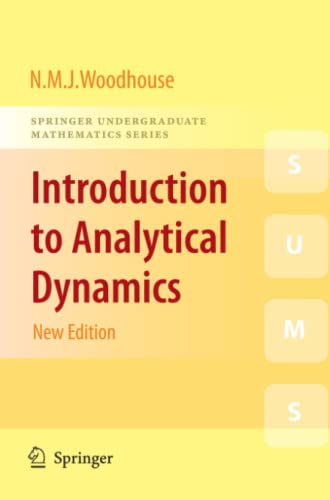
Ebook Info
- Published: 2009
- Number of pages: 253 pages
- Format: PDF
- File Size: 1.95 MB
- Authors: Nicholas Woodhouse
Description
First published in 1987, this text offers concise but clear explanations and derivations to give readers a confident grasp of the chain of argument that leads from Newton’s laws through Lagrange’s equations and Hamilton’s principle, to Hamilton’s equations and canonical transformations.This new edition has been extensively revised and updated to include:A chapter on symplectic geometry and the geometric interpretation of some of the coordinate calculations. A more systematic treatment of the conections with the phase-plane analysis of ODEs; and an improved treatment of Euler angles. A greater emphasis on the links to special relativity and quantum theory showing how ideas from this classical subject link into contemporary areas of mathematics and theoretical physics.A wealth of examples show the subject in action and a range of exercises – with solutions – are provided to help test understanding.
User’s Reviews
Editorial Reviews: Review From the reviews of the second edition:“It is designed to teach analytical mechanics to second and third year undergraduates in the UK, and probably to third or fourth year undergraduates in the US. … This book offers a very attractive traditional introduction to the subject. … the author is well tuned to the difficulties even strong students encounter. … discusses the relevance of classical mechanics in modern physics, especially to relativity and quantum mechanics. This is a fine textbook. It would be a pleasure to teach or to learn from it.” (William J. Satzer, The Mathematical Association of America, March, 2010) From the Back Cover Analytical dynamics forms an important part of any undergraduate programme in applied mathematics and physics: it develops intuition about three-dimensional space and provides invaluable practice in problem solving.First published in 1987, this text is an introduction to the core ideas. It offers concise but clear explanations and derivations to give readers a confident grasp of the chain of argument that leads from Newton’s laws through Lagrange’s equations and Hamilton’s principle, to Hamilton’s equations and canonical transformations.This new edition has been extensively revised and updated to include:A chapter on symplectic geometry and the geometric interpretation of some of the coordinate calculations. A more systematic treatment of the conections with the phase-plane analysis of ODEs; and an improved treatment of Euler angles. A greater emphasis on the links to special relativity and quantum theory, e.g., linking Schrödinger’s equation to Hamilton-Jacobi theory, showing how ideas from this classical subject link into contemporary areas of mathematics and theoretical physics. Aimed at second- and third-year undergraduates, the book assumes some familiarity with elementary linear algebra, the chain rule for partial derivatives, and vector mechanics in three dimensions, although the latter is not essential. A wealth of examples show the subject in action and a range of exercises – with solutions – are provided to help test understanding.
Reviews from Amazon users which were colected at the time this book was published on the website:
⭐This concise and well organized book covers the basics of Lagrangian and Hamiltonian mechanics in a rigorous yet reader-friendly manner. Based on Prof. Woodhouse’s lectures for undergraduate mathematics students, it is assumed that one has a background in standard linear algebra and vector calculus. It focuses on the conceptual and mathematical essentials so you will not get lost in an ocean of physics applications. But, and this is important, he does not neglect physical motivation or examples, which are deployed at critical points so the student can understand the utility of the concepts.Woodhouse is a master expositor and he takes pains to clarify points that he found sometimes confusing to students, e.g. he explains carefully the different interpretations of df/dt for f = f(q,v,t), holding q and v constant, and the partial derivative of f wrt t, where one substitutes q = q(t) and v =v(t) and applies the chain rule; the difference is shown pictorially in Fig 2.8, p. 48 [hint: search on “bead sliding”]. This sort of elaboration of key points can be very helpful to autodidacts because without a teacher, one can be unclear about some basic but key concept or definition without even being aware of it (at least that’s been my experience from time to time).There’s even a chapter on Geometry of Classical Mechanics, a stripped down introduction to some of the basic aspects of differential geometry (manifolds, vector fields, symplectic manifolds, etc) and its application to Lagrangian and Hamiltonian dynamics. It’s hard for me to evaluate this chapter since I have studied differential geometry elsewhere and only skimmed this chapter. The use of differential geometry in physics is a huge topic and so it could well be that it is too succinct for someone coming to this material for the first time.I have used this book in conjunction with several other books on mechanics, most notably Taylor’s
⭐, which I like for its clear explanations and detailed physics but have found a bit wordy to read straight through, and Kibble’s admirably clear and concise
⭐. As an autodidact primarily interested in the mathematics behind physics, I have found Woodhouse’s book to be a very helpful complement to these standard textbooks.In sum, he covers the key topics in an impeccable style, interleaving rigorous mathematics and physics in a way that keeps the development moving at a fast but comprehensible pace. This book will take you from a very elementary level to the point where you can study more advanced material with some confidence.______________P.S. For those interested in relativity, I also highly recommend checking out Woodhouse’s excellent books
⭐and
⭐).
⭐Instead of spending your money with three books by N. Woodhouse (Adv. Mechanics, Special Relativity, and General Relativity), buy the one book by J. Franklin,
⭐. It is a much more pleasant textbook with essentially the same contents and level of the texts by Woodhouse (I’d say that Franklin treats the physics, and perhaps also the math, better than Woodhouse) and at approximately the same cost.
⭐This perverted obfuscation should never have made itpast the slush pile. To say that the ‘writing’ is dry andhopelessly bogged down in formalism is to be charitable.In the first few pages alone, it defines – without the benefitof any motivation whatsoever – both angular momentumand even the coriolis force (!) in such an abstract mathematicalway as to mystify 90% of its intended audience and completelybewilder the rest.Readers familiar with the gray house style of oup may get the picturewhen tipped off that this aberration suffers even by comparison withthose weak standards.Three observations: — this is in no way shape or form a book for undergraduates to learn from unless we intend to sink our educational system — anyone interested in the actual real world physics of lagrangian mechanics would gag at the unenlightening and heavy handed approach — no one interested in the formal mathematical background behind the physics would benefit from its hopelessly outdated treatment either ( the book is not new and is just a reprint from an old oxford text that should have been buried in an unmarked grave ) .
⭐This book was recommend by my mechanics lecturer at UCL. A good book but I found the exercises particularly enjoyable – hence five stars.
Keywords
Free Download Introduction to Analytical Dynamics (Springer Undergraduate Mathematics Series) in PDF format
Introduction to Analytical Dynamics (Springer Undergraduate Mathematics Series) PDF Free Download
Download Introduction to Analytical Dynamics (Springer Undergraduate Mathematics Series) 2009 PDF Free
Introduction to Analytical Dynamics (Springer Undergraduate Mathematics Series) 2009 PDF Free Download
Download Introduction to Analytical Dynamics (Springer Undergraduate Mathematics Series) PDF
Free Download Ebook Introduction to Analytical Dynamics (Springer Undergraduate Mathematics Series)