Ebook Info
- Published: 2010
- Number of pages: 221 pages
- Format: PDF
- File Size: 1.54 MB
- Authors: Joseph Cardinal Ratzinger
Description
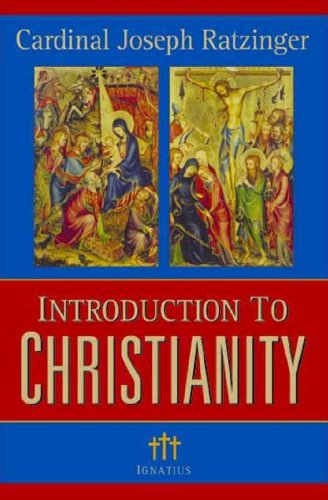
One of Cardinal Ratzinger’s most important and widely read books, this volume is a revised second edition with an improved translation and an in-depth 20 page preface by the Cardinal. As he states in the preface, since this book was first published over 30 years ago, many changes and significant events have occurred in the world, and in the Church. But even so, he says he is firmly convinced that his fundamental approach in this book is still very timely and crucial for the spiritual needs of modern man. That approach puts the question of God and the question about Christ in the very center, which leads to a “narrative Christology” and demonstrates that the place for faith is in the Church.Thus, this remarkable elucidation of the Apostle’s Creed gives an excellent, modern interpretation of the foundations of Christianity. Ratzinger’s profound treatment of Christianity’s basic truths combines a spiritual outlook with a deep knowledge of Scripture and the history of theology.
User’s Reviews
Reviews from Amazon users which were colected at the time this book was published on the website:
⭐I love all of Pope Benedict’s work. This one is especially good. Even though it says it’s an introduction you might want to read it once you’ve learned some fundamentals from other authors. I would suggest Theology for Beginners by Frank Sheed. Introduction to Christianity is one of the best book I’ve read that go deep into the faith. Catholiism is a deep faith. There is a lot there. I guarantee you that once you’ve read this book you’ll really understand why Catholicism is so profound and beautiful. Why it’s the truth.
⭐Wonderful overview of the faith. Because I taught German I have read it in German and have the translation. A great translation of a classic. One thought about the title. The German is ” Einführung,” which does mean “Introduction,” but is often used for a introductory course at a German university and is lecture centered, as the subtitle in German makes clear, “lectures on the Apostle Creed.” This is university level discussion of the faith. Lots of solid food for thought, eat slowly and enjoy.
⭐I had been putting off reading this book for a long time, and finally finished it after reading it slowly and letting it digest. Ratzinger truly had insight into what the Second Vatican Council really meant, and this is shown in how he really exposes the Creed in a truly revolutionary manner, paradoxically so with no “new ideas.” Even though it is titled “Introduction to Christianity,” keep in mind that Ratizinger is a scholar, so a good background on philosophy, theology, history, and even a little science is needed.
⭐Been a Catholic all my life and this is just giving me words and language to articulate the topics and issues…plan to read it to the end.
⭐I’ve read about 20 of his books, I’m surprised it took me this long to get to this one, it’s a simpler read compared to his other works but the content is top-tiered as always.
⭐This is such a great asset to have around… this sure is a wonderful tool and research book if you are an instructor…but a great book if a person was to have a deeper and better understanding of Christianity.. It is easy to read but a great theological essay…. Benedict XVI, is definitely one of the best theologian and writer of all times…. and this is a book everyone should be at least exposed to.
⭐I thought it was a good detailed book on the book the history of Christianity. It is a good book for catechism and knowledge behind the historic events of the Catholic Faith.
⭐This is certainly a magnificent introduction to Christianity. The core beliefs of Christians as formulated in its creeds is at the heart of this book. It takes a step back to deal with the expressed faith experience of humanity outside formal structures versus what is expressed formally through the Church, specifically as represented in the Apostles’ Creed.Ratzinger does a marvelous job of extracting from the Apostles’ Creed six salient principles on which he shares with his readers profound insights into the Christian narrative of “the God who has turned his face to us”. He demonstrates how these principles play a significant part in shaping our faith and in turn capture the “spirit of Christianity”.Ratzinger writes in a style and language that is appropriate for the “new millennium” impatient with irrationality and superficiality. His approach, appropriately, is eclectic. Adroitly he moves from the language and thought-processes of Jean Paul Sartre to Tielhard de Chardin to Rudolf Bultmann; from metaphysics to ontology (a la existentialism). Metaphysics and ontology to describe the parallel concepts of the Incarnation and the Cross; Sartrean language to describe our existence in terms of being and its dynamic Christian model of “being for”; Chardin provides the paradigm for his insights on the Resurrection; Bultmann’s demythologizing proposition, as Ratzinger applies it to Heaven and Hell, resonates with the secularized world of the twenty-first century.The legacy of philosophical inquiry of the Early Christians anticipates and facilitates Ratzinger’s efforts to dialogue with the rational mind of the “new millennium”. Ratzinger does acknowledge the contribution of philosophy to Christian theology. Christian theology he indicates got its stimulus very early from gentile converts who were philosophers. They brought to their new found faith the propensity to inquire, rationalize and conceptualize. While, as Ratzinger recognizes, this was the foundation of Christian theology, he cautions that there is a fundamental difference between philosophy and Christian theology that must be considered in order to avoid incorrect understanding and hence incorrect articulation of the Christian faith. Philosophy is essentially an individualistic enterprise that seeks to discover the truth through reflection. Whereas Christian theology seeks to understand and articulate what is given. The Word of God is given rather than discovered through reflection. Hence, philosophy should be used as a supplementary tool to help Christians express their faith in clear and precise manner. This is exactly what Ratzinger does in a masterful way.There is one disturbing note. There is no evidence that gender equality has penetrated Ratzinger’s consciousness. Today, no reflection on Christianity should fail to embrace women. And no writer should hide behind the veneer that the masculine term as used is generic. It is reprehensible that when Ratzinger speaks about “being for” he does not address the shabby treatment of women. Obviously women are not included in the “for”. The model does not apply to them because they’re not “God’s partner in a dialogue…”. They’re are excluded because it is only man who “is the being that can think of God, the being opened onto transcendence.” It is man whom God allows to become a part of his “entirely Other”. And I suppose these are the reasons why women are excluded from the ordained priesthood. This might not be what Ratzinger intended but nevertheless his statements reflect a mindset that precludes women from the ordained priesthood.However, despite this particular flaw, Ratzinger is still the great apologist of the Christian faith for our millennium. He shows remarkable awareness of cultural trends and challenges of millennia. And so his writing is on target to equip Christians with the intellectual tools to dialogue with the rest of the world.I found his insights on the Apostles’ Creed to be profound and refreshing. I felt inspired by his meditations which blended in well with theological propositions. It was a personal touch which engaged my mind and endeared me to the Christian faith. I am happy I read this book and I strongly recommend that all millennia do the same.
⭐Absolutely brilliant. I’m amazed at the difference between how Ratzinger is imagined to be – boring, stuck in the past, traditionalist, out of touch – and how he really is – a genius, full of insight, genuinely engaging with the questions and challenges of modernity, without merely giving way to modernity. What does it mean to be a Christian in today’s world? What sense can post-enlightenment people make of an ancient faith? These questions are properly addressed, without compromising the integrity of the faith.I was also pleasantly surprised by his love for Teilhard de Chardin’s radical ideas
⭐Then – Prof Ratzinger launched this book as a cardinal & archbishop, now – Pope Benedict XVI. Formally ‘just’ an exposition of the Apostles Creed, in reality a wide ranging, deeply probing, assessment of the spiritual needs of the world via philosophy and Christianity and through exploring the text of the creed and it’s OT & NT Biblical sources. It is absorbing. It requires concentration. It is thought provoking. Sometimes he just gives his opinion on a topic, at other times he gives a brilliantly constructed series of arguments to a biblically based simple (not simplistic) statement. Every minute spent in this book is rewarding. He is that important combination of a widely respected academic with a pastoral heart for individuals, the church, and a lost and wandering world. You need to be reasonably well read at least in theology, the history of theology, and philosophy of religion to really get much out of this book. As a protestant (small ‘p’) conservative evangelical my heart and mind sings in many places along with this man of God.
⭐A fundemental text
⭐By no means an easy read or simple introduction but highly rewarding if you put the effort in.
⭐Fine
Keywords
Free Download Introduction To Christianity, 2nd Edition (Communio Books) in PDF format
Introduction To Christianity, 2nd Edition (Communio Books) PDF Free Download
Download Introduction To Christianity, 2nd Edition (Communio Books) 2010 PDF Free
Introduction To Christianity, 2nd Edition (Communio Books) 2010 PDF Free Download
Download Introduction To Christianity, 2nd Edition (Communio Books) PDF
Free Download Ebook Introduction To Christianity, 2nd Edition (Communio Books)