

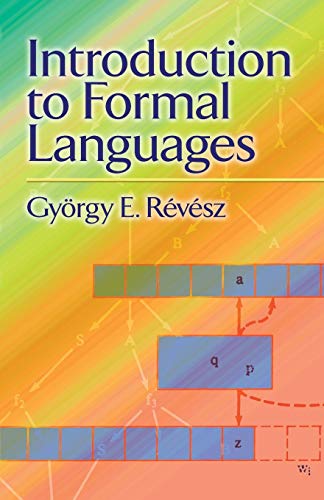
Ebook Info
- Published: 2012
- Number of pages: 208 pages
- Format: PDF
- File Size: 3.40 MB
- Authors: György E. Révész
Description
This highly technical introduction to formal languages in computer science covers all areas of mainstream formal language theory, including such topics as operations on languages, context-sensitive languages, automata, decidability, syntax analysis, derivation languages, and more. Geared toward advanced undergraduates and graduate students, the treatment examines mathematical topics related to mathematical logic, set theory, and linguistics. All subjects are integral to the theory of computation.Numerous worked examples appear throughout the book, and end-of-chapter exercises enable readers to apply theory and methods to real-life problems. Elegant mathematical proofs are provided for almost all theorems.
User’s Reviews
Editorial Reviews: About the Author Gyorgy Revesz is Professor Emeritus in the Department of Computer Science at the University of North Carolina at Charlotte.
Reviews from Amazon users which were colected at the time this book was published on the website:
⭐This review is being written on Sun 7Jul13, but the date on this review is that of a previous long-running review, which I finally deleted in 2012.I read most of chapters 1-8 of this 10-chapter book, except not many proofs, back in January to May of 2008 and found the book to be fascinating. The copy I read is the original 1991 reprinting by Dover of this 1983 McGraw-Hill book, and I owned that copy since 1995. Dover reprinted Revesz again in 2012, using some content from my previous review on the back cover. Incidentally, I did inexpensively find a new copy of the 1983 McGraw-Hill hardcover, which was a great find! Much more durable than Dover paperbacks.It is interesting that this small book tightly focuses on the formal language and grammar-related portions often included in more general theory of computation books. Since 2008, I have also read some of those other books, but this one is the most mathematically advanced among the others. Long and great chapter 6 of this book is where the pure formal language content meets the conceptual ‘machines’ that decide/accept/reject the languages.For reference, here is a simplified list of contents of this book: 1 The Notion of Formal Language-1 / 2 Operations on Languages-9 / 3 Context-Free Languages-17 / 4 Context-Sensitive Languages-44 / 5 Unrestricted Phrase-Structure Languages-53 / 6 Automata and Their Languages-59 / 7 Decidability-94 / 8 Complexity of Computation-108 / 9 Syntax Analysis-135 / 10 Derivation Languages-160 / Appendix: Elements of Set Theory-183 / Bibliographic Notes-188 / References-192 / Index-197 / On Sun 27Oct13, I did find that Amazon has made a quite open ‘Look Inside’ utility for this book.____________________________________________________________________________Six years after my previous reading of this book, and after large further reading of theory of computation, mathematical logic, ZFC set theory, model theory, modal logics, higher order logics and Boolean algebra, I started rereading this book on Wed 19Feb14. I am reading all proofs this time, unlike last time. Chapters 6-8 have a strange approach to dealing with those subjects, influenced by Revesz’s main subject of formal language theory instead of general theory of computing or recursion theory. Ended my second read of this book at end of section 8.2/p.123 on Thu 10Apr14.To end this review, the following 1980 book by Nigel Cutland uses the unlimited register machine (URM) as a conceptual machine, which completely avoids usage of formal languages. Personally, I am a huge fan of the URM.
⭐. Read the Cutland in summer of 2011.
⭐Very concise with proofs for everything. There are no gaps on the subjects presented …
⭐An introduction to theory of formal languages, with a lot of mathematics an no programming.There are also some chapter on automata, decidability and complexity of computation, but not algorithms on how to parse a program with a computer.Interesting, concise but I recommend to complete it with a book with some computer program.
⭐A good introduction if you’ve had formal languages in your lecture or seminar. Not really a book for self learning. It’s great for the extra stuff that lectures don’t cover. I recommend it for those studying computer science and other similar fields.
⭐Bonjour,il ne correspond pas à mes attentes. Il est très petit. Je m’attendais à un plus gros livre.
Keywords
Free Download Introduction to Formal Languages (Dover Books on Mathematics) in PDF format
Introduction to Formal Languages (Dover Books on Mathematics) PDF Free Download
Download Introduction to Formal Languages (Dover Books on Mathematics) 2012 PDF Free
Introduction to Formal Languages (Dover Books on Mathematics) 2012 PDF Free Download
Download Introduction to Formal Languages (Dover Books on Mathematics) PDF
Free Download Ebook Introduction to Formal Languages (Dover Books on Mathematics)