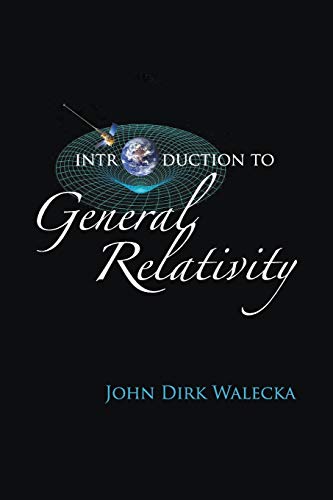
Ebook Info
- Published: 2007
- Number of pages: 356 pages
- Format: PDF
- File Size: 16.28 MB
- Authors: John Dirk Walecka
Description
A working knowledge of Einstein’s theory of general relativity is an essential tool for every physicist today. This self-contained book is an introductory text on the subject aimed at first-year graduate students, or advanced undergraduates, in physics that assumes only a basic understanding of classical Lagrangian mechanics. The mechanics problem of a point mass constrained to move without friction on a two-dimensional surface of arbitrary shape serves as a paradigm for the development of the mathematics and physics of general relativity. After reviewing special relativity, the basic principles of general relativity are presented, and the most important applications are discussed. The final special topics section guides the reader through a few important areas of current research.This book will allow the reader to approach the more advanced texts and monographs, as well as the continual influx of fascinating new experimental results, with a deeper understanding and sense of appreciation.
User’s Reviews
Editorial Reviews: Review This is one of the best introductory books on general relativity and cosmology that I have seen. The reader is guided through the maze of tensor indices that so bewilder the beginner, by working through them in elementary steps, and by explaining their physical relevance. This book takes the reader from the basics to some important applications, including the expanding universe and neutron stars, in a very clear and accessible fashion. –Kerson Huang, Emeritus Professor of Physics, MIT
Reviews from Amazon users which were colected at the time this book was published on the website:
⭐This is an EXCELLENT introduction to general relativity. It has both rigor and insight and can be handled by anyone with a little knowledge of advanced calculus and mechanics. Wikipedia easily fills in any missing background pieces for anyone with a BS in Physics, Math or even Engineering. I have tried to learn the basics of general relativity several times over the years and this is the only book I have found that works with self study. It has all the necessary math but it also motivates the math well. This sets it apart from the multitude of undergraduate texts and popular books that try to minimize the math, as well as modern graduate level texts that emphasize math principles over physics principles. Neither of those approaches works without someone to answer the questions that arise as a result.
⭐Book was not new as described.
⭐This is an unorganized context book. I find it very difficult to trace the connections between each subsection.
⭐In 1905, with the Special Relativity (SR) theory, Einstein brought a completely new idea into the field of physics: space and time are not two separate entities (or “categories”, as Kant had named them two centuries before), but they are related in some special way. By changing (inertial) reference system, i.e. by traveling with a different velocity, one can “transform” a bit of time in space and vice versa. This revolutionary idea left open the question about the _nature_ of inertial systems. Einstein was wondering what happens if, instead of changing my velocity with respect to the far stars, I move the entire universe in the opposite direction. The SR is completely symmetrical: two inertial observers will note the same effects when looking at the phenomena happening in the other’s reference system.On the other hand, the SR makes a neat distinction between uniform motion and accelerated motion, something which is also very near our common sense. For example, if we rotate a container filled with some water (and the water is also dragged to rotation), the surface of the water will change from a flat surface at rest to a concave shape due to the inertial force known as centrifugal force. On the contrary, if we leave the container still and _we_ sit into a reference frame which is rotating around the container, we do _not_ see a change on the shape of the water surface, but we (not the water) _feel_ the centrifugal force. However, what would happen if the entire universe were rotating around the container? We feel that, when speaking about “the entire universe”, we should point to some very special reference system: we feel that the shape of the water surface _should_ change in this case. But there is no space for this kind of effect in SR: there is no preferred or special reference system in this theory.The General Relativity (GR), when first introduced by Einstein, about a dozen years later than SR, represented a very new step in the history of science. The GR is a theory of _inertia_: it says (in axiomatic form) that the reference frame “attached to” a freely falling observer is _locally_ an intertial system. A freely falling observer is simply somebody (or something) who is moving without propulsion in a gravitational field. Because the observer is in a (local) inertial system, she can make use of the SR to describe all physical phenomena.For example, a satellite orbiting around the Earth is a freely falling system, as long as its dimensions are small compared to the typical scale on which one is able to measure different values for the Newton’s gravity force. The astronauts do not feel any gravity at all, and they can perform (small) experiments to verify that they really sit in an inertial reference system. To a quite good precision, the planets in the solar system are freely falling, even though the tides remind us that the Earth is not as small as a good inertial system would ideally require. In addition, the solar system itself can be considered an “object” which is freely falling in the gravitational field of the Galaxy, and so on. As long as one can neglect “tide” effects, everything is freely falling in the universe!But the GR says more than this: inertial observers follow the _geodesics_ of the spacetime. Because the source of gravity is the energy (in _any_ form, like mass or momentum), the distribution of energy defines the geometry of the spacetime. In other words, a small test mass which is left free to move (i.e. has no propulsor) will follow a trajectory in the spacetime which is defined by its initial conditions (position and velocity) and by the distribution of the masses all around—of the whole universe, in principle. Hence, the inertial motion depends on the universe configuration: if we could rotate the whole universe, we should see a change in the shape of the water surface! In the GR, we can find a sort of “special” reference systems, and this is experimentally confirmed: the angular distribution of the cosmic microwave background (CMB) radiation (the relic radiation from the hot Big Bang) has a dipole shape which is providing us a way to measure the _absolute_ (i.e. with respect to the special reference system) motion of the solar system. Once we correct for this dipole effect (i.e. we move to a reference system at rest, with respect to the special one), the distribution of the CMB is extremely flat, the fluctuations being at the level of a hundredth of percent.This is how the GR is usually introduced: first one emphasizes the two basic ideas that a freely falling system is a local inertial system and that it follows the geodesics of spacetime, defined by the distribution of energy in the universe; then one develops the (complicate) mathematical tools needed to address problems in this new framework. However, the time has come to provide the students with a smooth transition from the classical mechanics to the GR, as in the book by Walecka. This already happened with all earlier “revolutions” in the history of science (still it has to happen with quantum mechanics): today, nobody is marveled how the Maxwell’s equations are introduced by physics textbooks, just to make one example. Walecka introduces the differential geometry when addressing classical problems, and shows that the Newton’s equation can be reduced to a motion along a geodesics also in classical problems. Simply take a system with some mechanical constraint and choose a set of generalized coordinates which reflects the actual degrees of freedom of the system: the Euler-Lagrange equations in these coordinates are the equations of the geodesics in the metric defined by the coordinate transformation. This way, the student is taught the mathematical tools without being “distracted” with the new, powerful, ideas of GR.Once that things like tensor analysis, the affine connection, covariant derivatives, Riemann’s and Ricci’s tensors are introduced, Walecka starts speaking about SR and GR. In the first seven chapter, all the theory is exposed. The rest of the book is about applications of GR to solve problems like the orbital motion of the planes, the deflection of light, the gravitational and cosmic red-shifts, the neutron stars, the evolution of the universe, and the gravitational waves. Here, I should say that not all these items are addressed with the same depth, expecially the very last topics. However, a good literature exists on all of them and the book by Walecka provides the student with all the background one needs to browse the more advanced treatments.In conclusion, this book is probably one of the best choices as a first book on general relativity, because it guides the student through the path of minimum steepness toward the goal of understanding and learning this fascinating theory. I did not assign the maximum rate to it only because it is not very complete when addressing the very last topics. However, a fuller treatment of those would have required almost twice the number of pages of the present volume!
Keywords
Free Download Introduction to General Relativity in PDF format
Introduction to General Relativity PDF Free Download
Download Introduction to General Relativity 2007 PDF Free
Introduction to General Relativity 2007 PDF Free Download
Download Introduction to General Relativity PDF
Free Download Ebook Introduction to General Relativity