

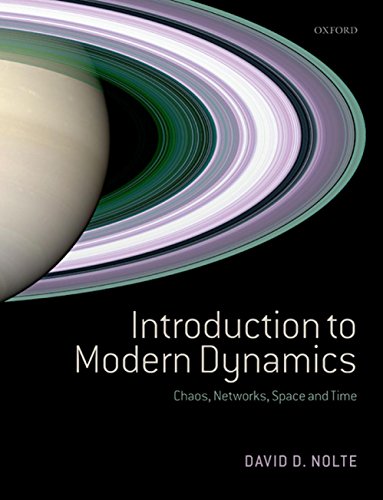
Ebook Info
- Published: 2014
- Number of pages: 432 pages
- Format: PDF
- File Size: 20.65 MB
- Authors: David D. Nolte
Description
The best parts of physics are the last topics that our students ever see. These are the exciting new frontiers of nonlinear and complex systems that are at the forefront of university research and are the basis of many high-tech businesses. Topics such as traffic on the World Wide Web, the spread of epidemics through globally-mobile populations, or the synchronization of global economies are governed by universal principles just as profound as Newton’s laws.Nonetheless, the conventional university physics curriculum reserves most of these topics for advanced graduate study. Two justifications are given for this situation: first, that the mathematical tools needed to understand these topics are beyond the skill set of undergraduate students, and second, thatthese are speciality topics with no common theme and little overlap.Introduction to Modern Dynamics dispels these myths. The structure of this book combines the three main topics of modern dynamics – chaos theory, dynamics on complex networks, and general relativity – into a coherent framework. By taking a geometric view of physics, concentrating on the time evolution of physical systems as trajectories through abstract spaces, these topics share a common and simple mathematical language through which any student can gain a unified physical intuition.Given the growing importance of complex dynamical systems in many areas of science and technology, this text provides students with an up-to-date foundation for their future careers.
User’s Reviews
Reviews from Amazon users which were colected at the time this book was published on the website:
⭐Of the texts used in my undergraduate physics courses, this is the one that I refer back to most often and recommend to colleagues and fellow students. It has the widest variety of topics for this level and seeks to introduce the reader to the many subtopics of higher level physics. This has changed the way I approach much of my research.When coupled with the Companion to IMD on Berkeley Press and used with the matlab (and now python!) scripts also made publicly available, this is a very rich textbook that I found very engaging. The tools accompanying this textbook aid in exposing readers to the usual Hamiltonian and Lagrangian dynamics, Lagrange multipliers, etc, into nonlinear dynamics, chaos theory and applications (you will become very familiar with Van Der Pol oscillators, phase space, and stability of systems), evolutionary dynamics, simple disease propagation, econo-physics, game theory.. then back to the more familiar territory of general and special relativity.A quick word of warning: As Professor Nolte once put it to his students, the undergraduate physics curriculum is about teaching yourself how to teach yourself. If you are ready to be introduced to topics ranging well beyond the typical Junior level Mechanics textbook, this is a wonderful textbook with many resources. I am very much looking forward to the second edition.Also be aware that not all of the homework questions have solutions.
⭐As a student who was one of the first to take this course with Dr. Nolte, I must say that I learned more with this book than I have with many of my other courses in my undergraduate physics career. This book not only expanded my knowledge of classical mechanics by delving into the Euler-Lagrange equation and stability analysis, but it also pushed us to become aware of more recent topics in physics and the mathematics behind them. The second half of the book serves as a very interesting survey of topics, and by briefly studying those topics, we gained a lot of insight into how abstract problems are approached. In general, the textbook focused on the major tools that physicists need when encountering classical mechanical problems, and it approaches them in a direct and understandable way. Additionally, Dr. Nolte’s book introduces a lot of computational problems with each chapter, and this helps develops students’ skills with numerical techniques and approaches to problems that cannot be solved analytically. Computer programming is a portion of our education that is not mandated by all undergraduate physics programs, and having it included in the text allows students to develop their own skills throughout the course.All in all, it was a difficult and rewarding class. Though the material is above the level that most classical mechanics courses cover, it allows students to be pushed and guided by the professor that is teaching the course, all while still learning the necessary topics that physicists require. Looking back on it, it has been one of the most beneficial courses of my undergraduate career.
⭐I found Dr. Nolte’s text quite insightful to a portion of physics that is often neglected in most undergraduate physics. This book does a wonderful job of clarifying and contextualizing the transition from intuitive idealized physical models that are ubiquitous in undergraduate physics to more real world scenarios. For example, many of the problems and exercises deal with introducing nonlinear perturbations and effects into a well understood system, and then presents the tools and ideas to analyse them.It is also worth noting sections of the book cover topics a bit outside of traditional physics, such as economics, systems analysis, and population dynamics to demonstrate and further contextualize the mathematical tools presented.I would highly recommend this text to students who already have a solid background in both linear algebra and Lagrangian and Hamiltonian mechanics. The book is builds much of its foundation on these topics and may be difficult to follow without a strong background.Overall, I recommend this text as a quality introduction to a variety of mathematical tools and analysis methods.
⭐UNa visione dei fenomeni non lineari di ampio spettro in vari settori applicativi. Richiede almeno un po’ di conoscenze di matematica a livello universitario.
⭐
Keywords
Free Download Introduction to Modern Dynamics: Chaos, Networks, Space and Time 1st Edition in PDF format
Introduction to Modern Dynamics: Chaos, Networks, Space and Time 1st Edition PDF Free Download
Download Introduction to Modern Dynamics: Chaos, Networks, Space and Time 1st Edition 2014 PDF Free
Introduction to Modern Dynamics: Chaos, Networks, Space and Time 1st Edition 2014 PDF Free Download
Download Introduction to Modern Dynamics: Chaos, Networks, Space and Time 1st Edition PDF
Free Download Ebook Introduction to Modern Dynamics: Chaos, Networks, Space and Time 1st Edition