

Ebook Info
- Published: 2011
- Number of pages: 578 pages
- Format: PDF
- File Size: 22.83 MB
- Authors: C. R. Wylie
Description
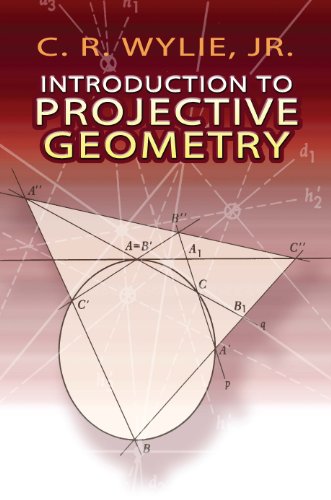
This lucid introductory text offers both an analytic and an axiomatic approach to plane projective geometry. The analytic treatment builds and expands upon students’ familiarity with elementary plane analytic geometry and provides a well-motivated approach to projective geometry. Subsequent chapters explore Euclidean and non-Euclidean geometry as specializations of the projective plane, revealing the existence of an infinite number of geometries, each Euclidean in nature but characterized by a different set of distance- and angle-measurement formulas. Outstanding pedagogical features include worked-through examples, introductions and summaries for each topic, and numerous theorems, proofs, and exercises that reinforce each chapter’s precepts. Two helpful indexes conclude the text, along with answers to all odd-numbered exercises. In addition to its value to undergraduate students of mathematics, computer science, and secondary mathematics education, this volume provides an excellent reference for computer science professionals.
User’s Reviews
Reviews from Amazon users which were colected at the time this book was published on the website:
⭐I thought I’d written a review when I finished the book, but recently discovered I hadn’t. Major oversight!This is a wonderful book. Wylie has “written it all down”, approaching the subject of the projective plane from both an analytic viewpoint (using linear algebra), AND an axiomatic one. No other author I’ve read had the patience to do so. He even takes the axiomatic approach far enough to introduce coordinates, for Pete’s sake! Of course he treats conics at length, a subject I always find amazing. (How can such a beautiful theory of “curvey” curves arise from a bare-bones theory of STRAIGHT lines?)One can view the dual treatment of the projective plane (axiomatic AND analytic) this way: Wylie sets up and explores an axiomatic system, and then shows very carefully that a model for the system is the usual coordinate-based one we get from linear algebra. We’re not entitled to apply the results of the axiomatic treatment, in a coordinate setting, until we’ve established this crucial connection.(This is not Wylie’s point of view, however. I think his intention is more pedagogical. First, give a “concrete” example of the projective plane by building on the reader’s knowledge of linear algebra, and after getting some experience with that, start over to develop the theory from a small set of axioms.)A signifcant omission from Wylie’s axiomatic treatment is the subject of 2-dimensional projectivities (automorphisms of the projective plane).Having done my best to praise the book, I wouldn’t necessarily recommend it for someone with NO prior exposure to projective geometry. Maybe I’m just too stupid, but I think it would be confusing to someone who didn’t already have some feeling for the major outlines of the subject. For the novice looking for an introduction, I would recommend Coxeter’s “Projective Geometry”. It’s mainly synthetic, and presumes no knowledge of linear algebra.
⭐Product quality matched description; delivery time as stated.
⭐VERY thorough and CONCRETE introduction, with a really nice (and challenging!) chapter at the beginning looking at projection from the original historical and very visual point of view. So a great place to start your journey to the heights of projective geometry and its uses in algebraic geometry.
⭐A wide, clear, and outstanding pedagogical presentation of projective geometry, this book is a great value for students, engineers and mathematicians.
⭐It was a new subject for me and it is a goog approach to get a perfect image on projective geometry.
⭐This book is a worthy introductory text not only for computer science professionals, but also for undergraduate college students of mathematics for its analytic and an axiomatic approach to plane projective geometry.
⭐THIS BOOK WAS PRINTED WITH A DISGUSTING PERFUME, LIKE FEBREZE – TOTALLY UNACCEPTABLE – AMOUNTING TO THEFT
⭐Concisione, chiarezza, semplicità del ragionamento. La discussione analitica prevale su quella sintetica, cioè grafica, e questo è l’unica scelta dell’Autore che mi sento di mettere in discussione. Per il resto si tratta di un testo utilissimo, non solo divulgativo, che colloca la geometria proiettiva nel contesto storico senza rinunciare ad una trattazione attuale.Es ist gewissermaßen episch breit und tief. Aber insgesamt lesbar, nachvollziehbar und hat auch einige sehr griffige Formulierungen für Theoreme und Corrolare. Für einen Geometrie Fan, eine leichte Entscheidung.Ce livre correspond exactement à ce que je voulais. Parfait.
⭐
Keywords
Free Download Introduction to Projective Geometry (Dover Books on Mathematics) in PDF format
Introduction to Projective Geometry (Dover Books on Mathematics) PDF Free Download
Download Introduction to Projective Geometry (Dover Books on Mathematics) 2011 PDF Free
Introduction to Projective Geometry (Dover Books on Mathematics) 2011 PDF Free Download
Download Introduction to Projective Geometry (Dover Books on Mathematics) PDF
Free Download Ebook Introduction to Projective Geometry (Dover Books on Mathematics)