

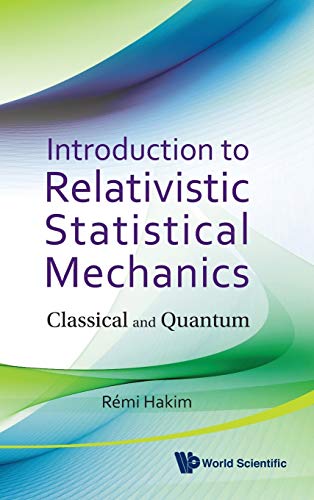
Ebook Info
- Published: 2011
- Number of pages: 568 pages
- Format: PDF
- File Size: 5.14 MB
- Authors: Remi Hakim
Description
This is one of the very few books focusing on relativistic statistical mechanics, and is written by a leading expert in this special field. It started from the notion of relativistic kinetic theory, half a century ago, exploding into relativistic statistical mechanics. This will interest specialists of various fields, especially the (classical and quantum) plasma physics. However, quantum physics — to which a major part is devoted — will be of more interest since, not only it applies to quantum plasma physics, but also to nuclear matter and to strong magnetic field, cosmology, etc. Although the domain of gauge theory is not covered in this book, the topic is not completely forgotten, in particular in the domain of plasma physics. This book is particularly readable for graduate students and a fortiori to young researchers for whom it offers methods and also appropriate schemes to deal with the current problems encountered in astrophysics, in strong magnetic, in nuclear or even in high energy physics.
User’s Reviews
Editorial Reviews: From the Back Cover This is one of the very few books focusing on relativistic statistical mechanics, and is written by a leading expert in this special field. It started from the notion of relativistic kinetic theory, half a century ago, exploding into relativistic statistical mechanics. This will interest specialists of various fields, including the (classical and quantum) plasma physics. However, quantum physics to which a major part is devoted will be of more interest since, not only it applies to quantum plasma physics, but also to nuclear matter and to strong magnetic field, cosmology, etc. Although the domain of gauge theory is not covered in this book, the topic is not completely forgotten, in particular in the domain of plasma physics. This book is particularly readable for graduate students and a fortiori to young researchers for whom it offers methods and also appropriate schemes to deal with the current problems encountered in astrophysics, in strong magnetic, in nuclear or even in high energy physics.
Reviews from Amazon users which were colected at the time this book was published on the website:
⭐For the reader with knowledge of general relativity and modern statistical mechanics, you will find ways of constructing the energy-momentum tensor at first for the linearized gravity theory(nearly Minkowskian). But the equations of motion will allow this to deviate from near flatness meaning a new metric evolves at least in an iterative sense. As is well known, the energy-momentum tensor requires a metric for its definition where as the Einstein tensor determines the metric-partly why the energy-momentum side is “wood”- i.e., certain symmetry assumptions are made to evade this circular reasoning and allow usable solutions. This allows for a start where gravity equations are coupled to equations of motion for the e-m tensor a step in avoiding circularity at a great increase in complexity. This is one avenue that might excite the reader. Also there are more conventional ones that are of great use to plasma physicists and astrophysicists. Well worth the price for these types. Please see my comment posted 4/14/2013 in response to a voter. Update 1/24/2014:Having been working on this book for some time now I think I might give a better indication as to the background required to read it, its pros, cons, etc. I mostly concur with the other reviewer but have not changed the rating. Its strength really is the Wigner distribution function approach and the fact that it is not thermal quantum field theory(TQFT). Quark-gluon plasma is treated by TQFT and results here have not been satisfactory. TQFT is basically developed from the imaginary time Feynman path integral which is called the Feynman-Kac integral. The imaginary time substitution essentially results in an integral over a Boltzmann-like factor, i.e., it’s exponentially damped. Being this is a sum of Boltzmann factors, it sure looks like a partition function-see the book by Kapusta for this stuff. Unfortunately TQFT works best only for ground state results as only the ground state will dominate as time grows arbitrarily large. The Wigner function is a semi-classical way of implementing the quantum statistical density operator or dyadic-it’s a Fourier transform of this dyadic smeared over an interval(dyadic=ket> Free Download Introduction to Relativistic Statistical Mechanics: Classical and Quantum in PDF formatKeywords
Introduction to Relativistic Statistical Mechanics: Classical and Quantum PDF Free Download
Download Introduction to Relativistic Statistical Mechanics: Classical and Quantum 2011 PDF Free
Introduction to Relativistic Statistical Mechanics: Classical and Quantum 2011 PDF Free Download
Download Introduction to Relativistic Statistical Mechanics: Classical and Quantum PDF
Free Download Ebook Introduction to Relativistic Statistical Mechanics: Classical and Quantum