

Ebook Info
- Published: 2010
- Number of pages: 240 pages
- Format: PDF
- File Size: 1.71 MB
- Authors: Ewald Balcar
Description
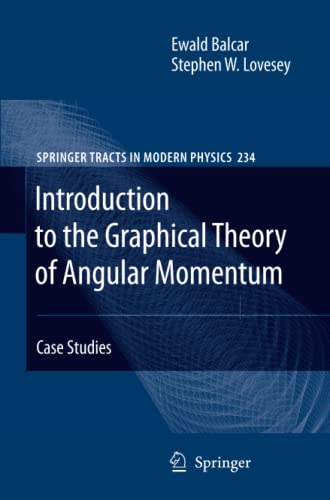
Application of quantum mechanics in physics and chemistry often entails manipulation and evaluation of sums and products of coupling coefficients for the theory of angular momentum. Here is the first step-by-step exposition of a graphical method grounded in established work.
User’s Reviews
Product description Review From the reviews:“The present book presents a concise and solid introduction to the graphical methods in the theory of angular momentum. … Each of the diagrams is completed with an explanatory caption that summarises its main features. … this book provides an excellent opportunity to self-study and exploration in angular momentum theory that goes beyond the standard books on the topic. … it represents a highly interesting complement to the theory, which can be further used to discover or derive new relations undetected until now.” (Rutwig Campoamor-Stursberg, Zentralblatt MATH, Vol. 1187, 2010)“The present book is intended as a reader-friendly introduction into this area. … It contains a historical background, motivation for writing the book and a brief summary of its contents, and some remarks on applications of the graphical theory, including references to the most important works in this area. … It should also be added that the diagrams, which play such a prominent role in the book, were prepared with the help of the PSTricks package and look really nice.” (Wojciech Lisiecki, Mathematical Reviews, Issue 2011 d) From the Back Cover Application of quantum mechanics in physics and chemistry often entails manipulation and evaluation of sums and products of coupling coefficients for the theory of angular momentum. Challenges encountered in such work can be tamed by graphical techniques that provide both the insight and analytical power. The book is the first step-by-step exposition of a graphical method grounded in established work. Copious exercises recover standard results but demonstrate the power to go beyond.
Reviews from Amazon users which were colected at the time this book was published on the website:
⭐In Yutsis we learn that to change to a -m from m we change the direction of the arrow in a 3jm symbol. We take it as self evident, but these people show it is only a rule, as best I can judge after a bit of maturation they require a change of sign on the node also. It is a different language on the same symbols.
⭐
⭐
⭐
⭐
Keywords
Free Download Introduction to the Graphical Theory of Angular Momentum: Case Studies in PDF format
Introduction to the Graphical Theory of Angular Momentum: Case Studies PDF Free Download
Download Introduction to the Graphical Theory of Angular Momentum: Case Studies 2010 PDF Free
Introduction to the Graphical Theory of Angular Momentum: Case Studies 2010 PDF Free Download
Download Introduction to the Graphical Theory of Angular Momentum: Case Studies PDF
Free Download Ebook Introduction to the Graphical Theory of Angular Momentum: Case Studies