Ebook Info
- Published: 2005
- Number of pages: 624 pages
- Format: PDF
- File Size: 30.22 MB
- Authors: David Park
Description
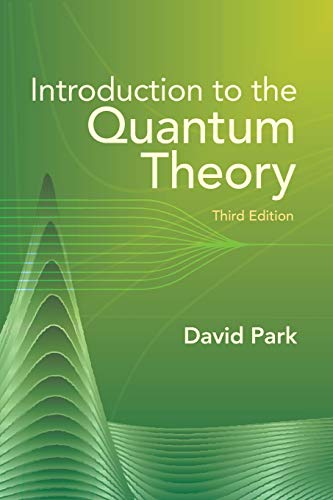
More than a chance to gain new insights into physics, this book offers students the opportunity to look at what they already know about the subject in an improved way. Geared toward upper-level undergraduates and graduate students, this self-contained first course in quantum mechanics consists of two parts: the first covers basic theory, and the second part presents selected applications. Numerous problems of varying difficulty examine not only the steps of the proofs but also related ideas.Starting with an introduction that ventures beyond classical physics, the first part examines the physical content of the wave function; general principles; physics in one dimension; hermitian operators, symmetry, and angular momentum; and systems in two and three dimensions. Additional topics include approximate methods of calculation; the theory of scattering; spin and isospin; questions of physical meaning; electromagnetic radiation; systems containing identical particles; and classical dynamics and Feynman’s construction. Focusing on applications, the second part explores the theory of alpha decay; electrons in a periodic lattice; the hydrogen spectrum; the helium atom; interatomic forces; the neutron-proton interaction; and the quark model of baryons.
User’s Reviews
Reviews from Amazon users which were colected at the time this book was published on the website:
⭐I used this book when I taught upper-level undergraduate quantum mechanics. My students loved it. What makes it unique is that, in addition to the standard sections common to all QM textbooks, Park included at Part II some applications to the theory given in Part I. The applications are not just simple computations to illustrate the theory, but real world situations that showed physicists why QM was in the correct direction. For instance, after reading Chapter 4 (Physics in one dimension), students could use its theory to work the problem of alpha decay (the discovery of quantum tunneling by George Gamow) shown in Part II. I find this book to be a gem. It is, of course, not as detailed and mathematically formal as Cohen-Tannoudji, but it is a great textbook for upper-level undergraduate courses.I included below the table of contents to give an idea about the book and its applications part.Part I. Theory1. Beyond Classical Physics2. The Physical Content of the Wave Function3. General Principles4. Physics in One Dimension5. Hermitian Operators, Symmetry, and Angular Momentum6. Systems in Two and Three Dimensions7. Approximate Methods of Calculation8. The Theory of Scattering9. Spin and Isospin10. Questions of Physical Meaning11. Electromagnetic Radiation12. Systems Containing Identical Particles13. Classical Dynamics and Feynman’s ConstructionII. Applications14. The Theory of Alpha Decay15. Electrons in a Periodic Lattice16. The Hydrogen Spectrum17. The Helium Atom18. Interactive Forces19. The Neutron-Proton Interaction20. The Quark Model of Baryons
⭐I think this book would be great for a first undergraduate course in quantum mechanics or even an introduction to modern physics if supplemented with an intro to special relativity. Really covers all the basics from the Schroedinger viewpoint though the Dirac notation is introduced around p. 140. What’s unique about this text is the applications which spur interest. For example Gamow’s theory of alpha decay which gave evidence for the validity of quantum mechanics is presented as an application of the WKB method. It also relates half-life to quantum mechanical parameters. Also a derivation of the Richardson-Dushman equation is done as an application of statistical mechanics. Lotsa neat stuff! Added 11/17/19 This is a review of the first edition, the 1992 and Dover editions don’t have statistical mechanics or thermodynamics but do discuss the Feynman path integral.
⭐Personally I think that this book is much easier to follow than other texts on the market but it should be noted that no book is ever a substitute for a talented physics instructor.
⭐Great book on this subject, example problems, too.
⭐good
⭐The text is rich with physical insights and the explanations are clear.
⭐This is an outstanding traditional approach to quantum theory and in fact was the text I used when I was an undergraduate a thousand years ago. It is essentially a historical approach and covers all the essential techniques in a more understandable way than some of the alternatives. When I used it, it used SI variables which many other texts of the time did not. However, there are newer books that take a more modern approach akin to that advocated by Feynman in volume three of the Lectures. In particular, within the last year, David McIntyre of Oregon State University has published an outstanding text
⭐that draws on OSU’s work on the Paradigms and Capstones pedagogy which integrates not only problem solving but lab-like activities using freely available materials and software. I’d recommend that one for the interested reader.
⭐This textbook treats the standard introductory topics in a conventional way. Solutions to the Schrodinger equation includes quantum wells, the radial equation, the hydrogen atom, and so forth. Spin and angular momentum are given ample space. An introduction to scattering theory is also provided. Hermitian operators are discussed, though not Dirac’s bra-ket notation.Although this book seems to be a suitable introduction for undergraduates, I do not believe that it would be much more difficult for them to read Schiff’s
⭐. When I was a first year Materials Science graduate student I took the standard two-semester graduate level quantum mechanics course taught by the physics department. My only exposure to quantum physics prior to that course was a junior level modern physics course taught out of McGervey’s
⭐and a senior level solid state physics course taught out of Kittel’s
⭐. At the time I did not find Park to be nearly so useful as Schiff.
⭐A solid text on an introduction to the quantum theory. It doesn’t use Dirac notation so the maths can get a bit off putting and I would advise having pen and paper handy while reading the book to fully understand the text. Goes into significant depth and I would recommenced it to a physics undergraduate.
⭐Testo ben noto, forse il migliore sell’argomento. Arrivato persino in anticipoBEST BOOK ON QUANTUM MECHANICS…
Keywords
Free Download Introduction to the Quantum Theory: Third Edition (Dover Books on Physics) in PDF format
Introduction to the Quantum Theory: Third Edition (Dover Books on Physics) PDF Free Download
Download Introduction to the Quantum Theory: Third Edition (Dover Books on Physics) 2005 PDF Free
Introduction to the Quantum Theory: Third Edition (Dover Books on Physics) 2005 PDF Free Download
Download Introduction to the Quantum Theory: Third Edition (Dover Books on Physics) PDF
Free Download Ebook Introduction to the Quantum Theory: Third Edition (Dover Books on Physics)