

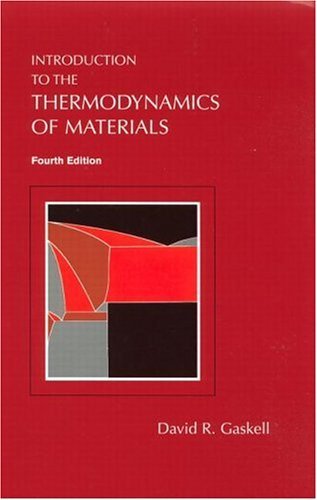
Ebook Info
- Published: 2009
- Number of pages: 763 pages
- Format: PDF
- File Size: 17.38 MB
- Authors: David R. Gaskell
Description
No description available
User’s Reviews
Reviews from Amazon users which were colected at the time this book was published on the website:
⭐I bought the book in Taiwan, and recieved it with its cd also.
⭐The tables in the back of the book have a very small default font size, and for Kindle for PC there is no zoom function. Without superhuman eyes I was unable to read some of the key tables, most notably table A-2, the specific heat capacity table.
⭐I was not expecting a book that was in good shape, but it was a good buy for the right price
⭐This book is one edition older than required in my class, but i have found that it is very similar to the new one (the fifth edition) and a lot cheaper. I think its a great book to get, and i recommend it to everyone.
⭐This book is a very good one very well focused on the thermodynamics of materials. I highly recommend it and I use it for the Materials Science Master degree program at University of Juarez
⭐I used this book for my course in Materials Thermodynamics, and I must say that it’s got some pretty good material and also some poor parts. In particular Gaskell usually does a good job of explaining his derivations, but there are times when the typographic errors get in the way and you sit there for an hour, until your teacher finally tells you that Gaskell made a mistake.Another annoyance is that Gaskell’s solutions in the back of the book are sometimes wrong, which means that it may be difficult to use a self-teaching book. In addition, Gaskell’s solutions to some configurational entropy problems are just completely unconventional and nonsensical from an intuitive standpoint — my teacher told us to disregard his method entirely.The text does have some pluses: it has plentiful diagrams, excellent thermodynamic appendicies, and in general does a good job of rigorously explaining every concept. It’s definitely not a beginner’s book, but Thermodynamics is a complex topic and there are certain assumptions made of the reader in any Thermodynamics textbook.
⭐To the curious minds of today and tomorrow:While it seems most of the reviews on Gaskell’s book are not very favorable I beg to differ. As someone with substantial expertise in this subject :), I can say that Gaskell succeeds in discussing a range of very important topics with utmost mastery. Let me elaborate…The discussions on auxiliary functions, solid-gas reactions, activity concept, solution thermodynamics, free energy diagrams, multicomponent phase equilibria and phase diagrams are very thorough. There are plenty of examples by which the use of the principles can be mastered. In most books you will not find such a detailed presentation. The formulation of free energy formalism is well developed.The weakness of the book lies in the first couple of chapters where Gaskell is discussing the first and second laws of thermodynamics. Those chapters might have been better written. And I suggest Callen’s book for a first reading of the first and second laws.As my thermodynamics professor used to say “If you think you understand thermodynamics on the very first exposure, then you either didn’t understand a single thing or you’re a genius.” In retrospect, he was right.Learning thermodynamics takes a lot a patience, unlike less abstract topics such as classical mechanics, for instance. Hence, be patient and read your texts carefully. As you progress through your studies, you will soon discover that Gaskell’s book is a much better book than it appears on the first reading.Cheers,Entropy4Life————————————
⭐I enrolled in my first thermo course last semester and two books were recommended by my processor: Thermodynamics in Material Science by Robert T. DeHoff (he’s one of the founding fathers of our dept.) and Introduction to the Thermodynamics of Materials (4th edition) by David R. Gaskell. In my opinion, the Gaskell text makes the subject much more difficult than it has to be. Even my professor admits that Gaskell’s treatment of the subject can be rough on a newbie. I’ve read some of Gaskell last semester and this semester …. only to obtain the same frustrating results. I think that DeHoff’s book is a much gentler introduction; however, having a professor who can provide proper and adequate practice problems to complement DeHoff’s easy to understand and philosphical approach would be a plus. Also, a book that I’ve found to be very helpful is Thermodynamics and Statistical Mechanics by John M. Seedon and Julian D. Gale. It gives a very clear and concise treatment of the most important thermodynamic concepts. The sections are short and objectives are clear with pertinent and challenging practice problems given at the end. Solutions are also provided in the back of the book. Compared to Gaskell, I found this book to be a much more straightforward, beneficial and less frustrating read.
Keywords
Free Download Introduction to the Thermodynamics of Materials, Fourth Edition 4th Edition in PDF format
Introduction to the Thermodynamics of Materials, Fourth Edition 4th Edition PDF Free Download
Download Introduction to the Thermodynamics of Materials, Fourth Edition 4th Edition 2009 PDF Free
Introduction to the Thermodynamics of Materials, Fourth Edition 4th Edition 2009 PDF Free Download
Download Introduction to the Thermodynamics of Materials, Fourth Edition 4th Edition PDF
Free Download Ebook Introduction to the Thermodynamics of Materials, Fourth Edition 4th Edition