Ebook Info
- Published: 2011
- Number of pages: 333 pages
- Format: PDF
- File Size: 2.16 MB
- Authors: Wendy Z. Goldman
Description
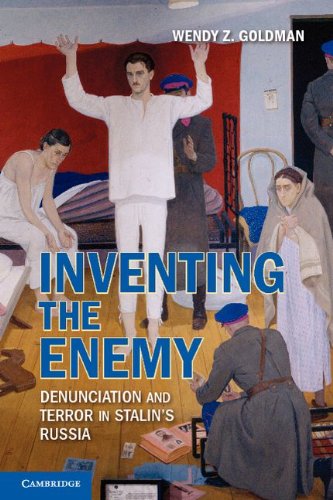
Inventing the Enemy uses stories of personal relationships to explore the behaviour of ordinary people during Stalin’s terror. Communist Party leaders strongly encouraged ordinary citizens and party members to ‘unmask the hidden enemy’ and people responded by flooding the secret police and local authorities with accusations. By 1937, every workplace was convulsed by hyper-vigilance, intense suspicion and the hunt for hidden enemies. Spouses, co-workers, friends and relatives disavowed and denounced each other. People confronted hideous dilemmas. Forced to lie to protect loved ones, they struggled to reconcile political imperatives and personal loyalties. Workplaces were turned into snake pits. The strategies that people used to protect themselves – naming names, pre-emptive denunciations, and shifting blame – all helped to spread the terror. Inventing the Enemy, a history of the terror in five Moscow factories, explores personal relationships and individual behaviour within a pervasive political culture of ‘enemy hunting’.
User’s Reviews
Reviews from Amazon users which were colected at the time this book was published on the website:
⭐While I was aware of the Great Terror, I gained many new insights through Goldman’s well-researched text. It is a powerful indicator of how easily people can be sucked into progressing from victim to victimizer and eventually destory an entire system.
⭐Goldman has assembled important research, intelligently presented, for anyone researching the fate of children related to those who became categorized as “enemies” of the USSR. The author’s careful detail is invaluable. For example, on July 5, 1937 the Politburo stipulated “… that children under the age of fifteen should be taken to orphanages, while the fate of older children would be decided individually. All children of “enemies” were to be prohibited from living in regime cities such as Moscow, Leningrad, and Kiev.” This explains the many children who were born and schooled in these cities but pop up unexpectedly in far-flung regions where they may become street urchins. The “regime” cities, therefore, acquired a special character, both highly desirable and Stalinist approved. The natural draw that such important cities as Moscow, Leningrad, and Kiev had through their history, cultural institutions and many advantages, now served as an incentive in all who aspired to live there to strict loyalty and even enthusiasm for the official USSR narrative. Living in these cities in the USSR had a halo effect unimaginable in the U.S. today.
⭐This is a fascinating look at the phenomenon of denunciation in Stalin’s Russia that shows just how impossible it was to live through this period without incriminating oneself or getting sucked into the vortex of terror in some way. Easy to read, with lots of specific examples of individuals caught in the Soviet web, anyone could enjoy this book. While much of the basic information will be familiar to specialists, the author’s presentation and inclusion of individual cases and stories about families, and women in particular, makes this a worthwhile read for experts in the field, as well.
⭐This is another strong offering from Goldman, as she looks deep into the day-to-day operations of several Moscow factories in order to uncover the dynamics of the ‘Great Terror’. She reveals intriguing, surprising and sometimes shocking accounts of rank-and-file party members stoking the fires of denunciation, contributing in no small part to the terror which consumed Soviet society as a whole. The sources used are very insightful and very strong, and one is left with an incredibly vivid picture of how the terror operated at the grass roots on factory floors. Whilst Soviet citizens effectively devoured themselves, they left behind what Goldman calls a ‘history without heroes’.This is a very important ‘must-read’ book for anybody looking at Soviet terror and should not be overlooked. I initially felt that Goldman became somewhat repetitive at times, but on reflection, this helped to reinforce some very crucial points which were incredibly clear and well-argued. I read this in conjunction with Goldman’s previous work ‘Terror and Democracy in the Age of Stalin’, which compliment each other but don’t necessarily have to be read together. Even for those not so well-versed in Soviet history, it would prove to be an invaluable companion to any other more generalised literature out there on Soviet terror.
⭐Thanks.
Keywords
Free Download Inventing the Enemy: Denunciation and Terror in Stalin’s Russia in PDF format
Inventing the Enemy: Denunciation and Terror in Stalin’s Russia PDF Free Download
Download Inventing the Enemy: Denunciation and Terror in Stalin’s Russia 2011 PDF Free
Inventing the Enemy: Denunciation and Terror in Stalin’s Russia 2011 PDF Free Download
Download Inventing the Enemy: Denunciation and Terror in Stalin’s Russia PDF
Free Download Ebook Inventing the Enemy: Denunciation and Terror in Stalin’s Russia