

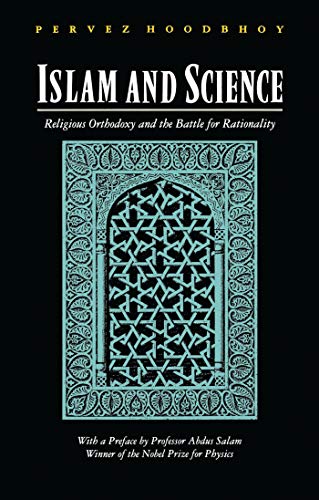
Ebook Info
- Published: 1991
- Number of pages: 176 pages
- Format: PDF
- File Size: 4.90 MB
- Authors: Pervez Hoodbhoy
Description
Hoodbhoy, Pervez
User’s Reviews
Editorial Reviews: Review “A compelling and provocative analysis of the relationship between the scientific spirit and the orthodoxy of one of the great monotheistic religions. Any reader, Muslim or non-Muslim, is bound to be affected by Dr. Hoodbhoy’s clear and persuasive arguments.” ―Edward Said“Perhaps the most important book written and published in Pakistan in recent years.” ―Irfan Husain, Dawn (Karachi) About the Author Pervez Amirali Hoodbhoy is a Pakistani nuclear physicist, mathematician and academic who serves as Distinguished Professor of Physics and Mathematics at the Forman Christian College in Lahore.Pervez Amirali Hoodbhoy is a Pakistani nuclear physicist, mathematician and academic who serves as Distinguished Professor of Physics and Mathematics at the Forman Christian College in Lahore.
Reviews from Amazon users which were colected at the time this book was published on the website:
⭐Dr. Hoodbhoy is a personal hero of mine. He is fearless and unapologetic in his quest to create a scientific awareness in Pakistan. This book helps to understand the origins of the lack of science in the muslim world. Most moderates would quote the famous hadith by the prophet Muhammad on the quest for knowledge even if it meant traveling to China as a strong argument for openness to science and rationality. This could be eminently refuted even by the likes of the great skeptics and scientists in the early centuries such as Al Razi, Al Kindi, Ibn Sina, Al Haytham, Jabir Ibn Hayyan and others whose works were in constant opposition to orthodoxy led by the likes of Al Ghazzali, Ahmed Ibn Hanbal and others with the thought that these ideas would lead to heresy if encouraged. With only 3 Nobel Prizes in science from the Muslim world in contemporary times, orthodoxy still remains paramount.This is a highly recommended book to help bring the awareness and urgency to adopt free thought, respect for evidence and rationality which are espoused by science.
⭐Pakistani physicist and historian, Pervez Hoodbhoy is massively informative, funny, and fearless. Hoodbhoy reviews Islam’s embrace of science, the civilization’s meteoric rise, opposition to science, and final defeat of rationalism along with Islam’s Golden Age as a package deal by about 1200-1300. Islamic extremists “proclaimed a holy war against Rationalism,” writes Hoodbhoy, “against the upholders of reason and advocates of philosophy and science.”Fast forward 500 years and we hear America’s Rush Limbaugh broadcast that science and scientists are “One of the four corners of evil and deceit.” Done so over radio waves discovered, and electronics built, by science. Portentous as the radicals of Islam.The book closes with an entertaining review of modern “Islamic Science,” little different from “Proletariat Science” of Stalin and Mao that starved 40,000,000 of their own people, Hitler’s “non-Jewish Science,” or UCLA’s Sandra Harding’s “Feminists Science,” none of which are science. One Islamic scholar claimed “That jinns [a magic spirit], who God made out of fire, should be used as a source of energy.” Hoodbhoy publicly unveiled the man and happily responded to his ire, as “my article successfully hit a nerve-center of obscurantist nonsense.” A good intro to what America could look like as our anti-science movements march on.Incidentally, “Islam and Science” and “Muslims & Science” are the same book, same author, same year, by different publishers.
⭐In this book, Dr. Pervez Amirali Hoodbhoy presents a timely report about the relationship between scientific thought and Islamic thought and practice. The book, a scientist’s analysis of the state of science in the Moslem world, abounds with facts, controversial but important historical quotes.Furthermore, citing the importance of the recent scientific and industrial development, the author points out that the attitude of Islamic leaders towards science is a decisive and significant parameter that will determine the state of the Moslem world.The first remark the author makes is the stunning reversal of roles between the Moslem world and Europe. Between the 9th and 13th centuries, the Moslem world abounded with hospitals, schools, and astronomical observatories. Today, frozen in a state of backwardness, the Moslem world rejects the new and clings to the old. In contrast, the Western world, once sunk in the gloom of the Dark ages, is now aiming at the stars. “What are the causes of this reversal?” asks the author. To answer this question, he raises the issue of compatibility of Science and Islam, a subject of intense debate and disagreement between reformist, modernist, and orthodox Muslims. He says that any further discussion on the matter will not resolve the dispute to the satisfaction of all. He states, however, that science is a secular pursuit and that its secular character does not mean it necessarily repudiates the existence of the Divine. “Scientists are free to be as religious as they please, but science recognizes no law outside its own”, adds the author. Later, he indicates that the purpose of religion is to improve morality rather than specify scientific facts.In the second chapter, he asks: “What is Science?” and “what are the origins and nature of science”. Dr. Hoodbhoy, a physicist at Quaid-i-Azam University in Pakistan and a regular visitor at MIT in the U.S.A., defines the concepts which comprise the heart of modern scientific thinking: Facts, laws, hypotheses, theories, deductions, and inductions. He discusses the birth of modern science and the scientific revolution, which began in the 16th century. He mentions Rene Descartes’ important discovery of the Cartesian framework of thought, the analytical method that requires dissection of a complex problems and thoughts into elementary parts. Pointing out that the advent of quantum physics has forced modern scientists into accepting their naive grasping of reality instead of pronouncing dead the conventional modern science, the author shows the evolving nature of science, a character which religions do not have. Finally, contrary to what some Western scientists advocate, the author shows that modern science is not simply Western science, but the intellectual property of all humankind, and part of the universal heritage.In the third chapter, drawing a similarity among all religions and science, the author says: “The rigidly orthodox of every faith – including the fundamentalist Muslim of today – has never been comfortable with methods and discoveries of science.” He adds: “But historically, it the Christian Church which fought the longest and most bitter battle against science”, giving a few examples of the medieval Church brutality and unparalleled violence on the human spirit, and of the crushing of the scientific inquiry. The attempt of the Christian church was to suppress independent thinking and scholarly learning that were not conforming to its preaching. Furthermore, Dr. Hoodbhoy notes that conflict such as the creation of humankind between Science and Orthodox Church is still unresolved.The information and statistics in Chapter four on scientific authorship and value added manufacturing reflect the bleak state of science in the Moslem world. As an institution, science in Moslem countries is considerably below that for the rest of the world. The author denounces the policies of indoctrination through education, the de-emphasis of secular subjects, and the reduction of intellectual activities. Furthermore, he adds that the intellectual climate in several Moslem countries is not propitious for free thinking and science.In his study of the Muslim responses to underdevelopment, the author cites three distinct lines that have emerged in the colonial and post-colonial eras. He sprinkles his discussion of the restorationist, the reconstructionist and the pragmatist with quotes by important Islamic leaders and thinkers. His analysis of the restorationist line includes a summary of the recommendations of the Institute of Policies Studies of Pakistan. These refute the basic assumption of science, the physical relation between cause and effect, and are devoid of any call to excite the curiosity and develop attitudes of questioning in students.Still on the issue of the relation between science and Islam, Dr. Hoodbhoy examines Maurice Bucaille’s methodology of linking scientific advances to the Quran. The author explains that the linking of an eternal truth to the changeable theories of science is a dangerous business. Indeed, he simply states that:”Science is quite shameless in its abandonment of old theories and espousal of new ones… in Bucaille’s book there is not a single prediction of any physical fact which is unknown up to now, but which can be tested against observation and experiment in the future.”Furthermore, he refutes the existence or creation of an Islamic science. He indicates that the purpose of religion is to improve morality rather than specify scientific facts. In a sincere statement, he observes the impossibility to define an Islamic science which is acceptable to all Muslims, knowing the eternal disagreement among Muslims over what constitutes legitimate science.On the Golden Age, the author shows that only recently has the West paid lavish tributes to Islamic scientific achievements. He notes that: “Until the period of decisive European supremacy, Islam represented a military and a moral threat to Christianity because it was a powerful and vigorous alternative faith. So, to explain the spread of Islam, Christian theology had developed a defensive theory which demonstrated that Islamic success was the product of Muslim violence, lasciviousness and deceit.”An important issue, raised by the book, is the reason behind the rise of science in the medieval Muslim society. The author rules out the possibility of technology being a major motivation. Instead, he advances the patronage of enlightened caliphs and rulers. He remarks that this patronage was also crucial in keeping at bay fanatics and conservationists. However, such patronage presented a dangerous structural weakness for science, as a change of rulers and personal whims of patrons often meant disaster for scholars. This is supported by the histories of Ibn-Sina and Al-Kindi.Dr. Hoodbhoy concludes this issue by the following strong statement:”Science in the Golden Age was a private initiative of individual scholars with crucial support from the enlightened nobility, and with the masses being more or less out of the picture.”Dr. Hoodbhoy observes that the decline of science in the Islamic World was contemporaneous with the rise of a strong religiosity, which made it harder and harder for secular pursuit to exist. Ulim-Al-Awa-il (knowledge of antiquity) was equated with heresy. The author tells about the case of the greatest physician of Islam, Mohammed Ibn Zakaria Al-Rasi, who was charged with heresy, lost his eyesight as well as his zest for life after being hit with his books on the head. When an occultist suggested remedial eye surgery, Al-Razi replied:” I have seen enough of this world, and I do not cherish the idea of an operation for the hope of seeing more of it.” Shortly thereafter, he died.One may ask: “why didn’t the scientific revolution happen during five hundred years of scientific and intellectual leadership of the Golden Age?” The author cites the gradual hegemony of the fatalistic doctrine, the denial of cause and effect connection, and the continuous Divine intervention. He adds that knowledge was not principally viewed for utilitarian ends and economic causes. He also stresses, however that with no formal center of tyrannical religious authority, the level of persecution of Islamic scholars and thinkers was much less than in Europe. But again, he states:”With a great freedom of interpretation of doctrine led to the absence of a politico-religious authority which can resolve and mediate disputes. Usurpers could state power and claim religious leadership, they could turn disputes into territory or power into an occasion for Jihad, or they could mobilize religious sentiments of the masses to suppress minority or unorthodox religious groups.”Linking the rise of the fundamentalist line with the decline and the ultimate ruin of science in the Islamic civilization, the author does not exclude economic and military factors, but stresses the retreat of secular sciences as intolerance and blind fanaticism reached its crescendo. By the 14th century, the edifice of the Islamic science had been reduced to rubble.In the last chapter, the author presents a framework for thought. He stresses that modern society faces complex issues, such as the pollution versus demands for industrial expansion, which have complex remedies, and that no remedy is likely to be perfect. Such issues require quantitative, rather than qualitative, measure of action.The second thought he conveys the need to fight against the tendency to confuse modernization with Westernization. The third thought and action is the need to separate religion form science. Dr. Hoodbhoy expresses his last but important thought by writing:”There is no reason to accept the inequalities within and between nations as natural or ordained by Providence. These inequalities can be, and must be mitigated.”An appendix, titled “They Call it Islamic Science, concludes the book. In it, Dr. Hoodbhoy presents and analyses a few “scientific” articles presented at the international conference on Scientific Miracles of the Quran and Sunnah held on October, 18, 1987 at Islamabad, Pakistan. The papers, with themes such as the calculation the Angle of God (?) and the Nature of Jinns, are the work of charlatans rather than scientists. Pointing out the religious purpose of such conference, he condemns the fraudulent use of the word scienceWith an appended list of references after each chapter and, a prefaced by Prof. Mohammed Abdus Salam, the winner of 1979 Nobel Prize for Physics, the book is a succinct analysis the relationship between science and Islam. Full of pertinent information which one can not disregard, it is a thorough examination of the science-Islam issue, even if the author does not give specific remedies for the present bleak situation of the Moslem countries.
⭐The author has painted such a clear and crisp picture of the people of the Islamic world showing both our positive and negative points throughout the history and in the present days. I appreciate the easy flowing manner of the author commenting daringly on the History and speaking his mind out on the present conditions of the Muslims around the globe. It’s like looking in the mirror. Thank you Hoodbhoy. It’s about time somebody speak up the truth.
⭐After reading this book I have been able to understand a lot of confusion and seperation among the muslim ummah. This book is also great in referencing other classical and new works at the end of every chapter.I am actually using these ideas to enlighten my riligous friends in the community and i think Hoodboy needs to keep working on this type of material. The rift between “understanding” needs to be reduced and more work is required in setting goals.An excellent book.+
⭐I have a tremendous amount respect for the author and this book. it takes a brave man to take a rational approach in places like pakistan where magical ideas and superstition are part of the fabric of the country.this book is a must read. highly recommended
⭐A truely excellent book! recommended reading to everyone interested in the future of science and rationalism
⭐I previously read a much earlier incarnation of this book so I was interested to see what had changed, if anything.The size of the work has significantly increased and it is much more of a balanced read.I’ve read the ‘Structure of Scientific Revolutions’ twice and am currently reading Karl Popper’s ‘The Logic of Scientific Discovery’. It is important that the author emphasises what can be defined as ‘Science’ and the principle of falsifiability. I was surprised on reading Popper that whilst he stresses the principle of falsifiability he does also states that a hypothesis remains for ever potentially disapprovable, a point that is often missed. Arguably most of Science appears self-evident and we never expect that it will be disproved or to discover circumstances where it does not apply. Newtonian Physics must have appeared so before the advent of the 20th Century and the discovery of Relativity. To Hoodbhoy’s credit he does touch upon the possibility of paradigm change when he covers the danger of proving Science from the Quran, rightly saying the an argument could be made to support a Scientific hypothesis that is replaced tomorrow. The key point being that the proofs never precede the scientific theory and so is evidently a worked back argument to make the verses in question fit the scientific model under scrutiny.Hoodbhoy rightly crticises the misguided attempts to islamise Science, which I believe that neither needs. If Scientific enquiry is properly conducted then I would agree that the principle of Science are self-policing. However Science is done by humans and even Secularists can have their own biases and agendas too. If some Muslims are guilty of trying to artifically steer to an end conclusion then this is just as true with some members of the Scientific community, Dawkins and his hypothesis of memes being an example of an obvious attempt to try to reach a pre-conceived end point. In relation to approaching any subject with pre-formed entrenched ideas, interested readers would find it interesting to read Rupert Sheldrake’s ‘The Science Delusion’ and his own experience with Dawkins.Particularly interesting that Hoodbhoy points out that String Theory does not qualify as Science and in this there is an important balancer to the debate that wasn’t in the earlier edition that I read.In the case of the author’s critique of al-Ghazalli’s Cause and Effect, I think a workable philosophical approach could have been suggested; such as if cause and effect are both created by God in the world, we see one preceeding the other and hence the justifiable convention of connecting the two. In fact in the traditions God ordering the fire not to burn Abraham (peace be upon him) implies the de-facto characteristic of burning and reinforces the justification of employing a model of cause and effect. In places in the book these expanded discussions would have improved the book. This isn’t to say that Islamic authors dont need to rehabilitate some of their ways. Abu Ameenah Bilal Philips in his book on Tawhid for example attacks the Conservation of Energy as a denial of God’s Lordship, which is disingeneous, as he suggests that if you accept this then you have denied the attributes of God, which is not necesarily true as one can accept the Conservation of Energy as a working convention without denying that God can create or destroy as He wants. As humans we could not operate without accepting coherence in the world, Science could not be performed, and indeed many of the appealing arguments to ‘men of understanding’ in the Quran would become meaningless without coherence. So if this was the point intended it is correct but this did deserve a more thorough treatement in the book.As a Muslim it has sometimes been painful to watch poor fallacious argument put forward as a proof that then becomes a stick with which Muslims are beaten. I was in a masjid once where there was a flyer which acknowledged that the claimed sighting of the new moon was scientifically impossible but they had two witnesses who claimed that they had seen the the moon and so this proved science wrong. I have come across supposedly educated Muslims who believe that the Moon has its own light and so the concern over perspective within some portions of the Muslim community is justifiable and makes the debate even more pressing. Ghazalli picks up this issue in ‘The Refutation of the Philosophers’ where he says that when the (scientific) reality of the crescent and the waxing and waning of the moon has been clearly explained and provable by mathematics, a Muslim who continues to refute this, does not defend his religion but on the contrary actually harms it. So there is no doubt that this book is an important contribution to the ongoing debate.I have rated the book on content, if I was to rate it as a publication I would Have knocked off another star for the small font used which reading under some light conditions is difficult.Finally and I want to make this crystal clear, that the rating is based specifically on, and only on this book’s content and is not necessarily a reflection of how I feel about Hoodbhoy’s approach in general. Outside of a carefully edited book and in debate, he doesn’t appear as strong, and in places not as convincing. I was almost agog in a debate I watched, that he was so eager to dismiss the literal great flood (of Noah), that he completely missed the quite reasonable assertion (suggested for example by Harun Yahya) that the flood was not literally global and that the animals were the usual domesticated animals (sheep, goat, cows etc) which would be necessary to start afresh. I almost feel, and I could be wrong, that some views expressed elsewhere but not in this book may have been deliberately omitted so as not to alienate some of the potential readers. Whatever you feel about this book I think it would be worth supplementing it with further research.
Keywords
Free Download Islam and Science: Religious Orthodoxy and the Battle for Rationality in PDF format
Islam and Science: Religious Orthodoxy and the Battle for Rationality PDF Free Download
Download Islam and Science: Religious Orthodoxy and the Battle for Rationality 1991 PDF Free
Islam and Science: Religious Orthodoxy and the Battle for Rationality 1991 PDF Free Download
Download Islam and Science: Religious Orthodoxy and the Battle for Rationality PDF
Free Download Ebook Islam and Science: Religious Orthodoxy and the Battle for Rationality