

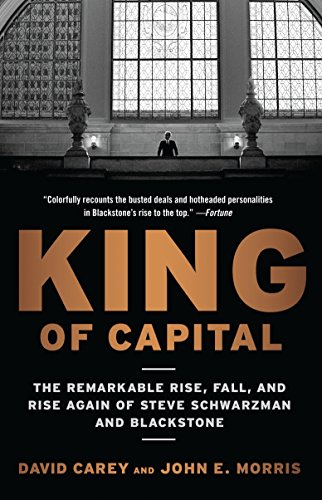
Ebook Info
- Published: 2012
- Number of pages: 400 pages
- Format: PDF
- File Size: 2.23 MB
- Authors: David Carey
Description
The story of Steve Schwarzman, Blackstone, and a financial revolution, King of Capital is the greatest untold success story on Wall Street. In King of Capital, David Carey and John Morris show how Blackstone (and other private equity firms) transformed themselves from gamblers, hostile-takeover artists, and ‘barbarians at the gate’ into disciplined, risk-conscious investors while the financial establishment—banks and investment bankers such as Citigroup, Bear Stearns, Lehman, UBS, Goldman Sachs, Merrill Lynch, Morgan Stanley—were recklessly assuming risks, leveraging up to astronomical levels and driving the economy to the brink of disaster. Now, not only have Blackstone and a small coterie of competitors wrested control of corporations around the globe, but they have emerged as a major force on Wall Street, challenging the likes of Goldman Sachs and Morgan Stanley for dominance. Insightful and hard-hitting, filled with never-before-revealed details about the workings of a heretofore secretive company that was the personal fiefdom of Schwarzman and Peter Peterson, King of Capital shows how Blackstone and private equity will drive the economy and provide a model for how financing will work in the years to come.
User’s Reviews
Editorial Reviews: Review “The authors … [take] us from the early days of the Blackstone Group, when the firm was just two guys and a secretary, to the buyout boom, when Mr. Schwarzman’s conspicuous consumption became a symbol of the new Gilded Age. In between, the book dives deeply into the firm’s signature deals — Celanese! Nalco! Distressed cable bonds! — that made Mr. Schwarzman and his partners so rich. It also delivers some fun details about many of the now-famous Wall Street players that did tours of duty at the firm. —New York Times DealBook “Carey and Morris’ thorough reporting offers a compelling look into the little understood Wall Street giant and the secrets of its success.” —Worth Magazine “[R]anks as one of the most even-handed treatments of the industry. David Carey and John Morris . . . received unusual access to Blackstone. . . . This allowed them to chronicle the firm in full and entertaining fashion across its 25-year history.” —Bloomberg Brief – Mergers “[A] broad history of private equity, with Blackstone as the touchstone.” —Fortune.com “Check out “King of Capital” because it’s got gossip, it’s got brains, and it’s as readable as hell. And it’s got some really good Schwarzman stories too.” —The Deal “King of Capital aspires to be a serious portrait of Blackstone and the way that Schwarzman so brilliantly built it up, scoring numerous coups along the way and avoiding the mistakes of many competitors. And it does a fine job in what it sets out to do.” —Financial Times“The authors link Blackstone’s history to the larger story of private equity’s expansion and its relationship to corporate America. They offer a lucid explanation of how the debt markets evolved from junk bonds to securitised loans, changing the types of deals that private-equity firms were able to finance.”—The Economist About the Author DAVID CAREY is a reporter at Bloomberg. Before joining Bloomberg, he was a senior writer for The Deal, an editor of Corporate Finance magazine, and wrote for Adweek, Fortune, Institutional Investor, and Financial World. JOHN E. MORRIS has been a Bloomberg Brief editor, an editor with Dow Jones Investment Banker, and was for many years an assistant managing editor at The Deal in New York and London. Before that, he was an editor and writer at The American Lawyer magazine.To find out more visit: www.king-of-capital.com Excerpt. © Reprinted by permission. All rights reserved. CHAPTER 1 The Debutants”More Rumors About His Party Than About His Deals,” blared the front-page headline in the New York Times in late January 2007. It was a curtain-raiser for what was shaping up to be the social event of the season, if not the era. By then, the buzz had been building for weeks.Stephen Schwarzman, cofounder of the Blackstone Group, the world’s largest private equity firm, was about to turn sixty and was planning a fête. The financier’s lavish holiday parties were already well known in Manhattan’s moneyed circles. One year Schwarzman and his wife decorated their twenty-four-room, two-floor spread in Park Avenue’s toniest apartment building to resemble Schwarzman’s favorite spot in St. Tropez, near their summer home on the French Riviera. For his birthday, he decided to top that, taking over the Park Avenue Armory, a fortified brick edifice that occupies a full square block amid the metropolis’s most expensive addresses. On the night of February 13 limousines queued up and the boldface names in tuxedos and evening dresses poured out and filed past an encampment of reporters into the hangarlike armory. TV perennial Barbara Walters was there, Donald and Melania Trump, media diva Tina Brown, Cardinal Egan of the Archdiocese of New York, Sir Howard Stringer, the head of Sony, and a few hundred other luminaries, including the chief executives of some of the nation’s biggest banks: Jamie Dimon of JPMorgan Chase, Stanley O’Neal of Merrill Lynch, Lloyd Blankfein of Goldman Sachs, and Jimmy Cayne of Bear Stearns. Inside the cavernous armory hung “a huge indoor canopy . . . with a darkened sky of sparkling stars suspended above a grand chandelier,” mimicking the living room in Schwarzman’s $30 million apartment nearby, the New York Post reported the next day. The decor was copied, the paper observed, “even down to a grandfather clock and Old Masters paintings on the wall.” R&B star Patti LaBelle was on hand to sing “Happy Birthday.” Beneath an immense portrait of the financier—also a replica of one hanging in his apartment—the headliners, singer Rod Stewart and comic Martin Short, strutted and joked into the late hours. Schwarzman had chosen the armory, Short quipped, because it was more intimate than his apartment. Stewart alone was known to charge $1 million for such appearances. The $3 million gala was a self-coronation for the brash new king of a new Gilded Age, an era when markets were flush and crazy wealth saturated Wall Street and especially the private equity realm, where Schwarzman held sway as the CEO of Blackstone Group. As soon became clear, the birthday affair was merely a warm-up for a more extravagant coming-out bash: Blackstone’s initial public offering. By design or by luck, the splash of Schwarzman’s party magnified the awe and intrigue when Blackstone revealed its plan to go public five weeks later, on March 22. No other private equity firm of Blackstone’s size or stature had attempted such a feat, and Blackstone’s move made official what was already plain to the financial world: Private equity—the business of buying companies with an eye to selling them a few years later at a profit—had moved from the outskirts of the economy to its very center. Blackstone’s clout was so great and its prospects so promising that the Chinese government soon came knocking, asking to buy 10 percent of the company. When Blackstone’s shares began trading on June 22 they soared from $31 to $38, as investors clamored to own a piece of the business. At the closing price, the company was worth a stunning $38 billion—one-third as much as Goldman Sachs, the undisputed leader among Wall Street investment banks. Going public had laid bare the fantastic profits that Schwarzman’s company was throwing off. So astounding and sensitive were those figures that Blackstone had been reluctant to reveal them even to its own bankers, and it was not until a few weeks before the stock was offered to investors that Blackstone disclosed what its executives made. Blackstone had produced $2.3 billion of profits in 2006 for the firm’s sixty partners—a staggering $38 million apiece. Schwarzman personally had taken home $398 million that year. That was just pay. The initial public offering, or IPO, yielded a second windfall for Schwarzman and his partners. Of the $7.1 billion Black-stone raised selling 23.6 percent of the company to public investors and the Chinese government, $4.1 billion went to the Blackstone partners themselves. Schwarzman personally collected $684 million selling a small fraction of his stake. His remaining shares were worth $9.4 billion, ensuring his place among the richest of the rich. Peter Peterson, Blackstone’s eighty- year- old, semiretired cofounder, garnered $1.9 billion. The IPO took place amid a financial revolution in which Blackstone and a coterie of competitors were wresting control of corporations around the globe. The private equity, or leveraged buyout, industry was flexing its muscle on a scale not seen since the 1980s. Blackstone, Kohlberg Kravis Roberts and Company, Carlyle Group, Apollo Global Management, Texas Pacific Group, and a half-dozen others, backed by tens of billions of dollars from pension funds, university endowments, and other big investors, had been inching their way up the corporate ladder, taking over $10 billion companies, then $20 billion, $30 billion, and $40 billion companies. By 2007 private equity was behind one of every five mergers worldwide and there seemed to be no limit to its ambition. There was even talk that a buyout firm might swallow Home Depot for $100 billion. Private equity now permeated the economy. You couldn’t purchase a ticket on Orbitz.com, visit a Madame Tussauds wax museum, or drink an Orangina without lining Blackstone’s pockets. If you bought coffee at Dunkin’ Donuts or a teddy bear at Toys “R” Us, slept on a Simmons mattress, skimmed the waves on a Sea- Doo jet ski, turned on a Grohe designer faucet, or purchased razor blades at a Boots pharmacy in London, some other buyout firm was benefiting. Blackstone alone owned all or part of fifty-one companies employing a half-million people and generating $171 billion in sales every year, putting it on a par with the tenth-largest corporation in the world. The reach of private equity was all the more astonishing for the fact that these firms had tiny staffs and had long operated in the shadows, seldom speaking to the press or revealing details of their investments. Goldman Sachs had 30,500 employees and its profits were published every quarter. Blackstone, despite its vast industrial and real estate holdings, had a mere 1,000 employees and its books were private until it went public. Some of its competitors that controlled multibillion-dollar companies had only the sketchiest of websites. Remarkably, Blackstone, Kohlberg Kravis, Carlyle, Apollo, TPG, and most other big private equity houses remained under the control of their founders, who still called the shots internally and, ultimately, at the companies they owned. Had there been any time since the robber barons of the nineteenth century when so much wealth and so many productive assets had come into the hands of so few? Private equity’s power on Wall Street had never been greater. Where buyout firms had once been supplicants of the banks they relied on to finance their takeovers, the banks had grown addicted to the torrent of fees the firms were generating and now bent over backward to oblige the Blackstones of the world. In a telling episode in 2004, the investment arms of Credit Suisse First Boston and JPMorgan Chase, two of the world’s largest banks, made the mistake of outbidding Blackstone, Kohlberg Kravis, and TPG for an Irish drugmaker, Warner Chilcott. Outraged, Kohlberg Kravis cofounder Henry Kravis and TPG’s Jim Coulter read the banks the riot act. How dare they compete with their biggest clients! The drug takeover went through, but the banks got the message. JPMorgan Chase soon shed the private equity subsidiary that had bid on the drug company and Credit Suisse barred its private equity group from competing for large companies of the sort that Blackstone, TPG, and Kohlberg Kravis target. Read more
Reviews from Amazon users which were colected at the time this book was published on the website:
⭐I purchased this book to better understand more about private equity (PE) after I purchased a position in Blackstone. The authors reveal (in this dry read for the layman) historically what happened behind the financial revolution and reveal how Blackstone and PE changed forever the game of financing and Wall Street.For the “Baby Boomer” the book takes you back to the mid-70s and testifies to the history of the Leverage Buy Out (LBO). It coalesces with companies, people, and tactics used to gain control of everyday companies. It appears this Merger and Acquisition (M&A) hostile takeover era sometimes has led to many corporate boards of today buying back their stock and consistently increasing dividends to keep shareholders satisfied. Additionally, it appears although the take-over wave of the 80s may have been ignored by many of us; the scandal of Drexel Burnham Lambert and the Milken junk bond adventures are remembered that led to his imprisonment.I read this book right after “The Smartest Guys in the Room” by McLean and Elkind and as that work this one is a thorough examination of another corporate finance subject, private equity. In fact the authors spend some time simply explaining terms even the difference between PE versus venture capitalist which I originally thought were the same. “The story of Blackstone parallels that of PE and its transformation from a niche game played by a handful of financial entrepreneurs and upstart firms into an established business of giant institutions backed by billions of public pension money, and other mainstays of the investment world.” This compelling look at this little understood Wall Street world assisted me in understanding my investment selection.
⭐Highly recommended reading for MBA students prior to taking a private equity course!
⭐This book is a fairly quick read that lays out the history of Blackstone and the origins of some of its spinoffs. Overall, I would say this book reads like a reporter’s account of the facts of the situation. It does not have anywhere near the level of detail of an insider or someone that had intimate knowledge of the doings or workings of this firm. For that reason, i was a little disappointed with this book as it did not describe what has made this one of the great players in finance. Sure there is discussion of the leadership’s obsessions with this or that and some color of the roles some of the senior players had in the direction of the firm, but I struggled to identify what was the critical element, other than the leadership’s, or more specifically Schwartzman’s, relentless pursuit of success that made this a great firm. It certainly appeared the author relied a great deal or was heavily influenced by Schwartzman’s account and as such I was left wanting and believing as with so many other books written by reporters, not industry experts or insiders, that they lacked an understanding of the true dynamic within the organization. In the author’s defense, there is a fair amount of criticism of the firm throughout the book. The most critical part revealed the culture of the firm which is described as a revolving door where talented individuals are not nurtured, but sooner or later get frustrated and trade away. Not too unusual on Wall Street, but the author describes this turnover as far more excessive than normal and given some of the talent that left, it is pretty hard to believe Blackstone has achieved all it has given some of these departures. Its a quick read that would be helpful to understand the firm if you are doing business with them, but this certainly would not qualify as a definitive account of this remarkable firm.
⭐If you are looking for a history of the company and its rise to the forefront of Wall Street titans, this is the book. The authors had incredible access such as two years of interviews with Schwarzman himself. They exhaustively go through each deal, the personalities behind them, the infighting and the external negotiations that allowed Blackstone to separate itself from the rest of the pack. Considering the privileged access, I thought the authors criticized the firm and its leaders when appropriate.If you are looking for more of a general finance book or a thrilling read, this is not that book. Barbarians at the Gate is better for pure entertainment. Do not expect the same sort of roller coaster here but do expect a well written and comprehensive summary of the good and the bad within the company.I also do like the authors’ strong defense of private equity in general. They do write for a publication called The Deal so they are biased but they provide coherent and important arguments showing the importance of strong investor control in the functioning of well managed companies.
⭐The author does a wonderful job of leading the reader through this story of one of the private equity greats, while also delving deep into the world of private equity. I wish the author would have spent a little more time on Mr. Schwarzman’s life. Nonetheless, it was fascinating to dig into the story of Blackstone.A few takeaways:-Focus on what you do well. There will always be other opportunities and people may very well capitalize on them. It doesn’t mean you will-Private equity certainly has a role in the markets, though that has changed over time-“If we don’t reinvent ourselves, we’re dead” -Scharzman-Just because you can give someone money, even lots of it doesn’t make you special. The key is to be able to differentiate yourself from all the other people throwing money around
⭐Great paperback book, and perhaps gives a real, unpolished insight into the Blackstone story compared with the self penned founders autobiography version I have also read.Fasinating story, company and lessons learnt. I really enjoyed the book and its well written and inspiring. However, its printed on what appears to be low grade loo paper. This makes it hard to read, as the pages are so thin and cheap that they are hard to turn and fold and the cover bends as you read it (the book does not have the robust spine that most other books have).Pity, because this value engineered print run rather detracts from a great book. Although it is a little ironic that a book about hte most successful PE company in history and one that is massively financially successful if so “cheap”.
⭐What a gripping read! The insight and journey from the 1980s to now was a trip down memory lane. The wealth and size of investments is repulsive and it seems success is measured by hard cash and nothing else. Nothing wrong with that but makes for a lack of interesting characters to be inspired by. That said, balls of steel are evident in times of crisis! Certainly demonstrated the zero tolerance to mediocrity in performance-a shame not more evident today in business.The book is really well written, captivating and full of facts and quotes. I could read it again as there is so much to take in.
⭐This journey through the world of buy-outs and private equity and in particular Blackstone and it’s co-founder and longtime driving force Steve Schwarzman, is comprehensively told by the authors David Carey and John E Morris, both experienced financial journalists. It is a very complete account of virtually (if not all) of the deals, both successes and failures undertaken by Blackstone from its start in 1985 through to fairly recently, and it explains in understandable jargon all of the ‘in’s-and-out’s’ and technicalities of the Private Equity money making merry-go-round.The book also strives to give a balanced view on the whole business, ethics and usefulness to society of Private Equity buccaneers from Knights on White Horses riding to save ailing businesses to bloodsuckers interested only in lining their own pockets with little or no regard for others. The reader is left to make his own mind up in this respect.However, I found that, whilst “King Of Capital” was a well researched and compiled book that was instructive as well as informative, it was perhaps a tad short of instilling a sense into the reader of the ‘passion’ and cut and thrust that surely must be a involved in the wheeling and dealing of company take-overs and buy-outs. Steve Schwarzman is undoubtedly some hell of a good business man and deal-maker but by the end of the book I did not feel that I ‘knew’ the man – perhaps this enigmatic persona is what has kept him on top of the pile?
⭐Insightful story about Blackstone and its main characters. Very enjoyable reading while very informative at the same time. It’s author managed to provide a simple description of what are usually arcane transactions without taking any excitement out from the book.
⭐Really well written and thoroughly researched book into the making of M&A and the buyout firms. Really insightful and really enjoyed it.
Keywords
Free Download King of Capital: The Remarkable Rise, Fall, and Rise Again of Steve Schwarzman and Blackstone in PDF format
King of Capital: The Remarkable Rise, Fall, and Rise Again of Steve Schwarzman and Blackstone PDF Free Download
Download King of Capital: The Remarkable Rise, Fall, and Rise Again of Steve Schwarzman and Blackstone 2012 PDF Free
King of Capital: The Remarkable Rise, Fall, and Rise Again of Steve Schwarzman and Blackstone 2012 PDF Free Download
Download King of Capital: The Remarkable Rise, Fall, and Rise Again of Steve Schwarzman and Blackstone PDF
Free Download Ebook King of Capital: The Remarkable Rise, Fall, and Rise Again of Steve Schwarzman and Blackstone