Ebook Info
- Published:
- Number of pages:
- Format: PDF
- File Size: 1.06 MB
- Authors: John Hawthorne
Description
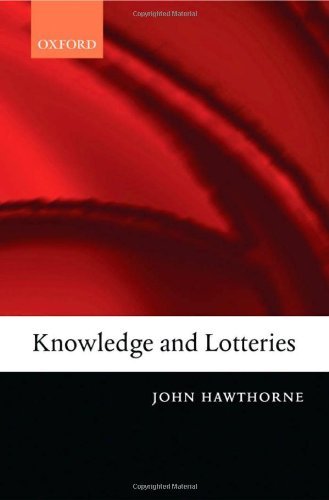
Knowledge and Lotteries is organized around an epistemological puzzle: in many cases, we seem consistently inclined to deny that we know certain propositions, while crediting ourselves with knowledge of propositions that imply them. In its starkest form, the puzzle is this: we do not think we know that a given lottery ticket will be a loser, yet we normally count ourselves as knowing all sorts of things which entail that its holder will not suddenly acquire a large fortune. After providing a number of specific and general characterizations of the puzzle, Hawthorne carefully examines the competing merits of candidate solutions, addressing along the way a range of central questions concerning the nature and importance of knowledge.
User’s Reviews
Reviews from Amazon users which were colected at the time this book was published on the website:
⭐This is a first rate piece of philosophy, that is interesting, instructive, and engaging. The book is rich with subtle, intriguing, and difficult arguments. Hawthorne’s writing style is clear and precise. He includes extensive footnotes and a length bibliography. He treats some many different areas in contemporary epistemology that those looking for an introduction to Contextualism, Closure, Assertion, etc. can do no wrong in reading this book. Even those who are veterans in epistemology will find, I believe, useful discussions. If anything is faulted about the book, it would be that the book is too short–the physical size is small, and the book is not even 200 pages.The book focuses on Lottery Puzzles. Lottery Puzzles originate because the following three claims all seems equally plausible: I know that I cannot afford to go to on an African safari this year, I also do not know that I will lose the lottery (for which I just bought a ticket), but if I know that I cannot afford to go on an African safari this year, then I know that I will lose the lottery. The paradox is, of course, that these three claims are mutually incompatible, but each is equally plausible. Enter Hawthorne’s book.The book has four parts. The first part introduces the puzzle. It explains the puzzle in some great detail, and examines–and ultimately rejects–one putative solution: the rejection of Epistemic Closure. The second part explains Contextualism, sketches an application of Contextualism to Lottery Puzzles, and concludes with an evaluation of Contextualism and a Contextualist style-solution to Lottery Puzzles. The third part treats Skeptical and Moderate Invariantism. Invariantism views hold that knowledge does not vary from context to context; Skeptical Invariantism holds that most knowledge ascriptions are false, Moderate Invariantism holds that most are true. Each is evaluated on its treatment of Lottery Puzzles and on its own merit. The fourth part treats Sensitive Moderate Invariantism, Hawthorne’s own preferred view.I thoroughly enjoyed this book and highly recommend it.
⭐Mr. Hawthorne is one of those philosophers who has the gift of making himself understood. This book concerns how and what it is that we can consider knowledge. This book centers around one story concerning our odd beliefs concerning the probabilities of what we typically think is possible. Generally, we believe we can win the lottery, but we do not believe we will go on a Safari. Hawthorne points out the oddity in such beliefs and disbeliefs and does it in such as way as to make it interesting.
⭐Very good and interesting.
Keywords
Free Download Knowledge and Lotteries in PDF format
Knowledge and Lotteries PDF Free Download
Download Knowledge and Lotteries PDF Free
Knowledge and Lotteries PDF Free Download
Download Knowledge and Lotteries PDF
Free Download Ebook Knowledge and Lotteries