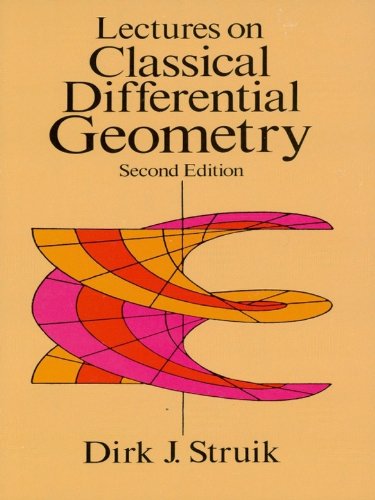
Ebook Info
- Published: 2012
- Number of pages: 256 pages
- Format: PDF
- File Size: 5.62 MB
- Authors: Dirk J. Struik
Description
Elementary, yet authoritative and scholarly, this book offers an excellent brief introduction to the classical theory of differential geometry. It is aimed at advanced undergraduate and graduate students who will find it not only highly readable but replete with illustrations carefully selected to help stimulate the student’s visual understanding of geometry. The text features an abundance of problems, most of which are simple enough for class use, and often convey an interesting geometrical fact. A selection of more difficult problems has been included to challenge the ambitious student.Written by a noted mathematician and historian of mathematics, this volume presents the fundamental conceptions of the theory of curves and surfaces and applies them to a number of examples. Dr. Struik has enhanced the treatment with copious historical, biographical, and bibliographical references that place the theory in context and encourage the student to consult original sources and discover additional important ideas there.For this second edition, Professor Struik made some corrections and added an appendix with a sketch of the application of Cartan’s method of Pfaffians to curve and surface theory. The result was to further increase the merit of this stimulating, thought-provoking text — ideal for classroom use, but also perfectly suited for self-study. In this attractive, inexpensive paperback edition, it belongs in the library of any mathematician or student of mathematics interested in differential geometry.
User’s Reviews
Reviews from Amazon users which were colected at the time this book was published on the website:
⭐This is an excellent textbook about the basics of differential geometry. Many concepts are well explained and delivered in an easy to understand way. I have read other books about the same subject aiming at the same level but quite often—in contrast to the Struik book—they failed to make clear and straightforward explanations.I only regret that the book has been cheaply printed – some images are not adjusted to this type of print, i.e., black background with whitish objects. Note, that this is not a real problem you will still understand the concepts depicted by these images.Also, note that if you buy from Dover publishing (via their web page), you can get an eBook version of this book just for around 2$ more. Unfortunately, I did not know that. Too late.
⭐I bought the book on Kindle to study its contents. The equations are in graphics which are so small as to be unreadable. This makes the book unusable to me. What happened with the format???? I want a real electronic copy or a refund.
⭐ok
⭐So far good, reading it.
⭐Love it!!
⭐If you love calculus (which I do) and you love geometry (which I do) then this slim offering of “lectures” by Struik will be much loved. As with calculus textbooks, a student has many options from which to choose. A few of the better introductory differential geometry texts include Kreyszig (old-fashioned) and Barrett O’Neill (much less old-fashioned) alongside Dirk Struik’s masterpiece. Elementary, in this instance, implies merely prerequisite in foundations of calculus. Contrasting: Kreyszig is a bit more extensive than Struik (particularly regards tensors), while O’Neill is a bit more intensive (including differential forms). Be that as it may, those textbooks may be perused sequentially: Struik, then Kreyszig, followed by O’Neill. Better yet, study them together !Highlights of Dirk Struik’s masterpiece:(1) Excellent problems (including solutions provided at end-of-book): A quick glance at Tensor notation, a two-dimensional problem (page 114). Hints for others: ” integrate the differential equation for the tractrix using the substitution r=b sin (theta)” (problem #1, page 160). The preceding being comparatively simple examples, there are more difficult problems–” prove Euler’s theorem for convex polygons by applying the Gauss-Bonnet Theorem.”Dirk Struik provides an appropriate reference as aide for the solution (page 160):”Blaschke, Differentialgeometrie I, page 166.”(2) That accentuates another fine attribute: Struik’s historical references and brief notes, which provide for more background or bibliographic reference. An example: Darboux and Cartan, they are referenced in Problem #17 (page 22) which ties the Frenet Formulas to “moving frames.” (pages 18-20). Beautiful ! The index is helpful in this regard: not only is this a ‘subject’ index, it is a ‘name’ index. And, from that Index many more historical references follow. Happily, many of these obscure publications can now be found, and downloaded pdf, from the web: for instance, Vallee Poussin’s Cours de analyse infintesimele.(Hardy writes “I have found Poussin’s Cours d’Analyse the best guide.”).(3) Now, we get excellent problem sets (from relatively simple to advanced) alongside excellent bibliographic references (especially when providing for non-English language publications). How about textual content ?Assuming background in Calculus (Franklin’s 1941 calculus text is referenced) we proceed from the usual triad:points, curves, surfaces. Surfaces will occupy the majority of the text (after page 50). Along the way utilize: linear dependence, rank-of-matrix, scalar and vector products (one identity I have not seen before: #12-14, page 47), connections to differential equations (an example: Riccati, pages 36, 37, 39, 43, 126, 191). Ince and Goursat make collateral reading with respect to differential equations. Rolle’s Theorem oft-recalled (for instance, pages 10 & 66).(4) Besides copious examples provided, highlights of the exposition include: Lie and Darboux method of solution (page 36) as preliminary to imaginary-curves (page 44), the equations of Gauss-Weingarten (pages 106-110) as preliminary to Gauss-Codazzi (pages 110-113); here, the earlier problems of section 2-8 (page 91) are utilized for solution of problem #4 (page 113). In other words, the text ties together that which came before, to that which comes later. Another instance of that strategy, the use of “imaginaries” (section 1-12, later, section 5-6, from curves to surfaces).(5) Local and Global, differential and integral, the distinctions are emphasized. But, no more so than in the excellent section 4-8: The Gauss-Bonnet Theorem (pages 153-159). That distinction (local/global) is also highlighted elsewhere (for instance, page 47, Ovals, and page 63, area of region).(6) Dirk Struik intends this textbook for “a one-term course” with “care…given to material…to keep alive the memory of those to whom we owe the main structure of elementary differential geometry.” (preface).In that respect Struik has succeeded admirably. Struik, alongside Kreyszig and O’Neill, makes nice companion to McCleary’s Geometry From A Differentiable Viewpoint. The aforementioned texts are at reasonably elementary vantage (also, do not ignore Goursat’s Volume One).Dirk Struik is highly recommended as an introduction to, and a stepping- stone for, more advanced differential geometry (Spivak is more advanced).
⭐While it is quite true Dirk Struik’s work is on classical differential geometry, the older methods and treatment do not necesarily imply obsolescence or mediocrity as some readers or reviewers suggest in their evaluations. Classical Analysis is still an important branch of Mathematical Analysis. So classical approaches and topics should not be dismissed as a waste of time, useless, outdated or even invalid. Remember Andrew Wiles’ recent attack on Fermat’s Last Theorem and his ultimate proof of its validity, an event that made headline news. That is a quintessential classical problem in mathematics (i.e., in number theory), only recently resolved. So remember: CLASSICAL Differential Geometry is part of the title.First of all, this book is very readable, being that it requires no more than 2 years of calculus (with analytic geometry and vector analysis) and linear algebra as prerequisites. Exposure to elementary ordinary and partial differential equations and calculus of variations are highly desirable, but not absolutely necessary. There are numerous carefully drawn diagrams of geometric figures incorporated throughout the book for illustration and, of course, better understanding. Topological methods are not used in the book, and the concept of manifolds not mentioned, much less treated. So this is an older work that bridges the very foundational and applied aspects of differential geometry with vector analysis, a field and body of knowledge widely used nowadays in the sciences and engineering and exploited in applications such as geodesy. For those insisting on modern approaches and want to omit studying foundations and historical development, please read up on other books such as O’Neill and Spivak. These are essential to approaching the subject of differential geometry from a more modern and global perspective with heavy emphasis on rigor in proofs and derivations, mathematically speaking. (Also, there are tons of other newer works, i.e., on “modern differential geometry”, I am unfamiliar with. They are probably available for browsing in college bookstores.)The author begins by leading the reader from analytic geometry in 3-dimensions into theory of surfaces, done the old fashion or classical way, i.e., utilizing vector calculus and not much more. Along the way, he takes the reader through subjects such as Euler’s theorem, Dupin’s indicatrix and various methods for surfaces. Then he continues with developing important fundamental equations underlying surfaces, e.g., Gauss-Weingarten equations, looks at Gauss and Codazzi equations, and proceeds to geodesics and variational methods. He includes a somewhat detailed treatment of the Gauss-Bonnet theorem as he progresses. He ends up with introducing concepts in conformal mapping, which plays an important role in differential geometry, minimal surfaces and various applications, one of which is geodesic mapping useful in geodesy, surveys and map-making. He does all of it with clarity and focus, including problems or “exercises” as he calls it, in under 240 pages – brevity that is rare in many mathematical books and works these days.For those with a mind for or bent on applications, e.g., applied physics (geophysics), applied mathematics, astronomy, geodesy and aerospace engineering, this book would be an excellent introduction to differential geometry and the classical theories of surfaces – being that one need not worry about abstract analysis and topological aspects of mathematics. Perhaps the title should be “Topics in Classical Differential Geometry” or “Introduction to the Theory of Surfaces in Classical Differential Geometry”. But one must keep in mind that Dirk Struik is an old MIT hand and contemporary of Norbert Wiener, also at MIT, and Richard Courant (and many great German-educated mathematicians) who lived and worked in the early to mid-20th century, a long time ago and before computers became commonplace, an era in which total abstraction in mathematics and physics was not quite widely emphasized, but clear concrete thinking was important. A good friend of mine and co-worker who studied at the University of California, Berkeley, told me he had great respect for the classical geometers such as Struik and Eisenhart, understanding that they built ideas from a scratch and wrote in such a way that readers can discern the physical origins of geometry, in particular of differential geometry, a subject that supposedly started with Gauss during the early or mid-19th century when he performed survey work for his government in Germany. (The term “torsion” introduced and sed by Struik in the first few chapters of the book comes from classical mechanics, and is commonly employed in mechanical structures/structural engineering nowadays.)I for one am an aerospace engineer. There were one or more occasions where I consulted the book for formulas and expressions of curved surfaces and spheroids in my work of flight navigation (flying over the ellipsoidal Earth, as one example). I am sure that are other areas, e.g., space engineering and relativity, where classical methods of differential geometry embodied in Struik’s book can come in handy.The only problem I have with the book is that the “exercises” do not come with solutions, but I do not think that is a major drawback unless one uses it as a textbook for a course that requires assignments and drill exercises.Judge for yourself by borrowing this book to read, i.e., if you are interested, can tell whether you like or dislike it on the first pass, and for what reasons one way or another. Find out for yourself.
⭐Excellent book. Private study.
⭐One of the most accessible and most resourceful literature in the field of differential geometry that remains unparalleled since written.
⭐Si tratta di un testo molto interessante. Consigliato sia per gli esperti che per i principianti.Very good literature for the beginners in the field of Geodesy, it helps a lot to understand the theory of the earth geometry.it’s old edition so of course there are many other choices these daysExcellent. Thank you.
Keywords
Free Download Lectures on Classical Differential Geometry: Second Edition (Dover Books on Mathematics) in PDF format
Lectures on Classical Differential Geometry: Second Edition (Dover Books on Mathematics) PDF Free Download
Download Lectures on Classical Differential Geometry: Second Edition (Dover Books on Mathematics) 2012 PDF Free
Lectures on Classical Differential Geometry: Second Edition (Dover Books on Mathematics) 2012 PDF Free Download
Download Lectures on Classical Differential Geometry: Second Edition (Dover Books on Mathematics) PDF
Free Download Ebook Lectures on Classical Differential Geometry: Second Edition (Dover Books on Mathematics)