

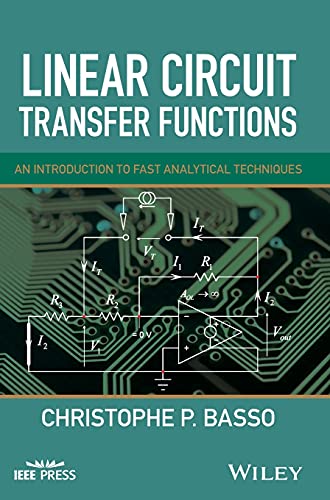
Ebook Info
- Published: 2016
- Number of pages: 464 pages
- Format: PDF
- File Size: 42.59 MB
- Authors: Christophe P. Basso
Description
Linear Circuit Transfer Functions: An introduction to Fast Analytical Techniques teaches readers how to determine transfer functions of linear passive and active circuits by applying Fast Analytical Circuits Techniques. Building on their existing knowledge of classical loop/nodal analysis, the book improves and expands their skills to unveil transfer functions in a swift and efficient manner.Starting with simple examples, the author explains step-by-step how expressing circuits time constants in different configurations leads to writing transfer functions in a compact and insightful way. By learning how to organize numerators and denominators in the fastest possible way, readers will speed-up analysis and predict the frequency response of simple to complex circuits. In some cases, they will be able to derive the final expression by inspection, without writing a line of algebra.Key features:Emphasizes analysis through employing time constant-based methods discussed in other text books but not widely used or explained.Develops current techniques on transfer functions, to fast analytical techniques leading to low-entropy transfer functions immediately exploitable for analysis purposes.Covers calculation techniques pertinent to different fields, electrical, electronics, signal processing etc.Describes how a technique is applied and demonstrates this through real design examples.All Mathcad® files used in examples and problems are freely available for download.An ideal reference for electronics or electrical engineering professionals as well as BSEE and MSEE students, this book will help teach them how to: become skilled in the art of determining transfer function by using less algebra and obtaining results in a more effectual way; gain insight into a circuit’s operation by understanding how time constants rule dynamic responses; apply Fast Analytical Techniques to simple and complicated circuits, passive or active and be more efficient at solving problems.
User’s Reviews
Editorial Reviews: Review Of the skills needed to be an analog circuit engineer, one of them is the ability to construct from a circuit diagram a representation of the behavior of the circuit. For linear circuits, the well-established general scheme has been to express behavior in the complex frequency or s-domain. The cause-effect, or input-output behavior of a circuit is its transfer function, and when expressed as a function of s, essentially all that circuit engineers are interested in can be found from it (including the time-domain response) – hence the importance of transfer functions expressed in the s-domain. Electronics engineers begin to acquire this skill in the undergraduate engineering course on passive circuits, and it becomes more complicated in the active-circuits course. In circuits with n independent inductances and capacitances, basic s-domain circuit analysis (which, by the way, requires little more than pre-university algebra, so that technicians having only introductory calculus can do it) results in nth-degree transfer function polynomials. When the polynomials are factored into real and complex pairs, the poles and zeros of the circuit are determined, and they determine the dynamic circuit behavior. Yet factoring a polynomial higher that a quadratic (that is, having s2 as the largest power in the polynomial) is difficult enough to drive most engineers to computer circuit simulation instead. So why this book? Circuits can often be compartmentalized into stages with only one or two reactances in each stage. These circuits can be formidable to analyze for engineers unaccustomed to using much math, yet Basso’s book presents higher-level circuit theorems or methods that reduce their apparent complexity. Chapter one starts easy, explaining basic concepts such as a port, the four possible transfer functions (input-output combinations of voltage and current), voltage dividers, Thevenin’s and Norton’s theorems, and how by shorting and opening circuits at the reactances, time constants can be found. These concepts form the “building blocks” for finding the three parameters of greatest interest: the transfer functions and input and output impedances. Chapter 2 shows, using simple examples, how the structure of circuits relates to the coefficients in the transfer function polynomials. It begins what is continued in Chapter 3 that was a forte of Robert David Middlebrook of Cal Tech, that of simplified methods for analyzing circuits. Middlebrook developed the Extra Element Theorem (EET), a refinement of previous methods that include those of Blackman, Mulligan, Cochrun and Grabel, and Paul E. Gray and Campbell Searle at MIT. (I published a ten-part article on EDN starting January 2013 called “Design-Oriented Circuit Dynamics” that gives more of the history and detailed development of these methods.) Chapter 3 includes, along with the EET, the important and basic superposition theorem. The EET is explained step-by-step by Basso and should eventually make its way into undergraduate circuits courses. This book is suitable as a textbook for an advanced active-circuits course; it has an extensive set of problems at the end of each chapter, with a chapter summary and references. The EET is a clever way of finding the effect on a circuit with an existing transfer function of adding an additional circuit element, usually a reactance. It is a way of starting with a simplified circuit, such as a transistor amplifier stage with an infinitely fast transistor (no Ce or Cc), and incrementally developing its transfer function by adding one capacitance for each invocation of the EET. Beware however, that these successive increments of transfer function development can become as algebraically-intensive as straightforward circuit analysis using the node-voltage and loop-current methods. Yet the EET is an improvement because it offers greater insight into how circuit elements affect the overall circuit behavior. In chapter 3, Basso does not leave the reader wondering how to apply the methods he is explaining because he gives detailed, step-by-step examples to illustrate them. Chapters 4 and 5 continue this trend with transfer functions which have second-degree (quadratic) polynomials. The EET procedure is the same only the examples become more complicated. Finally, in chapter 5, the EET is expanded to circuits with n independent reactances, and the nEET, a further development of the EET (mainly by Ali Hajimiri) and aided by the Cochrun-Grabel method (which I also cover in Transistor Amplifiers, at Innovatia, but to a far lesser extent than in Basso’s book). Besides Middlebrook, who is known for his emphasis on conceptual simplification and clarification of circuit analysis, Basso also credits Vatché Vorpérian who also has a book on methods of simplified circuit analysis. Basso’s book continues the tradition of finding ways of simplifying both an understanding of and analytical procedures for circuits. The book includes a glossary of key expressions and an index. Planet Analog (http://www.planetanalog.com) Article by Dennis Feucht, Electronics Engineer, 6/21/2016 From the Inside Flap Linear Circuit Transfer Functions: An introduction to Fast Analytical Techniques teaches readers how to determine transfer functions of linear passive and active circuits by applying Fast Analytical Circuits Techniques. Building on their existing knowledge of classical loop/nodal analysis, the book improves and expands their skills to unveil transfer functions in a swift and efficient manner.Starting with simple examples, the author explains step-by-step how expressing circuits time constants in different configurations leads to writing transfer functions in a compact and insightful way. By learning how to organize numerators and denominators in the fastest possible way, readers will speed-up analysis and predict the frequency response of simple to complex circuits. In some cases, they will be able to derive the final expression by inspection, without writing a line of algebra.Key features:* Emphasizes analysis through employing time constant-based methods discussed in other text books but not widely used or explained.* Develops current techniques on transfer functions, to fast analytical techniques leading to low-entropy transfer functions immediately exploitable for analysis purposes.* Covers calculation techniques pertinent to different fields, electrical, electronics, signal processing etc. * Describes how a technique is applied and demonstrates this through real design examples. * All Mathcad® files used in examples and problems are freely available for download. An ideal reference for electronics or electrical engineering professionals as well as BSEE and MSEE students, this book will help teach them how to: become skilled in the art of determining transfer function by using less algebra and obtaining results in a more effectual way; gain insight into a circuit’s operation by understanding how time constants rule dynamic responses; apply Fast Analytical Techniques to simple and complicated circuits, passive or active and be more efficient at solving problems. From the Back Cover Linear Circuit Transfer Functions: An introduction to Fast Analytical Techniques teaches readers how to determine transfer functions of linear passive and active circuits by applying Fast Analytical Circuits Techniques. Building on their existing knowledge of classical loop/nodal analysis, the book improves and expands their skills to unveil transfer functions in a swift and efficient manner.Starting with simple examples, the author explains step-by-step how expressing circuits time constants in different configurations leads to writing transfer functions in a compact and insightful way. By learning how to organize numerators and denominators in the fastest possible way, readers will speed-up analysis and predict the frequency response of simple to complex circuits. In some cases, they will be able to derive the final expression by inspection, without writing a line of algebra.Key features:* Emphasizes analysis through employing time constant-based methods discussed in other text books but not widely used or explained.* Develops current techniques on transfer functions, to fast analytical techniques leading to low-entropy transfer functions immediately exploitable for analysis purposes.* Covers calculation techniques pertinent to different fields, electrical, electronics, signal processing etc. * Describes how a technique is applied and demonstrates this through real design examples. * All Mathcad® files used in examples and problems are freely available for download. An ideal reference for electronics or electrical engineering professionals as well as BSEE and MSEE students, this book will help teach them how to: become skilled in the art of determining transfer function by using less algebra and obtaining results in a more effectual way; gain insight into a circuit’s operation by understanding how time constants rule dynamic responses; apply Fast Analytical Techniques to simple and complicated circuits, passive or active and be more efficient at solving problems. About the Author Christophe Basso, Engineering Director, ON Semiconductor, Toulouse, FranceChristophe Basso holds a BSEE equivalent from Montpellier University (France) and an MSEE from the Institut National Polytechnique of Toulouse. He has over 20 years of power supply industry experience. His recent research interests focus on developing new offline PWM controller specifications. On top of his 3 published books on Switch mode power supplies, Basso also has 30 patents on power conversion and has authored numerous conference papers and trade magazines. Read more
Reviews from Amazon users which were colected at the time this book was published on the website:
⭐I have recently completed “Linear Circuit Transfer Functions” book by Christophe Basso.I came across it after watching Dr. Middlebrook’s Technical Therapy for Analog Circuit Designers course.In a simple and systematic manner, the book presents a way to deal with deriving low entropy expressions for various transfer functions for up to n-th order circuits. It utilizes both GTF and EET, 2-EET and n-EET, which combined makes an excellent toolset for an engineer.I really loved the fact that the book contains reasonable amount of exercise problems (10 per chapter) and they are fully explained which lets you double-check yourself.Great book.
⭐If you want to learn how to apply FAST to quickly obtain transfer functions in their low entropy form – this is the book for you. It does the job well.
⭐This is a interesting book on how to calculate transfer functions for networks in a more systematic way without all the tedious algebra. There are a lot of examples with all the answers and tips how to double check your results using SPICE and Mathcad. I found the book interesting and useful for to my professional as an electrical engineer.I recommend this book to practicing electrical engineers who work on analog circuits analyzing network transfer functions.
⭐I have just finished reading “Linear Circuit Transfer Functions” by Christophe Basso. Years ago I also took Dr.Middlebrook’s Design-Oriented Analysis course. Being an analog design engineer myself but not power electronics designer, I find Mr. Basso’s book very useful in dealing with everyday’s problems and circuits encountered in analog design. It gives the tools of quickly finding the transfer functions in s-domain, as well as techniques of simulating and verifying the results. Christophe Basso in his book provides good review of analysis techniques initially proposed by Dr.Middlebrook as well as additions to them by Caltech’s prof.Ali Hajimiri. There are many problems both in the chapters and end of chapters exercises which are fully explained. Explanations throughout the book are clear and in many cases fun to read. Those, familiar with the topic of analyzing circuits in s-domain know that solving transfer functions of higher order circuits can be very tedious and labor-intensive job. The techniques described in the book render that to finding driving point resistances and DC transfer functions under several conditions for the capacitances or/and inductances in the circuit. Or to finding two types of driving point resistances if Middlebrook’s method is applied.
⭐When I was in university, I hated finding transfer function of 2nd or 3rd order systems because the amount of terms that you needed to deal with could span a few lines. Assuming you didn’t make any algebra mistakes, you were then left with an expression that told explained the system ONLY if its in a standard form, which is more algebra and some of it is not always obvious.This book changes that. It really changes that. The book builds up to the main concept covered in Chapter 3, which is the Extra Element Theorem. It uses some clever tricks that put the expression into a simple state where you can visually identify key elements, such as gain, zeros and poles.Chapter 4 is how to apply the Extra Element Theorem twice (ie. handle 2nd order systems) and Chapter 5 is how to apply it for nth order systems.The problems are worked out thoroughly, and if something was not clear, I emailed the author and he responded with additional information.
Keywords
Free Download Linear Circuit Transfer Functions: An Introduction to Fast Analytical Techniques (IEEE Press) 1st Edition in PDF format
Linear Circuit Transfer Functions: An Introduction to Fast Analytical Techniques (IEEE Press) 1st Edition PDF Free Download
Download Linear Circuit Transfer Functions: An Introduction to Fast Analytical Techniques (IEEE Press) 1st Edition 2016 PDF Free
Linear Circuit Transfer Functions: An Introduction to Fast Analytical Techniques (IEEE Press) 1st Edition 2016 PDF Free Download
Download Linear Circuit Transfer Functions: An Introduction to Fast Analytical Techniques (IEEE Press) 1st Edition PDF
Free Download Ebook Linear Circuit Transfer Functions: An Introduction to Fast Analytical Techniques (IEEE Press) 1st Edition