Ebook Info
- Published: 2007
- Number of pages: 382 pages
- Format: PDF
- File Size: 0.40 MB
- Authors: Bertrand Russell
Description
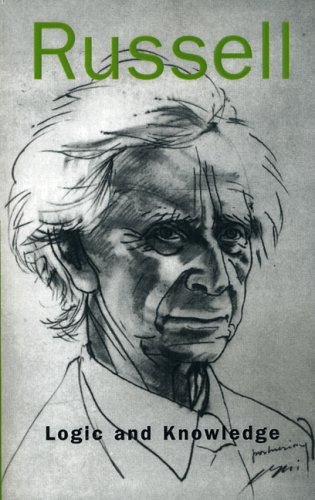
A collection of Bertrand Russell’s most important essays in the fields of logic and the theory of knowledge, which provide an understanding of the development of philosophy in England during the 20th century and of the influence upon one another of Moore, Russell and Wittgenstein.
User’s Reviews
Editorial Reviews: About the Author Bertrand Russell Robert Charles Marsh is also at Trinity College.
Reviews from Amazon users which were colected at the time this book was published on the website:
⭐This book, consisting of some of Bertrand Russell’s technical essays on philosophy, epistemology, etc., was a rather engaging read for me. However, much in the book requires considerable knowledge of philosophy in order to be able to fundamentally understand the issues Russell addressed. One particular essay, second from last in the book, is titled “On Order in Time”, and it is basically couched in symbolic logic, which is a level of logic beyond my level of technical expertise. Therefore, I chose to entirely skip over that essay. Also, the first essay of the book, “The Logic of Relations” was mainly versed in symbolic logic, and I skipped over most of it. Otherwise, I read every essay in the book, and I found most of them to be of considerable interest to me.One of my “gripes” against Russell’s philosophizing is his repudiation of consciousnessand mind as properties of reality that MUST be reckoned with, if one is going to have aremotely comprehensive worldview. I have just bought Russell’s The Analysis of Mind, but haven’t yet begun reading it. However, given Russell’s predilection to dismiss mind as (somehow) synonymous with physical brain activity, I’m not anticipating much in his analysis of mind that I’ll find enlightening.Another area of Russell’s philosophy that I find to be gravely problematic is his effort to find meaning in language within the structure or form of the language, whereas my understanding of meaning in language is such that meaning is never within the form or structure of the language, but is precisely in the ascription of meaning given to the structured symbolism of the language by a conscious entity. Without consciousness, meaning is an absurd oxymoron. That is, at any rate, the only reasonable way I can see to define meaning. In regard to these issues, the second essay in the book is highly relevant to these questions. It’s titled “On Denoting”. Russell argued that denotation is strictly in the form of a statement, whereas I regard denotation as residing in the meaning ascribed to the form of the statement by a conscious mind. Mere logical structure, without understanding (having conscious awareness of) the meaning of the structure, denotes nothing. Those are some of the issues on which I take great exception to Russell’s philosophy. Overall, though, Russell was the most engaging writer of philosophy I know of. Furthermore, he was quite clear-headed in a lot of critical issues in philosophy and epistemology. However, his strict avoidance of ascribing to any aspect of reality mental or spiritual powers was, I believe, a fatal error – one which is, however, highly praised and affirmed by most modern analytical philosophers.All in all, regarding the book currently being reviewed here, some of the essays included in this volume are rather critical to read, if one is going to get a fairly brief synopsis of much of Russell’s outlook on philosophy. Although much of the book is difficult reading, the patient fan of Russell’s approach to philosophy should be able to learn much that is of interest in the 10 essays included in this work. I would recommend the book as highly desirable for any student or fan of Russell’s philosophizing.
⭐This is an excellent selection by Marsh, in 1950, of Russell’s essays on language and knowledge. Excludingthe essays on mathematical logic, there are seven essays on logic in extremely clear English. These includeThe Logic of Relations (1901), On Denoting (1905), Relations of Universals and Particulars (1911), On theNature of Acquaintance (1914), On Propositions (1919), and Logical Atomism (1924). All of these are fiftypages or less.For me, the major content of the book is in The Philosophy of Logical Atomism (1918). This is a series ofeight lectures, in slightly over one hundred pages, given by Russell in Hyde Park. The exposition was intended for the layman, and Russell took questions from the audience on the previous lecture before beginning the next one.While one may not agree with all of Russell’s conclusions, the clarity of his writing is unparalleled.For one who accepts that the world consists of MANY things, and is not simply the myriad manifestations of ONE thing, the consequences are clearly explored. The conclusions are subjected to highly critical analysis by the writer and, occasionally, by the audience.
⭐With so many collections focusing on Russell’s views about morality, religion, politics, etc., it is easy to forget what Russell has always been first and foremost: a logician and a philosopher of language and knowledge. This book makes a wonderful job at fixing the issue. Here we are presented with the defining papers (such as On Denoting) that truly put Russell at the center of philosophical discussions within the analytic community, to this day.
Keywords
Free Download Logic and Knowledge: Essays 1901-1950 in PDF format
Logic and Knowledge: Essays 1901-1950 PDF Free Download
Download Logic and Knowledge: Essays 1901-1950 2007 PDF Free
Logic and Knowledge: Essays 1901-1950 2007 PDF Free Download
Download Logic and Knowledge: Essays 1901-1950 PDF
Free Download Ebook Logic and Knowledge: Essays 1901-1950