

Ebook Info
- Published: 2009
- Number of pages: 352 pages
- Format: PDF
- File Size: 70.60 MB
- Authors: Apostolos Doxiadis
Description
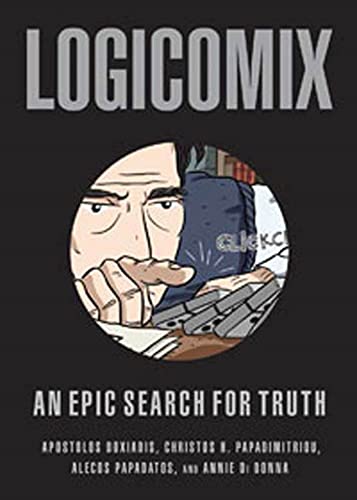
This exceptional graphic novel recounts the spiritual odyssey of philosopher Bertrand Russell. In his agonized search for absolute truth, Russell crosses paths with legendary thinkers like Gottlob Frege, David Hilbert, and Kurt Gödel, and finds a passionate student in the great Ludwig Wittgenstein. But his most ambitious goal-to establish unshakable logical foundations of mathematics-continues to loom before him. Through love and hate, peace and war, Russell persists in the dogged mission that threatens to claim both his career and his personal happiness, finally driving him to the brink of insanity. This story is at the same time a historical novel and an accessible explication of some of the biggest ideas of mathematics and modern philosophy. With rich characterizations and expressive, atmospheric artwork, the book spins the pursuit of these ideas into a highly satisfying tale. Probing and ingeniously layered, the book throws light on Russell’s inner struggles while setting them in the context of the timeless questions he spent his life trying to answer. At its heart, Logicomix is a story about the conflict between an ideal rationality and the unchanging, flawed fabric of reality.
User’s Reviews
Editorial Reviews: Amazon.com Review Book DescriptionThis exceptional graphic novel recounts the spiritual odyssey of philosopher Bertrand Russell. In his agonized search for absolute truth, Russell crosses paths with legendary thinkers like Gottlob Frege, David Hilbert, and Kurt Gödel, and finds a passionate student in the great Ludwig Wittgenstein. But his most ambitious goal–to establish unshakable logical foundations of mathematics–continues to loom before him. Through love and hate, peace and war, Russell persists in the dogged mission that threatens to claim both his career and his personal happiness, finally driving him to the brink of insanity. Take a Look InsideThe creators of Logicomix introduce us to Bertrand Russell in 1939 during one of his public lectures. Russell explores the question, “What is logic?” by telling the story of “one of [logic’s] most ardent fans”–himself. The panels that follow (click each image to see the full page) reimagine the life of a brilliant young man with a passion for mathematics. From Publishers Weekly Starred Review. An ambitious full-color exploration of the life and ideas of philosopher and mathematician Bertrand Russell, the book meticulously interconnects Russell’s life, the timelessness of his ideas and the process of creating the book. While a comic about the quest for the foundations of mathematics may seem arduous, it is engrossing on many levels; the story moves, despite heavy philosophical and technical information, as the images, dialogue and narration play off each other. Russell’s story is framed within a speech he gave on the brink of America’s entry into WWII, in which he expounds his life and philosophical journey. Russell’s story is also framed by the creators working in Greece, as they discuss and mold his life into a narrative structure. One of the most prominent themes is the conflict and symbiosis between madness and logic. The fear of madness haunts Russell because of childhood trauma, as he neurotically pushes himself toward what he conceives of as its opposite, a system for certainty. Inventive, with both subtle and overt narrative techniques, the comic form organizes the complex ideas into a simpler system, combining to form a smart and engaging journey through the ambiguity of truth. (Sept.) Copyright © Reed Business Information, a division of Reed Elsevier Inc. All rights reserved. Review “This is an extraordinary graphic novel, wildly ambitious in daring to put into words and drawings the life and thought of one of the great philosophers of the last century, Bertrand Russell…A rare intellectual and artistic achievement, which will, I am sure, lead its readers to explore realms of knowledge they thought were forbidden to them.” ―Howard Zinn“This magnificent book is about ideas, passions, madness, and the fierce struggle between well-defined principle and the larger good.” ―Barry Mazur, Gerhard Gade University Professor at Harvard University, and author of Imagining Numbers (Particularly the Square Root of Minus Fifteen)“Logicomix is witty, engaging, stylish, visually stunning, and full of surprising sound effects, a masterpiece in a genre for which there is as yet no name.” ―Michael Harris, professor of mathematics at Université Paris 7 and member of the Institut Universitaire de France About the Author Admitted to Columbia University at age 15, Apostolos Doxiadis has studied mathematics at both the undergraduate and graduate level. An internationally recognized expert on the subjects of mathematics and narrative, he has also worked in film and theater, and is the author of the international bestseller Uncle Petros and Goldbach’s Conjecture.His personal website is www.apostolosdoxiadis.com. Christos Papadimitriou is a professor of Computer Science at Cal-Berkeley. He is the author of several books on computer science, as well as the novel Turing: A Novel about Computation. From The Washington Post From The Washington Post’s Book World/washingtonpost.com Reviewed by Dan Kois Though it may serve as a primer on early 20th-century philosophy and mathematics, “Logicomix” is no textbook — it’s a comic book. “The form is perfect for stories of heroes in search of great goals!” exclaims one co-author to the other. In this case, the superhero is the philosopher Bertrand Russell, and the adventure is his quest for a rational foundation to mathematics and logic, from his childhood in 1870s England to the eve of World War II. Along the way, we also catch glimpses of philosophical luminaries like Gödel and Wittgenstein — and of the madness to which so many of the discipline’s great thinkers succumbed, and which Russell himself feared all his life. A clever framing story, set in Athens and starring the authors themselves, clarifies the more complicated ideas for the lay reader, as the writers helpfully explain the philosophical issues to their bewildered artists. Stepping back into the book at the end, the authors find a poetic counterpoint for Russell’s journey in Aeschylus’ “Oresteia.” The story — and Russell’s philosophical evolution — comes to a head days after the Nazi invasion of Poland. Now in the United States, Russell, who was jailed for his pacifist activism during World War I, lectures to a nervous American audience about the impotence of logic in the face of tyranny. “Logicomix” is an engaging, energetic work that makes big ideas accessible without dumbing them down. bookworld@washpost.com Copyright 2009, The Washington Post. All Rights Reserved. Read more
Reviews from Amazon users which were colected at the time this book was published on the website:
⭐Stand back, Spiderman. Back off, Batman. Comic books have a new hero with unexpected powers, and he isn’t even imaginary. He’s Bertrand Arthur William, the Third Earl Russell. To most Americans, Bertrand Russell is notorious for being an outspoken atheist long before the current crop of Dawkins, Hitchens, Harris, and others. He was also a pacifist, and during the last decades of his long life he campaigned for nuclear disarmament. He makes his debut in comics, however, not for these causes, but for his work in the early twentieth century trying to make sure that mathematics was founded on irrefutable logic. If you think that seems an inauspicious or inappropriate topic for a comic book, you are simply wrong; _Logicomix: An Epic Search for Truth_ (Bloomsbury) is consistently surprising, informative, and delightful. Authors Apostolos Doxiadis, a novelist who has worked mathematical themes into fiction, and Christos H. Papadimitriou, a computer science professor, working with Alecos Papadatos for art and Annie di Donna for color, have made a good-looking 350-page introduction to Russell’s mathematical life as well as to basic mathematical ideas that he resolved, or failed to resolve. Don’t worry if you didn’t like math; these are realms of mathematics far above what you got in high school, and while none of us is going to understand them at Russell’s level of understanding, _Logicomix_ provides clear introductions to them and shows why Russell and others were so passionately interested in nailing down all the truth they could.The frame story is set in 1939, when Russell is in America, and England has just declared war on Germany. He gives a lecture which is a series of flashbacks on how he and others struggled with this very basic question. The lecture panels are in subdued colors, the flashbacks are somewhat brighter, and most colorful of all are the pages devoted to the authors and artists of the book itself, pondering how to show the ideas and arguing over themes and presentations. When Russell got to Cambridge, he found that mathematics was undermined by circular reasoning and intuition. Unshakable logical foundations were needed, and he determined that he himself would construct them and would build the mathematical edifice upon them. For a decade he labored with Alfred North Whitehead on _Principia Mathematica_, an attempt to weed out paradoxes. This was a work going back to fundamentals so deep that it takes the first 362 of its thousands of pages to get to the useful demonstration that 1 + 1 = 2. One of the people who read the book (to Russell’s knowledge, the only person to do so) was Kurt Gödel, who was to show that Russell and Whitehead’s goal was illusory; he mathematically proved that no logical system could capture all of mathematics, and that there would always be mathematical questions that could not be answered and mathematical truths that could not be proved. Russell’s great quest turned out to be a failure, but it turned out to be a hugely productive one, as from the work of Gödel, Turing, and others profiled here, we do have a groundwork for mathematics and logic, only it is not at all the bedrock that Russell had set out to find. The search for truth here is not just Russell’s but that of mathematicians through the centuries._Logicomix_ is good-looking, with glossy papers and a rich color scheme. The often witty pictures take every advantage of comic book art, with exaggerated perspective, elevated views, big-letter sound effects, and nightmares depicted as reality. Russell’s story is a great one, and piquant when including details of his erratic and decidedly illogical love life. The book winds up with the authors and their crew going to a performance of Aeschylus’s Oresteia that nicely sums up big themes of war, justice, madness, and wisdom that are within Russell’s tale. I sincerely hope if you know anyone interested in comics or anyone with the slightest interest in mathematics or philosophy, or if you know a young person whose thoughts might turn that way, that you will ensure a copy gets into that person’s hands.
⭐Most impressive book
⭐This graphic novel attempts to tell the history of the quest for the foundations of mathematical logic, as epitomized through the life and career of Bertrand Russell. It explores the vigorous (and ultimately futile) efforts of philosophers to find a firm basis for irrevocable truth, as built on the foundations of mathematics. A subsidiary theme is the peculiar relationship between such efforts and “madness” (as we used to call it), as indicated by the several individuals engaged in these efforts who teetered on the borders of sanity. Russell is central to the story — indeed the novel purports to portray his boyhood, adolescence, early career, first marriage, and publication (with Alfred North Whitehead) of “Principia Mathematica.” His intellectual encounters with Ludwig Wittgenstein are portrayed, as are fictionalized (i.e., entirely made- up) encounters with Georg Cantor, Gottlob Frege, David Hilbert, and Kurt Gödel. An extended appendix provides introductions to the historical figures alluded to in the graphics, along with summaries of such terms and topics as “algorithm,” “predicate calculus,” “Vienna Circle,” and “Russell’s paradox.””Logicomix” is an ambitious and inventive work that has brought arcane aspects of mathematical logic and intellectual history to a new audience. The work brims with ideas, passion, and drama. I found the graphics skillfully done, the only flaw being the somewhat wooden and repetitious portrayals of people. Imaginative portrayals abound, all in full color, and sometimes with a single scene filling an entire page.Despite this book’s ambitions, as a one-time philosophy major and a long- term admirer of Bertrand Russell, I cannot wholeheartedly share the great enthusiasm of many other readers. (Of more than 140 reviews at Amazon, only three rate it below 3 stars). First, I found the book’s dealings with philosophy to be superficial – less than one would get in a freshman- level college lecture. Second, the authors repeatedly interject themselves into the story with cartoon panels full of argumentative dialogue and (oftimes) peripheral trivia. Personally, I found the device distracting and annoying.Third, contrary to many reviewers, this is not a biography of Russell. Its portrayal of Russell’s life is full of outright inventions that bear no relationship to reality. In contrast to the account in “Logicomix”, the newly orphaned baby Bertrand Russell was not deposited all alone at his grandparents’ house; he moved there along with his older brother. His grandfather was not a spry gentleman who danced in his garden, but a frail, wheelchair bound man of 83. His grandfather did not introduce the boy to his library, leading young Bertie to resolve to return and investigate the locked cabinet of forbidden books – after all, Bertie was only three when he came to live with his grandparents, and his grandfather died when he was six. It was not a tutor who introduced Russell to Euclid’s theorems, but his own brother Frank, also living at the estate. And then there’s the running theme of the strange howlings that emanate from the attic, disturbing Russell’s sleep for years — these are revealed to emanate from an insane uncle who lives therein. This is a wholesale invention that owes more to Jane Eyre than to reality. There was no uncle in the attic, nor did the young Bertrand ever hear or imagine ghostly howlings. Why the authors felt inclined to invent such stories is hard to imagine. All of the chapters abound with inventions likely to mislead the reader into thinking them factual.In the afterword to the book, the authors cheerfully admit to having invented “deviations from fact,” insisting that their work be regarded as a “graphic novel” rather than a work of history. In their defense, one could argue that the invented encounters between Russell and other historical figures (e.g. Cantor, Frege, and Gödel) reflect actual encounters of the protagonist with their written ideas. One might even stretch the point and argue that the fictional boyhood they invent for Russell represents his later memories of a lonely boyhood and his adult fears of the possibility of insanity. Personally, I wish the book authors had not felt compelled to invent a fictionalized life for the protagonist. Russell is after all one of the 20th century’s most interesting historical figures. The version of Russell’s life portrayed will undoubtedly mislead the majority of readers (one reader enthusiastically proclaims: “I now have a far greater interest and understanding in the man and his life after reading this book.”) For readers interested in the established facts of Bertrand Russell’s life, three excellent biographies and Russell’s own autobiography are available.Overall, I am strongly conflicted in judging this work. My disappointment in the historical inaccuracies necessarily costs the book two stars in my rankings. However, the book has its merits, the chief one being that it may introduce to new readers some interesting philosophical questions and the historical figures who have grappled with them.____________Personal note: Most likely, some readers who loved this book will be eager to label my review “unhelpful.” I respectfully suggest that the “helpful” / “unhelpful” responses to reviews are not intended to measure one’s level of agreement. (One can disagree with a point of view but still regard it as a helpful contribution to respectful discourse, especially when it comes to a work as thought- provoking as this one.)
⭐What made this special was simply the fact that it was (sort of) about one of the most interesting intellectual “quests” of recent centuries. That is to say, the “foundational crisis” in mathematics and the attempt to make it secure and logically rigorous. And yet, in a way, this was also what made this ultimately such a disappointment. Becasue, in truth, it isn’t really as much about this hugely fascinating theme as it might have been. The details on mathematical logic and foundations are actually quite paltry, and what explanation or description there is of the philosophical signicance of logicism, say, or of the foundational crisis in general and the attempt to resolve it, is sketchy and shallow. I do appreciate that it would be quite difficult to go into any of the issues in any depth without losing some readers. On the other hand, if you are prepared dumb things down and patronize the reader, then what exactly is the point of this? Still, one can make an excuse by appealling to the inherent difficulty of trying to put mathematical logic and philosophy into the graphical novel format (faced with the difficulty, the authors managed to avoid it completely by not making the attempt).What is less excusable, I think, is just the way this story is told and structured. It is really quite bad. The “Russian doll” idea simply doesn’t work here; in fact, it makes the narrative quite awkward and cumbersome. The authors repeatedly insering themselves in the middle of narrative as characters discssuing how best to write the story really doesn’t add anything valuable to the story itself. It does afford the authors the opportunity to cover (in cursory, box-ticking fashion) topics which apparently they could think no way of addressing within the story itself. Which feels like some kind of cheap trick. Perhaps the authors were also persuaded that writing themselves as charcters, and breaking up the story, was clever and appropriate because this was “self-referential”, and self-referenntial antinomies (Russell’s Paradox in particular) lie at the heart of the foundational crisis. If that is so, then again it feels awfully misguided. Then there is the scene from Aeschylus’ Oresteia, which bizarrely forms the final chapter of the book. It is supposed to be relevant because the main story, we are reminded again and again, is “tragic”. Any further link is tenuous at best. But no matter, it’s a great play and a fair amount of this graphic novel is set in Athens (albeit nothing to do with main story), so why not throw it in anyway? This is, well, ideosyncratic, to put it politely.Having said all that, I am still giving this three stars out of five. That is mostly just for the idea of writing a graphic novel that, if not exactly *about* the foundational crisis of mathematics, the development of modern logic, the “incompleteness” if mathematics, the philosophical significance of these issues, has at least something to do with these things. It’s a pity this isn’t as good as it might’ve been. Still, it’s not bad.
⭐This is an education in the history of a particular period of Mathematics. The Maths was beyond me, but this in no way detracted from the story, which is really more about the lives of mathematical geniuses, most prominently Russell and Whitehead who collaborated to produce Principia Mathematica. There are a number of tragic figures, the german genius David Hilbert, who rejected his mentally ill son; George Cantor who invented set theory, but died in poverty ; Henri Poincare who objected to Cantor’s work – I couldn’t grasp the Mathematical basis for the objections, but it’s good enough for me that these controversies were going on and being passionately debated in these rarefied circles; Russell himself, but a great man no doubt.I gave this to my 12 year old to read and he struggled a little, however he now has a context for the maths he is learning, which I think will enrich his experience of it.An excellent and surprising graphic novel, highly recommended even if Maths is not your thing.
⭐I’m a fan of graphic novels, but not really the superhero and spandex variety. This, to me, was a fairly novel way of telling what could have been a very dry academic text. Utilises that ‘post-modern’ feature of having sections where the writers and illustrators depict themselves discussing how bet to tell the story, which breaks things up nice.At the end of the day, I felt like I was being ‘taught’ stuff sometimes, rather than just reading and enjoying, but, I did learn things from it! Result!
⭐I read “Uncle Petros” in the original Greek and loved it. On the evidence of the dialogue in “Logicomix,” the author, an amateur mathematician, has a much better command of the Greek language than any other, and I presume that’s what’s steered him toward the comic format here.It’s mighty successful!There’s poetic license here, a lot of interpretation, a fair amount of vanity (I once went to a lecture where Doxiadis spoke and he’s a lot thinner in “Logicomix” than in real life) but the bottom line is that the book is vastly entertaining, highly instructive and paints a deep, complex portrait of Bertrand Russell, takes you though his relationships with the mathematicians and logicians he worked with, including Frege, Whitehead, Wittgenstein and Godel and as an added bonus teaches you a fair amount of logic.It’s easy to complain that it’s not complete, or that it’s not fully accurate etc. but IT’S A COMIC BOOK for crying out loud. If you want more there are libraries out there.I guess the ultimate measure of the book’s success will be if I find it in me to schlep over to Imperial and take out a couple books on logic…
⭐This is a real change of pace from the average graphic novel fare, it fits few of the standard genres of heroics and critical responses to the same I can think of and it isnt exactly typical of the magical realism or mundane/everyday extraordinary reads either.The story’s open sequence introduces the artists and writers themselves as they go to meet one of their expert content analysts and returns to these characters throughout and in concludion too. There is an afterword and great descriptive notes about all the principle and important characters or theorists mentioned throughout the text.Recommended to myself as a book about Bertrand Russell (to which it is very fair) and Wittgenstein (to which it is perhaps a little less fair) it is that and may appeal to philosophers of logic or mathematics but equally could disappoint the hardcore enthusiast since a balance is well struck so the books appeal remains, hopefully, general enough too. There is as much about the personalities of the stories protagonists as their theories, perhaps more because that’s easier to tell or present easily. Russell did appear more of a gloomy character than I’m used to thinking of him since I have read a great number of his other books and social commentary (as opposed to principa mathematica).The autobiographical form is used to discuss the innovations and development in thinking and it is situated within a lecture delivered in the context of protests at the possible entrance of the US into the war. I think its commendable that they were able to come up with all that, although it sort of petered out towards the finish I felt and then returned to the writers and artists again as they finish their day.So, I thought it was good, something a little different and for the money there’s a lot of reading here but its not what I’ve read in some of the excited reviews here, at least I did not feel so personally.
Keywords
Free Download Logicomix: An epic search for truth in PDF format
Logicomix: An epic search for truth PDF Free Download
Download Logicomix: An epic search for truth 2009 PDF Free
Logicomix: An epic search for truth 2009 PDF Free Download
Download Logicomix: An epic search for truth PDF
Free Download Ebook Logicomix: An epic search for truth