

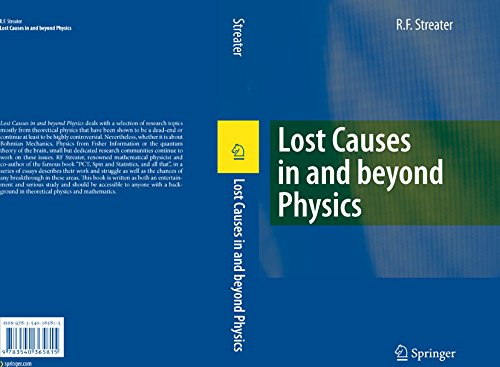
Ebook Info
- Published: 2007
- Number of pages: 166 pages
- Format: PDF
- File Size: 1.21 MB
- Authors: R.F. Streater
Description
This book deals with a selection of research topics in theoretical physics that have (almost) been proven to be a dead-end or continue at least to be highly controversial. Nevertheless, small but dedicated research communities continue to work on these issues. In a series of essays this book describes their work and struggle as well as the chances of any breakthrough in these areas. It is written as both an entertainment and serious study.
User’s Reviews
Reviews from Amazon users which were colected at the time this book was published on the website:
⭐First, I wish to thank R.F. Streater for keeping my book “Physics from Fisher Information” (PFI) in the public eye. The worst fate for any new theory is to be ignored. Streater may well be competent working within the framework of generally accepted, textbook physics. However, his book, and Sec. 5.2 in particular criticizing PFI, indicates that he is behind the times when it comes to understanding new physics. For example, PFI emphasizes the fundamental role that information plays at the foundations of physics. Streater evidently dislikes the idea, and chooses to attack it, even despite its many published successes over the past 20 years. His attack often consists of a misinterpretation of the approach, substituting for it statements that are textbook correct but irrelevent. This gives a paraphrase of the theory that (the desired end) constitutes circuitous reasoning. For example, he claims that the approach in PFI necessarily has to assume quantum mechanics in order to derive it. But Streater’s manifest ignorance of the very book he is critiquing easily negates this argument (as below). Note that space limitations permit considering just one of his arguments. I’ll gladly email to any reader a response to all of them. Also, readers who do not have a copy of PFI can find a paper [1] that succinctly covers the material.”The author tentatively identifies I with the kinetic energy, and J with the potential energy”Rebuttal. Even with the qualifier “tentatively,” this statement is wrong. First, regarding Fisher information I: Streater appears to have gotten as far into the book as pgs. 13-14, where that section explicitly expresses I as a *mean* (not instantaneous) KE as he is implying. Moreover, as clearly stated there, this was a hypothesis of the old variational approach [2] of 1989, not of PFI. In fact the approach developed in PFI — that of Extreme physical information or EPI — does not generally ‘identify’ I with the KE. (Rather, it is an upper bound (2.19) to the Fisher information.) Indeed generally identifying I with the KE is ruled out by the derivation in Chap. 4 of relativistic quantum mechanics. At Eqs. (4.12),(4.13) I is derived as the mean (not instantaneous) *difference* between the squared total energy E² and the KE.Next, regarding Fisher information J: Functional J is the source information (called ‘bound’ in this edition of PFI). To the contrary, J is not generally ‘identified with’ the potential energy in PFI. The role of J is to describe the information source for the particular problem, which varies from one to the next. For example, in a later, 2nd edition of PFI titled “Science from Fisher Information,” when deriving Newton’s 2nd law in Sec. D.2 it is the potential. Finally, the basic Fourier relation (4.4) that the derivation assumed to connect position and momentum spaces has recently been derived [3], again using EPI. [1] B.R. Frieden and B.H. Soffer, “Lagrangians of physics and the game of Fisher-information transfer,” Phys. Rev. E 52, 2274-2286 (1995) [2] B.R. Frieden, “Fisher information as the basis for the Schrodinger wave equation,” Am. J. Physics 57, 1004-1008 (1989) [3] B.R. Frieden and B.H. Soffer, “de Broglie’s wave hypothesis from Fisher information,” Physica A 388, 1315-1330 (2009)
⭐In “Lost Causes in and beyond Physics” you will find Streater’s assessment of a plethora of subjects. Most of them are physical theories he considers a dead end. But there is also a very enjoyable and cogent exposition of probability and algebra in relation to (quantum)physics. This makes up the first third of the book and servers as a basis for the later discussion of hidden variables and Bohmian mechanics. On the last pages Streater writes about some theories he considers worth researching.Being a physics student myself I found the introduction to probability most fascinating. As the author noted this is a badly thaught subject to physicists. The first part of the book is coherently written and is apart from the omitted proofs more or less like a textbook. If you know quantum mechanics and the typical undergraduate math it will give you the bigger picture. The second part consists of short essays on the lost causes, which I found quite demanding. It is also lacking the coherent structure of the first part. This might be because the essays are compiled from the author’s website. If you are into mathematical physics the last few pages might give you some insight into worthwhile research but lacking the expertise I can’t comment on this.”Lost causes in and beyond Physics” shows how careful one has to be in science to avoid error. If you are a physicist it will add to your toolkit on how to construct valid models of reality.
⭐Disclaimer: I myself am a physicist, although not an adherent of any unusual theories. That said, this was an interesting treatise, if complex and dense. He *knows* his physics, but he should stay away from philosophy.
Keywords
Free Download Lost Causes in and beyond Physics 2007th Edition in PDF format
Lost Causes in and beyond Physics 2007th Edition PDF Free Download
Download Lost Causes in and beyond Physics 2007th Edition 2007 PDF Free
Lost Causes in and beyond Physics 2007th Edition 2007 PDF Free Download
Download Lost Causes in and beyond Physics 2007th Edition PDF
Free Download Ebook Lost Causes in and beyond Physics 2007th Edition