

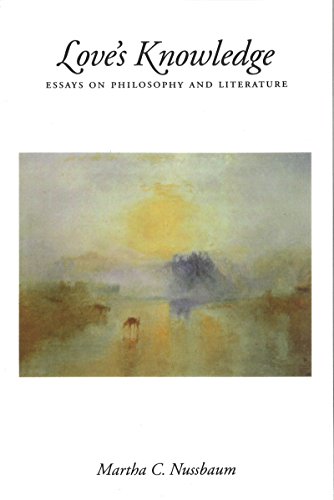
Ebook Info
- Published: 1992
- Number of pages: 423 pages
- Format: PDF
- File Size: 49.98 MB
- Authors: Martha C. Nussbaum
Description
This volume brings together Nussbaum’s published papers on the relationship between literature and philosophy, especially moral philosophy. The papers, many of them previously inaccessible to non-specialist readers, deal with such fundamental issues as the relationship between style and content in the exploration of ethical issues; the nature of ethical attention and ethical knowledge and their relationship to written forms and styles; and the role of the emotions in deliberation and self-knowledge. Nussbaum investigates and defends a conception of ethical understanding which involves emotional as well as intellectual activity, and which gives a certain type of priority to the perception of particular people and situations rather than to abstract rules. She argues that this ethical conception cannot be completely and appropriately stated without turning to forms of writing usually considered literary rather than philosophical. It is consequently necessary to broaden our conception of moral philosophy in order to include these forms. Featuring two new essays and revised versions of several previously published essays, this collection attempts to articulate the relationship, within such a broader ethical inquiry, between literary and more abstractly theoretical elements.
User’s Reviews
Reviews from Amazon users which were colected at the time this book was published on the website:
⭐I don’t know who constructed the review form for this work, but clearly he or she has no clue about the book. It is a work of philosophy; not fiction. So none of the descriptors really apply. Nussbaum combines philosophical inquiry using some serious literature (Proust, James, etc.,) to illustrate and illuminate her points. Indeed, that is her project: to view philosophy not through abstract and rigorous analysis using the language of philosophy, but rather through the narrative and emotional expression of great literature. It is not an “easy” book; but then, very little of Nussbaum is “easy”. It is, however, worth the effort if seeing philosophy illuminated from a different angle is your interest as it was mine.
⭐I was doing research on the same topic and came across Martha Nussbaum’s book. If you like Henry Miller’s works, you will really learn much from her understandings of them.
⭐Good knowledge – not easy to read.
⭐Brilliant article about Henry James’s novel The Golden Bowl. Martha Nussbaum is so wise. I look forward to reading more articles about literature by moral philosophers.
⭐Nussbaum comes across as very smart but also engaging, human, normal. Good philosophy, solid scholarship, relatively easy to read. I strongly recommend it.
⭐Great!
⭐Which genre of writing better models the life well lived, poetry or philosophy? In this quarrel, Martha Nussbaum, though principally a philosopher herself, takes the side of the poets. Her earliest adult studies were of the ancient tragedians and of Dickens, James, and Proust, in all of whose works she found an inspiring commitment to life’s passions and irreducible particularities. Like many a Greek before Plato, Nussbaum regarded her favourite tragedians and novelists as poet-thinkers who, as a very consequence of their philosophy, chose to write poetry (or fiction) instead. She was nearly turned off philosophy by her later studies of Stoics, Platonists, Kantians, and Utilitarians, all of whom she found more or less closed to the incommensurable and not easily controlled aspects of life. At last, Nussbaum discovered Aristotle and, in him, the ultimate philosophical ally of literary reflection (18).Part of what made Aristotle very distinctive from Plato, and attractive to Nussbaum, was his beginning of every inquiry with a dialectic of opinions. Whereas Plato began in intellectual isolation, Aristotle asked first, What do other wise men say about this question? He then compared a variety of opinions, continually seeking a synthesis that would salvage the best and the most numerous doxa proposed by his contemporaries. Nussbaum calls the result of inquiry like this “perceptive equilibrium” (26) (explained much more extensively in Upheavals Of Thought), and she recognised in it an ideal of literary as well as of philosophical inquiry. The complex tensions of a Henry James novel, for instance, should not be reduced to a common propositional denominator but found and tested against each other. Nussbaum also found in Aristotle a powerful defence of “the emotions and imagination as essential to rational choice” (55).Underlying Nussbaum’s defence of the passions is her profound understanding of what passions are and are not. In our reserved Anglo-sphere, it is often implied that the passions are irrational and nonsensical (and calling them “emotions” is one way of putting them down). Nussbaum observes, by contrast, that “irrational” and “nonsensical” are mutually cancelling allegations: if irrational, passions have content (just incorrect content); if nonsensical, they are devoid of content altogether. In fact, the passions are neither irrational nor nonsensical since they are “belief based” (41): unlike an “unqualified” urge such as thirst (120), a passion cannot ignite itself without certain beliefs obtaining on the part of the impassioned. Most subtly of all, Nussbaum argues that passions are not even merely the good or bad response to, or basis for, a thought but themselves have cognitive content (291). We may, like Marcel, try to lose ourselves in a “science of life,” but the resurgence of emotion at some crisis returns us to knowledge of our true selves.The only objection I have to the beautiful argument of Love’s Knowledge regards its not being clear enough about the proper function of rules. I can find no fault with Nussbaum’s emphasising the “ethical relevance of circumstances” (37) and the resourceful interpretation needed even to see the situation to which a rule may then be applied. It sounds right to me to say that rules are “authoritative insofar as [they are summaries] of wise decisions” in the past but that a further wise decision must be made in applying them. But Nussbaum at one point herself admits that it is possible to “[take] fine-turned [rule-superior] perception to… dangerously rootless extreme[s]” (158). One must not, she warns, “refuse the guidance of general rules to the extent” that we appreciate the complexity of particulars without feeling the pull of moral obligation toward any. I don’t think we should refuse the guidance of good rules to any extent; we should never make aspirations the enemy of orthodoxies, which properly exist to be our baselines and stable grounds, not to constrain us from flight.
⭐”Martha Nussbaum’s philosophy assumed an ambivalent attitude towards the volatile subject of emotion…Given this…, Nussbaum’s systematic defense of the ethical and cognitive dimensions of emotion, makes a significant contribution to contemporary philosophy and to feminist theory.” Claudia MoscoviciMoral philosophy has flourished in recent years, and Nussbaum has been one of its most vivid practitioners. Ways of thinking and writing that developed in the analytic tradition are appropriate to some inquiries, such as epistemology and philosophy of science, but they cannot accomplish what is necessary for moral philosophy.Most Ancient Wisdom:The oldest work of social moral Philosophy known to us is the “Instruction of Ptah-Hotep,” which apparently goes back to 2880 BC, 2300 years before Confucius, Socrates and Buddha. Ptah-Hotep, Governor of Memphis, instructs his son, and successor: “Be not proud because thou art learned; but discourse with the ignorant as with the sage. For no limit could be set to skill, neither is there any craftsman that possesseth full advantages. …Overstep not the truth, neither repeat that which any man, be he prince or peasant, saith in opening the heart; it is abhorrent to the soul…” (cited in J. H. Breasted: The Dawn of Conscience)Poverty of a moral philosophy:Nussbaum conceives moral philosophy neither as the formulation and systematization of rules; nor as the identification of “virtues” constitutive of a good character. Like several other philosophers, she argues that the attentive reading of literary works, specifically novels, is an indispensable aid for moral reflection. Martha Nussbaum’s lack of a discernible interest in religion has not hindered the Divinity School, University of Chicago from assigning her a course in Theological Ethics. For her, novels provide rich emotions and meticulous situations relative to the real complexities of experience. By contrast, the examples created by philosophers are thin and lack support. Nussbaum’s emphasis has typically been on the poverty of a moral philosophy that fails to use the great resources provided by literature. She argues, there are some aspects of knowledge that are revealed to us only when we experience some emotions, especially love. We may love people because of what we know about them, but we come to know them more fully because we love them. Alan Jacobs thinks Nussbaum finds most compelling accounts of the richness of our emotional lives portrayed in great novels. Novels are particularly rich in their explorations of these issues, though such understanding need not be gained only from novels.Analytical Evaluation:”Nussbaum’s project orbits elliptically around two points: the defense of reflection on the literary particular against Kantians, utilitarians, Platonists, analytic philosophers, and any other one-sided champions of the general and universal; and actual commentaries on scenes from novels she loves and finds particularly significant. … Yet the measure of this book’s power is that it stimulates us to raise serious questions like these, not as rhetorical, but as genuinely inviting Nussbaum’s response.”D. Marshall, U. of Illinois, Chicago
⭐Well, it’s Nussbaum isn’t it? If you believe that literature is a branch of philosophy and are an Aristotelian, I suppose you would be happy. Also, if you lack a sense of irony, as her (imo disastrous) reading of Beckett shows. I don’t believe any of those things, so I didn’t like it. Still, she is an immensely important theorist in the field of aesthetic education, so you have to read her if you are interested in that field.
⭐Everyhing delivered as promised.
⭐Good book. Thank you
⭐Fab Excellent Brilliant Challenging Tough Rewarding Fulfilling Eye-Opening. It’s really very well written and is sure to reward any who have an interest in Philosophy, Literature/Art, or both.
⭐Phenomenal collection of essays on the philosophy of literature. Hugely recommended.
Keywords
Free Download Love’s Knowledge: Essays on Philosophy and Literature in PDF format
Love’s Knowledge: Essays on Philosophy and Literature PDF Free Download
Download Love’s Knowledge: Essays on Philosophy and Literature 1992 PDF Free
Love’s Knowledge: Essays on Philosophy and Literature 1992 PDF Free Download
Download Love’s Knowledge: Essays on Philosophy and Literature PDF
Free Download Ebook Love’s Knowledge: Essays on Philosophy and Literature