

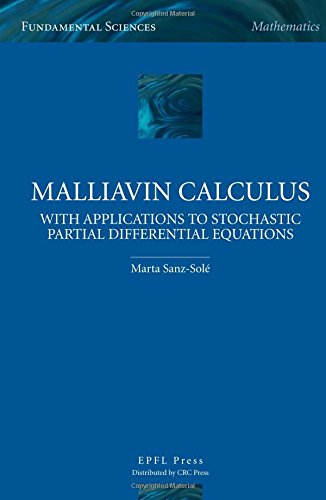
Ebook Info
- Published:
- Number of pages:
- Format: PDF
- File Size: 1.81 MB
- Authors: Marta Sanz-Sole
Description
Developed in the 1970s to study the existence and smoothness of density for the probability laws of random vectors, Malliavin calculus–a stochastic calculus of variation on the Wiener space–has proven fruitful in many problems in probability theory, particularly in probabilistic numerical methods in financial mathematics.This book presents applications of Malliavin calculus to the analysis of probability laws of solutions to stochastic partial differential equations driven by Gaussian noises that are white in time and coloured in space. The first five chapters introduce the calculus itself based on a general Gaussian space, going from the simple, finite-dimensional setting to the infinite-dimensional one. The final three chapters discuss recent research on regularity of the solution of stochastic partial differential equations and the existence and smoothness of their probability laws.About the author: Marta Sanz-Solé is Professor at the Faculty of Mathematics, University of Barcelona. She is a leading member of the research group on stochastic analysis at Barcelona, and in 1998 she received the Narcis Monturiol Award of Scientific and Technological Excellence from the autonomous government of Catalonia.
User’s Reviews
Reviews from Amazon users which were colected at the time this book was published on the website:
⭐The development of Malliavin Calculus was motivated by a fundamental question: Under what circumstances does the distribution of a random variable have a density? The theory developed to address this basic question by Paul Malliavin and others sets a mathematically beautiful landscape and has had profound impact on the theory of stochastic processes.As is often the case in such ground-breaking studies, finding the solution to the motivating question is just a small part of the ultimate value of the theory. To get the most out of the material, it is usually important to carefully explore the foundations of the theory along the way. Additional insight can be gained and new applications are often discovered in the manner.Unfortunately for the reader, the author has decided to forego touring the foundations in her treatment of Malliavin Calculus. The text has eight chapters and for the first five of these, the author’s focus is squarely on determining criteria under which random variables have densities. All the while, the development of the foundational material is extremely sketchy. The author quickly breezes through the Wiener chaos expansion, the development of the derivative operator, the divergence operator, the Ornstein-Uhlenbeck operator, establishing the density function criteria and probabilistic version of Hormander’s Theorem on hypoelliptic operators. Even more exasperating than the speed at which this is developed is the brevity; the material in the first five chapters of the text constitutes a mere 68 pages. Coincidently, this is precisely the length of Paul Malliavin’s seminal 1976 paper on the topic.In a exposition this brief, the reader might expect to find no more detail than is typically provided in a research paper. In the author’s treatment, there is in fact less detail here. The reason for this is Chapter 2 and the exploration of a finite-dimensional version of Malliavin calculus. This reviewer speculates that the author’s intent is to motivate the development of the general case. This finite-dimensional treatment does provide a kind of an outline for the main arguments in the general case, although in the end the finite-dimensional overview doesn’t begin to illuminate the difficult issues (and profound solutions) eventually found.The last three chapters deal with applications of Malliavin calculus and the existence of densities to stochastic partial differential equations. In order to get through the first application, in Chapter 6, the author states a “prerequisite knowledege of the theory of stochastic integration with respect to martingale measures” is required, as developed by Walsh in
⭐. The author has poorly choosen a relatively inaccessible topic as her first application of Malliavin theory. This poor choice puts the readers desire to apply the results on hold, as well as raises the unnecessary question as to whether any accessible applications truly exist.The author proceeds without introducing any notation for the sets and spaces used throughout. There is, buried in the back of the book, an unreferenced table collecting symbols and defining notation. This is one of the few spots in which the author defines some of the terms she uses.
Keywords
Free Download Malliavin Calculus with Applications to Stochastic Partial Differential Equations 1st Edition in PDF format
Malliavin Calculus with Applications to Stochastic Partial Differential Equations 1st Edition PDF Free Download
Download Malliavin Calculus with Applications to Stochastic Partial Differential Equations 1st Edition PDF Free
Malliavin Calculus with Applications to Stochastic Partial Differential Equations 1st Edition PDF Free Download
Download Malliavin Calculus with Applications to Stochastic Partial Differential Equations 1st Edition PDF
Free Download Ebook Malliavin Calculus with Applications to Stochastic Partial Differential Equations 1st Edition