Ebook Info
- Published: 2014
- Number of pages: 336 pages
- Format: PDF
- File Size: 22.76 MB
- Authors: Waitman Wade Beorn
Description
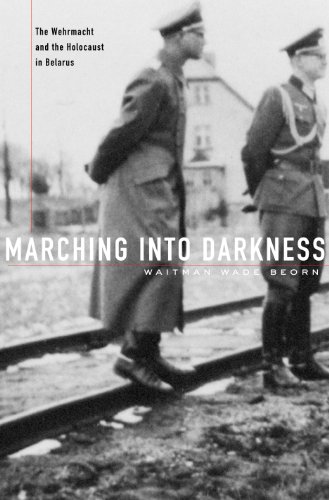
On October 10, 1941, the Jewish population of the Belarusian village of Krucha was rounded up and shot. This atrocity was not the routine work of the SS but was committed by a regular German army unit acting on its own initiative. Marching into Darkness is a bone-chilling exposé of the ordinary footsoldiers who participated in the Final Solution on a daily basis.Although scholars have exploded the myth that the Wehrmachtplayed no significant part in the Holocaust, a concrete picture of its involvement has been lacking. Marching into Darkness reveals in detail how the army willingly fulfilled its role as an agent of murder on a massive scale. Waitman Wade Beorn unearths forced labor, sexual violence, and grave robbing, though a few soldiers refused to participate and even helped Jews. Improvised extermination progressively became methodical, with some army units going so far as to organize “Jew hunts.” The Wehrmacht also used the pretense of Jewish anti-partisan warfare as a subterfuge by reporting murdered Jews as partisans. Through military and legal records, survivor testimonies, and eyewitness interviews, Beorn paints a searing portrait of an army’s descent into ever more intimate participation in genocide.
User’s Reviews
Reviews from Amazon users which were colected at the time this book was published on the website:
⭐Marching Into Darkness. I give this five stars. An unremitting, withering examination of the Wehrmacht, and the sickening “myth of a clean Wehrmact” deserves some flaws. The German exposition in roughly 2000, with photos of Wehrmacht members involved in shootings, hangings, public burning of Jews in barns or synagogues, sabbath day humiliations of Orthodox Jews … I didn’t think the Wehrmacht would get away clean … but that exhibit rocked post war German survivors and Wehrmacht veterans to the core. “Holocaust By Bullets;” “Christopher Browning’s “Ordinary Men,” Daniel Goldhagen’s “Hitler’s Willing Executioners;” a recent book on women in camps who were brutal … I’m sorry, but Saul Friedlander and Raul Hillberg’s excoriation of Goldhagen’s thesis that in Hiter’s era Germany, the German people, even above the Austrians, were very, very willing executioners. Who else, who were fascist in nature … ever accomplished the extraordinarily precise slaughter of Jews … the Italians? Bulgarians?Hungarians? Austrians? Ukrainian fascists? Polish anti-semites? Who was so ruthless, thorough, exacting in trying to kill every last Jews they could find? There are many soldiers who wrote about killing Jews, kommisars, patisans. I encountered a daughter of an Ordnungspolisei about the time Goldhagen’s book emerged. He served, as I remember, his entire tours on “the Eastern Front,” and had bragged to her of the ruthlessness of the Eastern Front War against communists, partisans, komissars, etc. He apparently did not ever believe, when telling her his exploits, that Goldhagen, Browning, Beorn, would ever dig up all the evidence they did on this other element: the Wehrmacht. And the myths perpetuated by almost every single German Wehrmacht general, right up until the most recent past, continues to deny Wehrmacht involvement. There were plenty of Wehrmacht soldiers who knew about the killings; a small # asked to be relieved; a miniscule condemned the killings; many failed to see cordoning off Jews, kommisars, partisans, was part of the same thing. No, they did not kill or shoot. But they sent clothes home; justified looting bodies; said that better them than our own people. Most knew full well the Wehrmacht was involved. Not every division, but when juxtaposed with the Sicherheistdienst (SD, Einsatzgruppen, Waffen SS, SS Death’s Heads, and other groups, the Wehrmacht was needed. Even books that portray fighting on the Russian front describe the ruthlesness. It’s best seen in the Belurusse film: “Come and See [Me].” It is about as accurate a portrayal of the aktions described in these books, and by Beorn’s new addition, as it gets. I have no sympathy whatsoever for any Wehrmacht soldier whose record shows cooperation, collusion, joint activities in the Divisions cited, as well as any not mentioned. If they were killing partisans, then the Mogilev Conference in 1941 was crystal clear: Partisans are communists. Communists are likely Jews. Jews are likely communists. Jews likely aid and abet partisans. The one common denominator is: “Jews.” The equation made it clear: kill every Jewish man, woman and child encountered. A very, very tiny minority of German Wehrmacht likely said: I really and truly never knew. I hope letters home are opened next. It will be interesting to learn what the wives and children who received those letters telling of the unfortunate need to kill partisans, or komissars, or Jews, thought. During the war, and all these years later. Do they rest easy remembering the justifcations given for the Holocaust by Bullet that was perpetrated East of the German/Polish line of 1939? I guess my friend … I would like to talk with her again now. She was livid at the time. I told her to read Goldhagen’s and Browning’s books. I doubt she ever did. And so, Germans, to my way of thinking, made it more likely than not that the Holocaust happened than any other people in Europe. No one carried it out to such degrees. And so, was Go/ldhagen really that wrong? The minutiae of Holocaust theories I do not pretend to get. But the evidence shows that the German people allowed Hitler to come to power. Jews and bolsheviks were maligned and outcasts. We must be careful who WE malign, and say, they must “go.” All must “go” and walls must be erected between our country and that country to the south. I wonder how many Wehrmacht, SS, SD, etc., ever, ever repented, and asked God for forgiveness? I doubt many. They seemed so certain during the war. I hope many did. I hope they tried to salvage their souls. God would forgive, but what is the amend? Honesty, I think. Just “yes, we did that. I did this much. For that I am guilty.” That would be a wothwhile book. Has any been written? I hope so.
⭐Let me start by saying I have just started reading about the Holocaust in-depth and this was one of the first books about it I’ve read. The book, while very morbid, as comes with the territory of the Holocaust is very well put together and is a very intriguing read for those interested in the subject. Beorn does an excellent job dispelling myths such as the “Clean Wehrmacht” and other such things at the beginning of the book and then immediately dives into talking about how the Germans were organized in Belarus and talking about the different Wehrmacht rear guard units that supported and even participated in the Holocaust (at the time mainly done through mass shootings and mass graves). While he mainly focuses on a few units and what they did to assist the SS/SD, and even at times perpetuated the Holocaust on their own, he connects this to the overall bigger picture not just in Belarus but to the Eastern Front as a whole. He also expands upon already well-known books relating to the subject and connects them all. Overall, it’s a very important book and study on the subject and in my opinion, a must-read for those studying WWII and the Holocaust.
⭐Waitman Wade Beorn’s “Marching Into Darkness: The Wehrmacht and the Holocaust in Belarus” is a contribution to two of the more active and interesting areas of World War II scholarship in recent decades: 1) the role of the German Army (as opposed to the SS) in perpetrating atrocities and taking part in the Holocaust; and 2) the debate over how and why Germans (in general) came to do such killing. I believe this book began as a dissertation under the guidance of Christopher Browning, who has played a leading role in this second debate.The book is not a general study of occupation policies and activities but rather essentially a set of case studies of specific killing incidents in 1941-1942 that illustrate a growing but not always planned involvement of the “Wehrmacht” (Beorn’s shorthand for the German Army) in the Holocaust, from taking part in the “roundup” of Jews and others for elimination by others to eventual “pro-active” killing activities initiated by themselves. It is well-written and well-researched and the author takes the trouble to find nuance, something that not everybody who contributes to these debates actually does.Some might find it useful to read Yitzhak Arad’s The Holocaust in the Soviet Union first, for some additional information and context, but this is not truly needed.The one weakness that the work has is not unique to this book but also exists in a number of other works that attempt to implicate the German military in the Holocaust and other crimes against humanity. This is the fact that the book strongly concentrates on Security Divisions and a few other units essentially designed for occupation duties. Units like these were a very small minority of the German military in the Soviet Union (in contrast to the “front-line” units) and someone could legitimately attempt to argue based on works like Beorn’s that this speaks more to a suborning of a select subset of the German Army rather than a broad indictment of the German Army in the Soviet Union. Thus I think more attention needs to be paid by scholars in this area to units such as “normal” infantry and armored divisions in the Soviet Union to examine their role in the East.In any case, this book is well worth getting for anybody interested in these areas.
⭐Much less in the way of personal testimonies than the description led me to expect. Somewhat repetitive in places. An inaccurate impression is created when Stalin is cited as having been opposed to, or having no faith in, the partisans. Soviet military doctrine from the late 1930s envisaged the adoption of guerilla warfare in the event of a Nazi invasion, particularly if it occurred while the Soviet Union was still militarily weak, and this philosophy was soon reflected in practice. There are several accounts by German soldiers and Soviet civilians to the effect that the relationship between the occupying troops and civilians changed in late 1941 as a result of a Stavka-directed initiative involving the intimidation by the partisans of the civilians. Of course, the Nazis did a good job of turning people against them anyway…Anyway, the author downplays the reality of the partisans in 1941 (for further evidence, consider the increase in casualty rates between police battalions in Poland and those deployed in captured Soviet territory in ’41).Still, an important and informative book that taught me quite a bit.
⭐A very readable book which is insightful, sensitive and poignant. My wife was born in West Belarus (June 18, 1939) and fled, with her parents, eastward in 1941, surrounded by the Holocaust. They spent the balance of the war in refugee camps in Germany and came to Canada in 1959. She has a remarkable early childhood memory, including being terrified by screaming and fires. This book has been most helpful to put things into perspective–and, yes, there was occasional lifesaving kindness.
Keywords
Free Download Marching into Darkness: The Wehrmacht and the Holocaust in Belarus in PDF format
Marching into Darkness: The Wehrmacht and the Holocaust in Belarus PDF Free Download
Download Marching into Darkness: The Wehrmacht and the Holocaust in Belarus 2014 PDF Free
Marching into Darkness: The Wehrmacht and the Holocaust in Belarus 2014 PDF Free Download
Download Marching into Darkness: The Wehrmacht and the Holocaust in Belarus PDF
Free Download Ebook Marching into Darkness: The Wehrmacht and the Holocaust in Belarus