

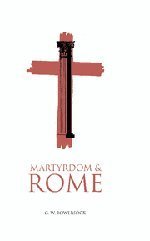
Ebook Info
- Published:
- Number of pages:
- Format: PDF
- File Size: 3.11 MB
- Authors:
Description
User’s Reviews
Reviews from Amazon users which were colected at the time this book was published on the website:
⭐excellent product
⭐Short text for the price but awesome source material
⭐This book began as the series of Wiles Lectures delivered at Queen’s University in Belfast in 1993. The author, G. W. Bowersock, taught Classics and History at Harvard University from 1962 to 1980. Then, from 1980 until his retirement in 2006, he was Professor of Ancient History at the Institute for Advanced Study at Princeton.The central thesis of this book is that the terms martyr and martyrdom should not be associated with pagans who were willing to die for a philosophy, or with Jews who were willing to die for their faith. Why? Because, strictly speaking, those terms originated with and belong especially to Christians who lived in the Roman Empire during the second through fourth centuries. Bowersock offers a set of arguments rooted in philology and history in order to show that in the Roman Empire martyrdom meant something very specific.In Chapter I, “The making of martyrdom,” Bowersock attempts to reveal the precise definitions of martyr and martyrdom. Of course, there were accounts of people in the ancient world, other than Christians, who “provided glorious examples of resistance to tyrannical authority and painful suffering before unjust judges.” So, then, what was different about true martyrdom per se? Bowersock answers that there were two things. First, starting with the Christians of the second century in their imperial Roman context, such courage was “absorbed into a conceptual system of posthumous recognition and anticipated reward.” Second, and related to the first point, “the very word martyrdom existed as the name for this system” (5).Chapter II, “The written record,” sets out to corroborate the argument of the first chapter along the lines of literary analysis. Bowersock notes that the distinctive literary form called martyrology bears little resemblance to Jewish stories from the Old Testament book of Daniel, or from the second and fourth books of Maccabees. Instead, judging from their narrative technique and literary style, the Martyr Acts most closely resemble “pagan historical fiction” (26). The author concludes that “like the very word ‘martyr’ itself, martyrdom had nothing to do with Judaism or with Palestine” (28). Furthermore, Jewish martyrology sounds nothing like pre-Constantine Christian martyrology. In those accounts, for example, the victims are asked, according to formula, if they are ready to change their minds. Such inquisitions have a “distinctively Roman character” (37).Chapter III, “The civic role of martyrs,” begins with the simple observation that the Martyr Acts “take place in the greatest cities of the Roman world” (41). Why was this the case, and why is it significant? Bowersock explains that, from the Roman side, major cities included the deadly legal authority of provincial governors as well as the crowds who would gather for “spectacles of blood sport in the amphitheater.” From the Christian side, “martyrdom in a city provided the greatest possible visibility for the cause of the nascent Church, and it simultaneously exposed the Roman administrative machinery to the greatest possible embarrassment” (42). Under these circumstances, pagans and Jews would unite publicly against Christian martyrs, a fact that underscores the author’s thesis that martyrdom was a uniquely-Christian phenomenon vis-a-vis imperial Rome.In Chapter IV, “Martyrdom and suicide,” the author describes the eagerness, good cheer, and even laughter of some early martyrs. In many cases, their dispositions reveal a desire for martyrdom that amounted to suicide by state official (59-61). Because of this development, some Christian theologians took up the question of martyrdom as opposed to suicide. On the one hand, Tertullian argued that if some pagans voluntarily died for false and foolish notions, how much more should Christians be willing to die for the truth of the gospel? On the other hand, Origen and Clement of Alexandria spoke against all forms of voluntary self harm. The debate reached all the way to the time of Augustine, who argued at length that to kill oneself, or to provoke someone else to kill you, even for what is true, is wrong. Augustine’s verdict combined with the effects of the Constantinian revolution to bring to an end to this major chapter of Christian history (73-74).Four Appendixes, a “Select Bibliography” and an index round out this book. Each appendix is a commentary or extended footnote on one of the points in the text. The book could have used a map of the Roman world and a few illustrations. At any rate, Bowersock’s lectures assert and advance a provocative thesis. One might quibble with a point here or there. Nonetheless, this book is a tour de force that no student interested in the topic should ignore.
⭐Bowersock is a distinguished scholar- particularly of the Greek world- who delivered the Wiles lectures at Belfast- upon which this book is based- in the early 90’s.The book is terse, readable and compelling and it is clear that it would have made an effective lecture series. The importance of marytrdom is set in its cultural context- and its importance for the development of Christianity is analysed. The key mistake of this book is the highly controversial notion that the approach to death of Christian martyrs- because of the etymological development of the greek ‘martyr’- was original and is divorcable from previous attitudes to self sacrifice. This rules out the highly likely role of the self sacrifice of the Maccabees of the second century as a formative influence for Christian notions of self sacrifice. This notion has not been approved by scholars- before and since. The Macabees were an important precursor to Christian martyrdom in the shaping of their religious identities.This said, the book makes an important contribution to awareness of the etymological development of the word ‘martyr’ itself and problematises its ascription to instances of self sacrifice before the late second century. To call self sacrifice ‘martyrdom’ before this is shown to be a linguistic anachronism, since the term ‘martyr’ had not developed this aspect before then.In summary, Bowersock’s book is provocative and well worth reading for anyone interested in the construction of a Christian identity and in the self-definition of the early Christian community in antiquity. Bowersock’s powerful knowledge of all things Hellenic generates some startling cross-cultural observations which are of integral importance to conceptions of the development of Christianity and of religion in general throughout antiquity. To be – qualifiedly- recommended.
Keywords
Free Download Martyrdom and Rome by G. W. Bowersock (April 28,1995) in PDF format
Martyrdom and Rome by G. W. Bowersock (April 28,1995) PDF Free Download
Download Martyrdom and Rome by G. W. Bowersock (April 28,1995) PDF Free
Martyrdom and Rome by G. W. Bowersock (April 28,1995) PDF Free Download
Download Martyrdom and Rome by G. W. Bowersock (April 28,1995) PDF
Free Download Ebook Martyrdom and Rome by G. W. Bowersock (April 28,1995)