

Ebook Info
- Published: 2007
- Number of pages: 592 pages
- Format: PDF
- File Size: 26.06 MB
- Authors: Bernd S. W. Schröder
Description
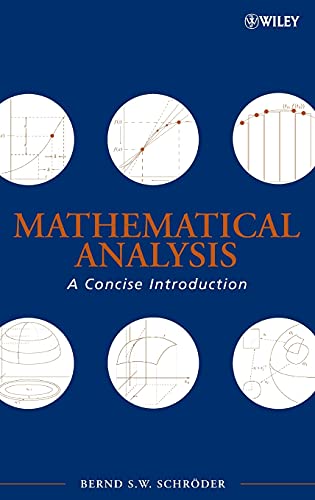
A self-contained introduction to the fundamentals of mathematical analysis Mathematical Analysis: A Concise Introduction presents the foundations of analysis and illustrates its role in mathematics. By focusing on the essentials, reinforcing learning through exercises, and featuring a unique “learn by doing” approach, the book develops the reader’s proof writing skills and establishes fundamental comprehension of analysis that is essential for further exploration of pure and applied mathematics. This book is directly applicable to areas such as differential equations, probability theory, numerical analysis, differential geometry, and functional analysis. Mathematical Analysis is composed of three parts: ?Part One presents the analysis of functions of one variable, including sequences, continuity, differentiation, Riemann integration, series, and the Lebesgue integral. A detailed explanation of proof writing is provided with specific attention devoted to standard proof techniques. To facilitate an efficient transition to more abstract settings, the results for single variable functions are proved using methods that translate to metric spaces. ?Part Two explores the more abstract counterparts of the concepts outlined earlier in the text. The reader is introduced to the fundamental spaces of analysis, including Lp spaces, and the book successfully details how appropriate definitions of integration, continuity, and differentiation lead to a powerful and widely applicable foundation for further study of applied mathematics. The interrelation between measure theory, topology, and differentiation is then examined in the proof of the Multidimensional Substitution Formula. Further areas of coverage in this section include manifolds, Stokes’ Theorem, Hilbert spaces, the convergence of Fourier series, and Riesz’ Representation Theorem. ?Part Three provides an overview of the motivations for analysis as well as its applications in various subjects. A special focus on ordinary and partial differential equations presents some theoretical and practical challenges that exist in these areas. Topical coverage includes Navier-Stokes equations and the finite element method. Mathematical Analysis: A Concise Introduction includes an extensive index and over 900 exercises ranging in level of difficulty, from conceptual questions and adaptations of proofs to proofs with and without hints. These opportunities for reinforcement, along with the overall concise and well-organized treatment of analysis, make this book essential for readers in upper-undergraduate or beginning graduate mathematics courses who would like to build a solid foundation in analysis for further work in all analysis-based branches of mathematics.
User’s Reviews
Editorial Reviews: Review “This highly original, interesting and very useful book includes over 900 exercises which are ranging in levels of difficulty, from conceptual questions and adaptations of proofs to proofs with and without hints.” (Mathematical Reviews, 2008h) From the Inside Flap A self-contained introduction to the fundamentals of mathematical analysis Mathematical Analysis: A Concise Introduction presents the foundations of analysis and illustrates its role in mathematics. By focusing on the essentials, reinforcing learning through exercises, and featuring a unique “learn by doing” approach, the book develops the reader’s proof writing skills and establishes fundamental comprehension of analysis that is essential for further exploration of pure and applied mathematics. This book is directly applicable to areas such as differential equations, probability theory, numerical analysis, differential geometry, and functional analysis.Mathematical Analysis is composed of three parts:Part One presents the analysis of functions of one variable, including sequences, continuity, differentiation, Riemann integration, series, and the Lebesgue integral. A detailed explanation of proof writing is provided with specific attention devoted to standard proof techniques. To facilitate an efficient transition to more abstract settings, the results for single variable functions are proved using methods that translate to metric spaces.Part Two explores the more abstract counterparts of the concepts outlined earlier in the text. The reader is introduced to the fundamental spaces of analysis, including Lp spaces, and the book successfully details how appropriate definitions of integration, continuity, and differentiation lead to a powerful and widely applicable foundation for further study of applied mathematics. The interrelation between measure theory, topology, and differentiation is then examined in the proof of the Multidimensional Substitution Formula. Further areas of coverage in this section include manifolds, Stokes’ Theorem, Hilbert spaces, the convergence of Fourier series, and Riesz’ Representation Theorem.Part Three provides an overview of the motivations for analysis as well as its applications in various subjects. A special focus on ordinary and partial differential equations presents some theoretical and practical challenges that exist in these areas. Topical coverage includes Navier-Stokes equations and the finite element method.Mathematical Analysis: A Concise Introduction includes an extensive index and over 900 exercises ranging in level of difficulty, from conceptual questions and adaptations of proofs to proofs with and without hints. These opportunities for reinforcement, along with the overall concise and well-organized treatment of analysis, make this book essential for readers in upper-undergraduate or beginning graduate mathematics courses who would like to build a solid foundation in analysis for further work in all analysis-based branches of mathematics. From the Back Cover A self-contained introduction to the fundamentals of mathematical analysis Mathematical Analysis: A Concise Introduction presents the foundations of analysis and illustrates its role in mathematics. By focusing on the essentials, reinforcing learning through exercises, and featuring a unique “learn by doing” approach, the book develops the reader’s proof writing skills and establishes fundamental comprehension of analysis that is essential for further exploration of pure and applied mathematics. This book is directly applicable to areas such as differential equations, probability theory, numerical analysis, differential geometry, and functional analysis.Mathematical Analysis is composed of three parts:Part One presents the analysis of functions of one variable, including sequences, continuity, differentiation, Riemann integration, series, and the Lebesgue integral. A detailed explanation of proof writing is provided with specific attention devoted to standard proof techniques. To facilitate an efficient transition to more abstract settings, the results for single variable functions are proved using methods that translate to metric spaces.Part Two explores the more abstract counterparts of the concepts outlined earlier in the text. The reader is introduced to the fundamental spaces of analysis, including Lp spaces, and the book successfully details how appropriate definitions of integration, continuity, and differentiation lead to a powerful and widely applicable foundation for further study of applied mathematics. The interrelation between measure theory, topology, and differentiation is then examined in the proof of the Multidimensional Substitution Formula. Further areas of coverage in this section include manifolds, Stokes’ Theorem, Hilbert spaces, the convergence of Fourier series, and Riesz’ Representation Theorem.Part Three provides an overview of the motivations for analysis as well as its applications in various subjects. A special focus on ordinary and partial differential equations presents some theoretical and practical challenges that exist in these areas. Topical coverage includes Navier-Stokes equations and the finite element method.Mathematical Analysis: A Concise Introduction includes an extensive index and over 900 exercises ranging in level of difficulty, from conceptual questions and adaptations of proofs to proofs with and without hints. These opportunities for reinforcement, along with the overall concise and well-organized treatment of analysis, make this book essential for readers in upper-undergraduate or beginning graduate mathematics courses who would like to build a solid foundation in analysis for further work in all analysis-based branches of mathematics. About the Author Bernd S.W. Schroder, PhD, is Edmondson/Crump Professor in the Program of Mathematics and Statistics at Louisiana Tech University. Dr. Schröder is the author of over thirty refereed journal articles on subjects such as ordered sets, probability theory, graph theory, harmonic analysis, computer science, and education. He earned his PhD in mathematics from Kansas State University in 1992. Read more
Reviews from Amazon users which were colected at the time this book was published on the website:
⭐I completed a bachelor’s degree in math twenty years ago, and my favorite course was Real Analysis; however, the text I used was very poor in nearly every way. Over the years, as I have continued to study analysis (real and complex), I have found texts which were mediocre, at best. Professor Schroder’s text is the absolute finest on analysis I have read. Professor Schroder is from Germany and was educated, in part, there; and, to beat a stereotypical drum, his text rings through with the thoroughness and clarity (and precision) for which Germans are oft celebrated. His command of English is superb, and this is seen in his lucid explanations of abstruse theorems and concepts. The text is arranged intuitively logically, such that topics are covered in an organic, holistic way. Schroder not only provides the logic behind the proofs of the theorems (never any ‘hand-waving’ in this able text), but he also provides detailed paragraph explanations about the ‘reasoning’ of the proofs. There are plenty of exercises which allow practice, and this text develops the student’s aptitude for proving theorems from an inductive basis of logic. A major strength of the book is that the author invited student input (and criticism) during the text’s development, and his incorporation of the suggestions makes the text exceptionally student-friendly. This text can be used fruitfully in undergraduate and graduate courses, for its layout, or format, presents the elementary aspects of the theory of functions of real (and complex) variables, first, and then builds (as I stated, inductively) to greater complexity. Another great strength (probably its greatest) is the comprehensiveness with which all the major branches of math are treated. Professor Schroder infuses abstract algebra, linear algebra, topology and the theory of differential equations into analysis in a seamless, disarming way, such that the reader is able to see the way in which, for instance, the concept of a ‘space’ shares domain with algebra and point-set topology. A clear, comprehensive and extremely well-written mathematics textbook is a true blessing for a math nerd. Therefore, the nerds of math can stop digging round amid poor imitations of readable analysis books; this book is the golden chalice par excellence.
⭐Great for college class.
⭐Writing a new book on mathematical analysis takes courage: the field is crowded and there are several well-known classics that are the focus of attention. My fascination with mathematical analysis (and advanced calculus, which is essentially the same area of study but with a focus on the theoretical underpinnings of calculus) has led me to collect more than 40 books on the subject. A good grounding in real analysis will provide a sturdy backbone for further study in key fields such as complex analysis, differential equations, differential geometry, functional analysis, harmonic analysis, mathematical physics, measure theory, numerical analysis, partial differential equations, probability theory, and topology.Thus, it is hardly surprising that the author, Professor Bernd Schroder, points out that upon completing this text, readers will be ready for all analysis-based and analysis-related subjects in mathematics. That is not hyperbole: this new analysis textbook is wide-ranging in its areas of interest yet concise in implementation, thorough yet crisply focused, well written and clearly presented even while using an axiomatic approach to mathematics. Most important for the author’s stated purpose, the book is a self-contained introduction to the fundamentals of analysis. The only obvious prerequisite is some experience with mathematical language and proofs. Also useful is a familiarity with the nature and structure of mathematical statements and proof methods, such as direct proofs, proofs by contradiction and induction. With a little assistance in the beginning, this textbook can be used without prerequisites in a first proof class. Standard proof techniques are discussed early in the text and they are explicitly analysed. Proofs are detailed and handwaving is minimal. Exercises have varying degrees of difficulty. Some problems require adapting arguments from the text. Fortunately, the book guides the reader through the process of making a critical analysis of an argument before adapting it, an especially useful skill. This textbook also guides the development of proof writing techniques, essentially from scratch. All of this material can be found in part one, whose primary focus is on the analysis of functions of a single real variable.Walter Rudin’s Principles of Mathematical Analysis (known as ‘Baby Rudin’) and his Real and Complex Analysis (‘Papa Rudin’) are the gold standard. This textbook’s subject matter and approach falls between those two legendary books. In its axiomatic style, it is reminiscent of Tom Apostol’s superb Mathematical Analysis. It also resembles Introductory Real Analysis by the great Russian mathematician A. N. Kolmogorov, which is available as an inexpensive Dover reprint. A unique aspect of Schroder’s book is that it features an intense focus on the practical use of mathematics with part three’s emphasis on applied analysis. This section of the book offers the practically-minded mathematics student the opportunity to develop a strong physics backgound. It discusses harmonic oscillators, Maxwell’s Equations, heat and diffusion, ODEs, and the finite element method. Part two of the book, on the other hand, takes a purist’s approach, focusing on analysis in abstract spaces. Topics include integration on measure spaces, L^p spaces, topology of metric spaces, an introduction to differential geometry, Hilbert Spaces, measure, topology and tensor algebra, multidimensional substitution and differentiation in normed spaces.With its well written clarity, its eclectic nature and its steady development of proof writing skills, this is not merely another book on mathematical analysis. As an adjunct to some of the other great books on analysis, it is extremely helpful in mastering the very first baby steps leading to mathematical maturity. Read it slowly and always with a pencil in your hand (‘To read without a pencil is daydreaming’). The author often provides hints for his exercises, allowing you to slowly build your expertise until hints are no longer necessary for success. By the end of the text, your grasp of mathematical analysis should be solid and deep. This is a fine textbook, multidimensional in its aspect and broad in its scope. It is certainly recommended for classroom usage but it is especially useful for self-study.Mike Birman
⭐just good,but not awesome like the book of Michael Spivak
Keywords
Free Download Mathematical Analysis: A Concise Introduction 1st Edition in PDF format
Mathematical Analysis: A Concise Introduction 1st Edition PDF Free Download
Download Mathematical Analysis: A Concise Introduction 1st Edition 2007 PDF Free
Mathematical Analysis: A Concise Introduction 1st Edition 2007 PDF Free Download
Download Mathematical Analysis: A Concise Introduction 1st Edition PDF
Free Download Ebook Mathematical Analysis: A Concise Introduction 1st Edition