Ebook Info
- Published: 2015
- Number of pages: 636 pages
- Format: PDF
- File Size: 8.61 MB
- Authors: V. A. Zorich
Description
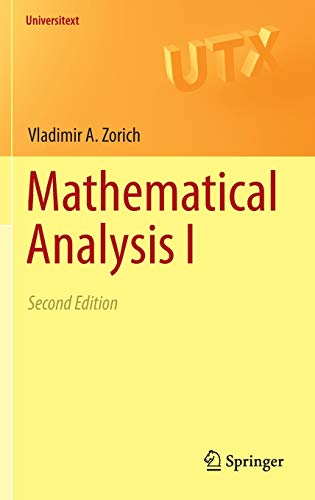
This second edition of a very popular two-volume work presents a thorough first course in analysis, leading from real numbers to such advanced topics as differential forms on manifolds; asymptotic methods; Fourier, Laplace, and Legendre transforms; elliptic functions; and distributions. Especially notable in this course are the clearly expressed orientation toward the natural sciences and the informal exploration of the essence and the roots of the basic concepts and theorems of calculus. Clarity of exposition is matched by a wealth of instructive exercises, problems, and fresh applications to areas seldom touched on in textbooks on real analysis.The main difference between the second and first editions is the addition of a series of appendices to each volume. There are six of them in the first volume and five in the second. The subjects of these appendices are diverse. They are meant to be useful to both students (in mathematics and physics) and teachers, who may be motivated by different goals. Some of the appendices are surveys, both prospective and retrospective. The final survey establishes important conceptual connections between analysis and other parts of mathematics.The first volume constitutes a complete course in one-variable calculus along with the multivariable differential calculus elucidated in an up-to-date, clear manner, with a pleasant geometric and natural sciences flavor.
User’s Reviews
Editorial Reviews: Review “This is a thorough and easy-to-follow text for a beginning course in real analysis … . In coverage the book is slanted towards physics (mostly mechanics), and in particular there is a lot about line and surface integrals. … Will be popular with students because of the detailed explanations and the worked examples.” (Allen Stenger, MAA Reviews, maa.org, May, 2016) From the Back Cover VLADIMIR A. ZORICH is professor of mathematics at Moscow State University. His areas of specialization are analysis, conformal geometry, quasiconformal mappings, and mathematical aspects of thermodynamics. He solved the problem of global homeomorphism for space quasiconformal mappings. He holds a patent in the technology of mechanical engineering, and he is also known by his book Mathematical Analysis of Problems in the Natural Sciences .This second English edition of a very popular two-volume work presents a thorough first course in analysis, leading from real numbers to such advanced topics as differential forms on manifolds; asymptotic methods; Fourier, Laplace, and Legendre transforms; elliptic functions; and distributions. Especially notable in this course are the clearly expressed orientation toward the natural sciences and the informal exploration of the essence and the roots of the basic concepts and theorems of calculus. Clarity of exposition is matched by a wealth of instructive exercises, problems, and fresh applications to areas seldom touched on in textbooks on real analysis.The main difference between the second and first English editions is the addition of a series of appendices to each volume. There are six of them in the first volume and five in the second. The subjects of these appendices are diverse. They are meant to be useful to both students (in mathematics and physics) and teachers, who may be motivated by different goals. Some of the appendices are surveys, both prospective and retrospective. The final survey establishes important conceptual connections between analysis and other parts of mathematics.The first volume constitutes a complete course in one-variable calculus along with the multivariable differential calculus elucidated in an up-to-date, clear manner, with a pleasant geometric and natural sciences flavor.“…Complete logical rigor of discussion…is combined with simplicity and completeness as well as with the development of the habit to work with real problems from natural sciences. ” From a review by A.N. Kolmogorov of the first Russian edition of this course“…We see here not only a mathematical pattern, but also the way it works in the solution of nontrivial questions outside mathematics. …The course is unusually rich in ideas and shows clearly the power of the ideas and methods of modern mathematics in the study of particular problems….In my opinion, this course is the best of the existing modern courses of analysis.” From a review by V.I.Arnold About the Author VLADIMIR A. ZORICH is professor of mathematics at Moscow State University. His areas of specialization are analysis, conformal geometry, quasiconformal mappings, and mathematical aspects of thermodynamics. He solved the problem of global homeomorphism for space quasiconformal mappings. He holds a patent in the technology of mechanical engineering, and he is also known by his book “Mathematical Analysis of Problems in the Natural Sciences”. Read more
Reviews from Amazon users which were colected at the time this book was published on the website:
⭐This is a wonderful first of two book on mathematical analysis used at the Moscow state university in the same Russian tradition of Kudriatsev Mathematical Analysis and Finkhtengolt The fundamentals of Mathematical Analysis.The level of this book is at about same with Baby Rubin (Principles of Mathematical Analysis) but is way less terse. Rudin seems to be more influence by that French diseased called Bourbaki. This first book covers Limits, Derivative and Integration in one variable and Derivatives for multi variable in about 600 pages and then about 700 pages for the second volume to cover integration on multi variable. So these books go into a lot of detail that Rudin does not get into. Is like flying 30000 feet high with Rudin while these books are flying at a mere 10 meters high!There is also the intention of exposing applications of Analysis to Physics. Some worked examples of applications of this mathematical machinery to solve physical problems.These are wonderfully written books a must have. Even if you enjoy Rudin’s 30 k view is always good to get down to a low level.
⭐The best analysis book from the country of analysis: Russia. Always like their extensive usage of little o and big O.
⭐Excellent, I like this book, I’m use it as a supplementary book for my course
⭐An amazing book for studying Mathematical Analysis.
⭐The quality of binding in the ORIGINAL 2004 EDITION is MUCH better than in this edition. In this edition the hardcover feels very unstable and in fact, for Analysis I (I have both volumes), the hardcover detached from the paper in just a year. The material between the 1st and 2nd edition is of negligible difference, so I would recommend the original edition for quality reasons alone.
⭐Este libro lo encontré en la biblioteca de mi facultad. Usaba el magnífico “Análisis Matemático” de Kudriavtsev y buscaba otro que tuviera esa formalidad, rigor y flexibilidad. Este libro tiene eso. Además no pierde de vista el punto geométrico que es bastante importante.Un bon livre d’analyse !
⭐
Keywords
Free Download Mathematical Analysis I (Universitext) in PDF format
Mathematical Analysis I (Universitext) PDF Free Download
Download Mathematical Analysis I (Universitext) 2015 PDF Free
Mathematical Analysis I (Universitext) 2015 PDF Free Download
Download Mathematical Analysis I (Universitext) PDF
Free Download Ebook Mathematical Analysis I (Universitext)