Ebook Info
- Published: 1992
- Number of pages: 382 pages
- Format: PDF
- File Size: 29.39 MB
- Authors: Underwood Dudley
Description
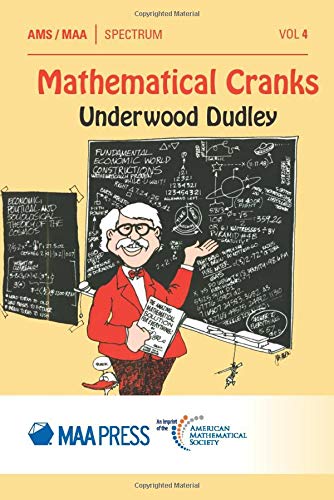
A delightful collection of articles about people who claim they have achieved the mathematically impossible (squaring the circle, duplicating the cube); people who think they have done something they have not (proving Fermat’s Last Theorem); people who pray in matrices; people who find the American Revolution ruled by the number 57; people who have in common eccentric mathematical views, some mild (thinking we should count by 12s instead of 10s), some bizarre (thinking that second-order differential equations will solve all problems of economics, politics and philosophy). This is a truly unique book. It is written with wit and style and is a part of folk mathematics.
User’s Reviews
Editorial Reviews: Review ‘A delightful collection of true accounts of individuals who claim to have achieved the mathematically impossible … It is hard to put down and provides topics for an unending series of interesting discussions. The organization and breadth of the book are impressive, supported by a helpful index and a list of resources that encourage further explorations. A classic.’ Choice’Dudley Underwood extracts insights from an astonishing variety of examples.’ Robert Matthews, New Scientist Book Description A delightful collection of articles about people who claim they have achieved the mathematically impossible. Book Description A delightful collection of articles about people who claim they have achieved the mathematically impossible (squaring the circle, duplicating the cube); people who think they have done something they have not (proving Fermat’s Last Theorem) and people with very eccentric views (thinking that second-order differential equations will solve all problems of economics, politics and philosophy). About the Author Underwood Dudley received his PhD from the University of Michigan and taught briefly at Ohio State University before accepting a position at DePauw where he has taught since 1967. He has been active in the publications program of the Mathematical Association of America (MAA) for over fifteen years as an Associate Editor of Mathematics Magazine Collaborating Editor of the Problem Section of The American Mathematical Monthly and as Chair of the Anneli Lax New Mathematical Library Editorial Board. He is currently the Editor of the College Mathematics Journal. His other publications include: “Numerology, or What Phythagoras Wrought,” “The Trisectors,” and “Readings for Calculus,” published by the MAA and “Elementary Number Theory,” published by W. H. Freeman. Read more
Reviews from Amazon users which were colected at the time this book was published on the website:
⭐If you’re a scientist or somebody who just likes to surf the internet for articles and forums about science, then you’ve no doubt run into “cranks”. These include people into pseudo-science, conspiracy theorists, and others who keep pushing for crazy ideas that really have no basis in the scientific method. Even after their claims have been debunked, that doesn’t stop them; it only makes them more determined to find excuses to rationalize away the opposing explanations from scientists, and keep trying to push their hogwash as being “science”. Many of them self-publish their own books, complete with incomprehensible sentences and no real use of established scientific terms, symbols and nomenclature. When defeated, quite often they’ll end up responding to the real scientists with the excuse of “Well you can’t be 100% sure that you’re correct, and you can’t 100% prove that my crazy idea is wrong. Therefore we’re at a stalemate, and there’s still a chance that I’m correct!” Ugh.You would think that this wouldn’t happen in mathematics, since mathematics deals with the abstract and pure logic, not experimentation, and can thus offer an irrefutable proof on why a theorem is true or false. So since we have the mathematical proof that pi is irrational, then that should settle it, right? Unfortunately, mathematical cranks do exist. And that’s who this book is about.The author has collected dozens and dozens of different examples of works from mathematical cranks, and compiled them all here. The people’s last names have been hidden. But you’ll see some jaw-droppingly crazy proposals sent in to various universities and math periodicals. Each example is, on average, just a few pages long, complete with a background story from the author. You can read it from beginning to end, or just flip around to the different examples. Geeky math humor at its best!
⭐In this book, math professor Underwood Dudley catalogues the characteristics and errors of mathematical cranks. These are the people, usually mathematical amateurs, who believe they have done the impossible: squared the circle, calculated a different value of pi (or in some cases, several different values), and so forth. Math has the advantage over darn near every other human system that one can absolutley prove these people are wrong, but that doesn’t stop a true crank.I am no math whiz, and a lot of this book is over my head. But I am a crank enthusiast (if you are, too, the best World Wide Web cranks can be found at Crank.net, with which I have no affiliation). What interests me most in this book, other than Dudley’s enthusiastic and deft writing, are his catalogues of crank behavior — for instance, how they can go from enthusiastic amateur to demented conspiracy theorist rather than simply admit nobody’s paying attention to them because they’re wrong. The math-oriented parts of the book are interesting case studies, and the crank-oriented parts have general application to all cranks, even of the non-mathematical variety. This makes for a useful and entertaining book.
⭐This book is about people who are convinced they have done something difficult, incredible or (provably) impossible. Or perhaps they discovered a deep and hidden truth about the universe. Or a government conspiracy. Or a flaw in the proof of a classical theorem. Unfortunately though, their ideas just don’t make sense.It is tough for these folks. They believe they deserve a great prize, fame or fortune. But no one will even hit play on MGMT’s congratulations for them. The professional maths community won’t entertain their ideas. It seems there is a cover up of their discoveries. Desperate, they resort to mailing hundreds or thousands of letters to mathematics departments, newspapers and anyone who will listen. The harder they try, the more it seems they are being persecuted. They get cranky!This book surveys the scene. The author keeps things fun and light, while being gentle and understanding that many cranks are real people doing their best, perhaps struggling with e.g. paranoia. The types of problems that attract cranks are identified, along with tips about recognising crank behaviour. Brief background for some of the problems is given. It is acknowledged that some conjectures made by cranks are actually interesting or non-obvious, at least! I got a few evenings entertainment revisiting some of the number theory “conjectures” with the help of a computer (the crank examples are all from before home computers became common place).E.g. p240, conjecture 27- “every even number is the sum of a Fibonacci number and a prime, except 148 and 208″Actually 148 can be written as the sum of a prime and Fibonacci in two ways:59 (17th prime) + 89 (11th Fib)127 (31st prime) + 21 (8th Fib)A few that can’t be written this way: 208, 416, 718, 768, 784, 926.Anyway, basically I enjoyed this book, even if I noticed crank behaviour in myself after reading it!
Keywords
Free Download Mathematical Cranks (Spectrum) in PDF format
Mathematical Cranks (Spectrum) PDF Free Download
Download Mathematical Cranks (Spectrum) 1992 PDF Free
Mathematical Cranks (Spectrum) 1992 PDF Free Download
Download Mathematical Cranks (Spectrum) PDF
Free Download Ebook Mathematical Cranks (Spectrum)