

Ebook Info
- Published: 2013
- Number of pages: 230 pages
- Format: PDF
- File Size: 6.29 MB
- Authors: Tomasz Placek
Description
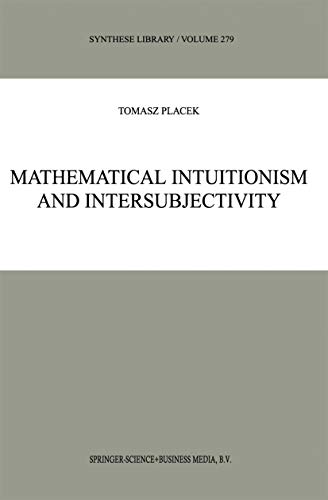
In 1907 Luitzen Egbertus Jan Brouwer defended his doctoral dissertation on the foundations of mathematics and with this event the modem version of mathematical intuitionism came into being. Brouwer attacked the main currents of the philosophy of mathematics: the formalists and the Platonists. In tum, both these schools began viewing intuitionism as the most harmful party among all known philosophies of mathematics. That was the origin of the now-90-year-old debate over intuitionism. As both sides have appealed in their arguments to philosophical propositions, the discussions have attracted the attention of philosophers as well. One might ask here what role a philosopher can play in controversies over mathematical intuitionism. Can he reasonably enter into disputes among mathematicians? I believe that these disputes call for intervention by a philo sopher. The three best-known arguments for intuitionism, those of Brouwer, Heyting and Dummett, are based on ontological and epistemological claims, or appeal to theses that properly belong to a theory of meaning. Those lines of argument should be investigated in order to find what their assumptions are, whether intuitionistic consequences really follow from those assumptions, and finally, whether the premises are sound and not absurd. The intention of this book is thus to consider seriously the arguments of mathematicians, even if philosophy was not their main field of interest. There is little sense in disputing whether what mathematicians said about the objectivity and reality of mathematical facts belongs to philosophy, or not.
User’s Reviews
Reviews from Amazon users which were colected at the time this book was published on the website:
⭐In this revised version of his doctoral dissertation, philosopher Tomasz Placek investigates three questions about intuitionism, a philosophy of mathematics that began in the early 20th century. The first question is whether intuitionism allows for the intersubjectivity of mathematical knowledge (or conversely, whether classical philosophy of mathematics does). The second question is how intuitionists view meaning, whether these views are sound, and how they relate to other aspects of intuitionism, such as its rejection of the law of the excluded middle. The third question is whether “militant intuitionism,” that is, intuitionism that claims classical philosophy of mathematics is fundamentally flawed and should be replaced by intuitionism, is justified.Placek proceeds by giving overviews of the philosophies of three intuitionists: L.E.J. Brouwer, Arend Heyting, and Michael Dummett. Though they were heavy going, it is these overviews themselves that I found the most valuable part of the book. They drew on far-flung portions of each author’s work to form cogent, step-by-step presentations of the author’s views on specific questions of interest for answering Placek’s overarching objectives.Placek’s own responses to each author were a bit uneven. In most cases his conclusions seemed well-taken to me (though perhaps a professional philosopher would find more to critique). However, on occasion he would write that such and such “seems absurd,” when this seemed to me a subjective view, which I did not share. Or he would write that of course we couldn’t expect such an argument to convince the classical mathematician, and I would wonder why not. As a classically trained mathematician myself, I found Placek’s mental model of a classical mathematician somewhat alien.Placek concludes by answering the three questions as follows. He does not find the attacks on either intuitionism or classical philosophy of mathematics on the grounds that they forestall intersubjectivity to be sound. He finds the most substantial exposition of how intuitionists view meaning in Heyting’s writings, which refer to Oskar Becker and Husserl. Finally, he finds the intuitionists’ arguments against classical mathematics to be inadequate.I was satisfied with Placek’s observations on the first question. His second question points me to other sources I might follow up on, though my interest in meaning independent of use is limited.It is on the third question that I disagree with Placek most. In the appendix, which I found particularly valuable, Placek summarized Heyting’s demonstration that classical mathematics with the law of the excluded middle leads to a contradiction. The argument hinges on the notion of choice sequences. On p. 126, Placek writes, “the weak point of [the intuitionists’] line of argumentation is the assessment of what is less philosophically neutral. Is it really so that the Platonist concept of arbitrary sequence of natural numbers is more philosophically loaded than the notion of choice sequence? We leave this question unanswered as we do not see any way to handle it.” It seems pretty clear to me that the answer to the question is yes. Even if we posit that the two are simply philosophically equivalent, that still leaves the demonstration in the appendix intact.Placek writes in his concluding remarks about the third question on p. 196, “Perhaps most promising is the argument, which we attributed to both Brouwer and Heyting, that tries to show that in reasoning pertaining to choice sequence we need to understand the logical constants in the intuitionistic way, it being further assumed that choice sequence is a general notion for infinite sequences, its special case being sequences determined by laws of progression. It is, however, plain in this case as well, since choice sequences have no place in classical mathematics, that there is much more to be done to make the argument convincing.” I have no idea what Placek means by “choice sequences have no place in classical mathematics.” The definition of choice sequences is quite basic and much less exotic than other concepts that classical mathematicians form and build on all the time. Choice sequences do not “look odd” (p. 146) at all, to this (heretofore) classical mathematician.It seems to me that Placek considers classical mathematicians to be so attached to their pre-existing positions that they would impose some indefinite additional burden of proof on the intuitionist. Be that as it may, his presentation of Brouwer’s and especially Heyting’s arguments has sufficed to convince me personally that classical philosophy of mathematics, like many “folk” disciplines, does not stand up to deep scrutiny, and is in need of replacement. Whether some version of intuitionism is suitable for that purpose would require more investigation on my part.
⭐
Keywords
Free Download Mathematical Intuitionism and Intersubjectivity: A Critical Exposition of Arguments for Intuitionism (Synthese Library Book 279) 1999th Edition in PDF format
Mathematical Intuitionism and Intersubjectivity: A Critical Exposition of Arguments for Intuitionism (Synthese Library Book 279) 1999th Edition PDF Free Download
Download Mathematical Intuitionism and Intersubjectivity: A Critical Exposition of Arguments for Intuitionism (Synthese Library Book 279) 1999th Edition 2013 PDF Free
Mathematical Intuitionism and Intersubjectivity: A Critical Exposition of Arguments for Intuitionism (Synthese Library Book 279) 1999th Edition 2013 PDF Free Download
Download Mathematical Intuitionism and Intersubjectivity: A Critical Exposition of Arguments for Intuitionism (Synthese Library Book 279) 1999th Edition PDF
Free Download Ebook Mathematical Intuitionism and Intersubjectivity: A Critical Exposition of Arguments for Intuitionism (Synthese Library Book 279) 1999th Edition