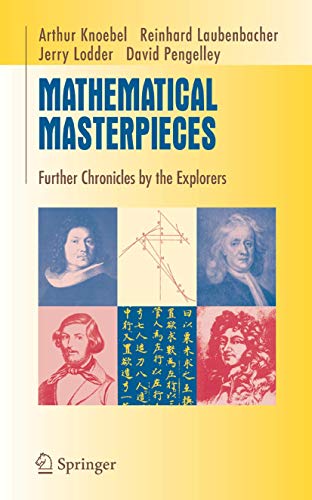
Ebook Info
- Published: 2007
- Number of pages: 352 pages
- Format: PDF
- File Size: 8.44 MB
- Authors: Art Knoebel
Description
Intended for juniors and seniors majoring in mathematics, as well as anyone pursuing independent study, this book traces the historical development of four different mathematical concepts by presenting readers with the original sources. Each chapter showcases a masterpiece of mathematical achievement, anchored to a sequence of selected primary sources. The authors examine the interplay between the discrete and continuous, with a focus on sums of powers. They then delineate the development of algorithms by Newton, Simpson and Smale. Next they explore our modern understanding of curvature, and finally they look at the properties of prime numbers. The book includes exercises, numerous photographs, and an annotated bibliography.
User’s Reviews
Editorial Reviews: Review From the reviews:”This book is closely related to courses of mathematics held for students at New Mexico State University … . An important aspect of the book is the numerous exercises, which should help students to gain a deeper insight into the presented material. Numerous references and well-organized indices make the book easy to use. It can be recommended for university libraries and students with an interest in the history of mathematics presented from a modern point of view.” (EMS Newsletter, September, 2008)”This book consists of four chapters, each of which presents a ‘sequence of selected primary sources’ leading up to a ‘masterpiece of mathematical achievement’. … Each chapter contains … lots of historical comments sketching the further development of the topic. There are also a lot of exercises. … This is a well written and entertaining book that can (and should) be used in seminars or reading courses.” (Franz Lemmermeyer, Zentralblatt MATH, Vol. 1140, 2008) From the Back Cover Experience the discovery of mathematics by reading the original work of some of the greatest minds throughout history. Here are the stories of four mathematical adventures, including the Bernoulli numbers as the passage between discrete and continuous phenomena, the search for numerical solutions to equations throughout time, the discovery of curvature and geometric space, and the quest for patterns in prime numbers. Each story is told through the words of the pioneers of mathematical thought. Particular advantages of the historical approach include providing context to mathematical inquiry, perspective to proposed conceptual solutions, and a glimpse into the direction research has taken. The text is ideal for an undergraduate seminar, independent reading, or a capstone course, and offers a wealth of student exercises with a prerequisite of at most multivariable calculus.
Reviews from Amazon users which were colected at the time this book was published on the website:
⭐”The most efficient logical order for a subject is usually different from the best psychological order in which to learn it. Much mathematical writing is based too closely on the logical order of deduction in a subject, with too many definitions without, or before, the examples which motivate them, and too many answers before, or without, the equations they address.” – William ThurstonThis book has an enjoyable “psychological order” that presents some great pieces of mathematics.
⭐This clumsily written book consists of short translations from primary texts with rambling historical introductions and ineffectual commentary. The selections are quite unoriginal; most of them are available in other English editions, typically with much more intelligent notes.The shortcomings of the book may be illustrated by some characteristic missteps in the section on Huygens’ work on evolutes (section 3.2).First of all the authors grossly misrepresent Huygens’ work to make it fit their preconceived narrative. They are interested in this work by Huygens only as a precursor of the the idea of curvature and the osculating circle, and thus they define evolutes as loci of centers of curvature (p. 170). Huygens himself, however, never mentioned the idea of the osculating circle but rather defined evolutes mechanically in terms of unwinding strings. As a result of this the authors’ commentary on the Huygens selection is misleading. For example the authors try to assist the reader in understanding the selection from Huygens by introducing it with this comment:”Recall that a tangent to a circle at some point B is perpendicular to the radius drawn from the center of the circle to B, a fact that Huygens used liberally in his description of the circle that best matches a given curve at a given point.” (p. 174)But this is completely false. Huygens did not use this fact “liberally”, or even at all. To Huygens, the fact that a tangent to the evolute hits the evolved curve at right angles is not a consequence of this trivial property of circles but rather a theorem to be proved starting with the string definition of evolutes (in fact it is Proposition I, Section III, of the Horologium Oscillatorium, which is earlier in the same section that the excerpt is taken from).What is the point of pretending to use historical sources if you are going to completely ignore what the author was trying to do and simply use his text as an excuse to talk about your own view of the subject?Another illustration of the authors’ utter lack of historical understanding is this:”Since acceleration was not yet articulated as a separate concept, Huygens expressed constant acceleration as ‘In equal times equal amounts of velocity are added to a falling body, and in equal times the distances crossed by a body falling from rest are successively increased by an equal amount.'” (p. 173)How on earth the authors could have gotten it into their heads that “acceleration was not yet articulated as a separate concept” is a mystery to me, especially as Huygens himself explicitly states that the theorem just quoted concerns “the laws of acceleration of freely falling bodies” on the very same page that the authors are trying to cite (namely p. 34 of the English translation, not p. 43 as the authors write with their usual negligence).Indeed, a minute or two at Google Books confirms that the authors’ nonsense is miles off the mark. For example in an English dictionary published in 1675 (two years after Huygens’ book) we find “acceleration” defined as “the act of hastening or quickening” and “equable acceleration” as “when the swiftness of any body in motion increases equally in equal times.” Thus, far from being “not yet articulated”, acceleration was such a commonplace notion that it was found in ordinary dictionaries.
⭐For a reader already versed in the topics of this book, it presents a useful historical perspective. Giving an appreciation of what our predecessors fumbled through.The first topic has perhaps the strongest historical tie-in. Relating problems that bedevilled classical European and Asian mathematicians to the rise of calculus. These concered the sums of infinite series. Pondering this problem with no definitive solution was the status quo for centuries. It took the genius of Euler to finally furnish an answer. For the modern reader, this narrative shows one of Euler’s masterpieces of deduction.Another topic is about numerical solutions of linear and non-linear equations. Today this is germane because of our computers. Yet, hard as it is to imagine, the methods were also pondered centuries ago, when all this had to be done by hand.
⭐
Keywords
Free Download Mathematical Masterpieces: Further Chronicles by the Explorers (Undergraduate Texts in Mathematics) 2007th Edition in PDF format
Mathematical Masterpieces: Further Chronicles by the Explorers (Undergraduate Texts in Mathematics) 2007th Edition PDF Free Download
Download Mathematical Masterpieces: Further Chronicles by the Explorers (Undergraduate Texts in Mathematics) 2007th Edition 2007 PDF Free
Mathematical Masterpieces: Further Chronicles by the Explorers (Undergraduate Texts in Mathematics) 2007th Edition 2007 PDF Free Download
Download Mathematical Masterpieces: Further Chronicles by the Explorers (Undergraduate Texts in Mathematics) 2007th Edition PDF
Free Download Ebook Mathematical Masterpieces: Further Chronicles by the Explorers (Undergraduate Texts in Mathematics) 2007th Edition