

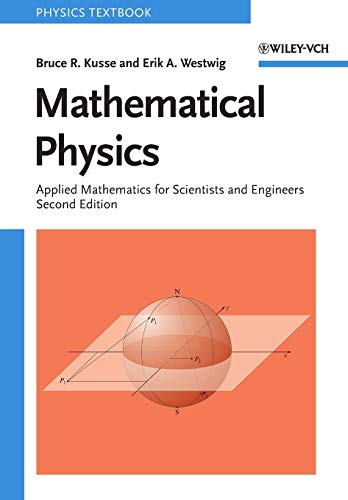
Ebook Info
- Published: 2006
- Number of pages: 689 pages
- Format: PDF
- File Size: 9.70 MB
- Authors: Bruce R. Kusse
Description
What sets this volume apart from other mathematics texts is its emphasis on mathematical tools commonly used by scientists and engineers to solve real-world problems. Using a unique approach, it covers intermediate and advanced material in a manner appropriate for undergraduate students. Based on author Bruce Kusse’s course at the Department of Applied and Engineering Physics at Cornell University, Mathematical Physics begins with essentials such as vector and tensor algebra, curvilinear coordinate systems, complex variables, Fourier series, Fourier and Laplace transforms, differential and integral equations, and solutions to Laplace’s equations. The book moves on to explain complex topics that often fall through the cracks in undergraduate programs, including the Dirac delta-function, multivalued complex functions using branch cuts, branch points and Riemann sheets, contravariant and covariant tensors, and an introduction to group theory. This expanded second edition contains a new appendix on the calculus of variation — a valuable addition to the already superb collection of topics on offer. This is an ideal text for upper-level undergraduates in physics, applied physics, physical chemistry, biophysics, and all areas of engineering. It allows physics professors to prepare students for a wide range of employment in science and engineering and makes an excellent reference for scientists and engineers in industry. Worked out examples appear throughout the book and exercises follow every chapter. Solutions to the odd-numbered exercises are available for lecturers at www.wiley-vch.de/textbooks/.
User’s Reviews
Editorial Reviews: Review “Any lecturer on mathematical methods is also looking for worked examples and numerous exercises. This book passes these tests admirably. […] In summary, a welcome addition to the good books in this area.” Australian PHYSICS “Insgesamt ist das Buch allen Studierenden zu empfehlen, die über den Tellerrand eines mathematischen Grundkurses hinausgehen wollen und gleichzeitig physikalische Motivationen suchen.” Physik Journal Januar 2008 From the Inside Flap The second, corrected edition of this well-established mathematical text again puts its emphasis on mathematical tools commonly used by scientists and engineers to solve real-world problems. Using a unique approach, it covers intermediate and advanced material in a manner appropriate for undergraduate students. Based on author Bruce Kusse’s course at the Department of Applied and Engineering Physics at Cornell University, Mathematical Physics begins with essentials such as vector and tensor algebra, curvilinear coordinate systems, complex variables, Fourier series, Fourier and Laplace transforms, differential and integral equations, and solutions to Laplace’s equations. The book moves on to explain complex topics that often fall through the cracks in undergraduate programs, including the Dirac delta-function, multivalued complex functions using branch cuts, branch points and Riemann sheets, contravariant and covariant tensors, and an introduction to group theory. The book covers applications in all areas of engineering and the physical science, and features numerous figures and worked-out examples throughout the text. Many end-of-chapter exercises are provides; a free solution manualis available for lecturers. The topics are organized pedagogically, in the order they will be most easily understood.From the contents: A review of Vector and Matrix Algebra Using Subscript/Summation Conventions Differential and Integral Operations on Vector and Scalar Fields Curvilinear Coordinate Systems Tensors in Orthogonal and Skewed Systems The Dirac Function Complex Variables Fourier Series Fourier and Laplace Transforms Differential Equations Solutions to Laplace’s Equation Integral Equations From the Back Cover The second, corrected edition of this well-established mathematical text again puts its emphasis on mathematical tools commonly used by scientists and engineers to solve real-world problems. Using a unique approach, it covers intermediate and advanced material in a manner appropriate for undergraduate students. Based on author Bruce Kusse’s course at the Department of Applied and Engineering Physics at Cornell University, Mathematical Physics begins with essentials such as vector and tensor algebra, curvilinear coordinate systems, complex variables, Fourier series, Fourier and Laplace transforms, differential and integral equations, and solutions to Laplace’s equations. The book moves on to explain complex topics that often fall through the cracks in undergraduate programs, including the Dirac delta-function, multivalued complex functions using branch cuts, branch points and Riemann sheets, contravariant and covariant tensors, and an introduction to group theory. The book covers applications in all areas of engineering and the physical science, and features numerous figures and worked-out examples throughout the text. Many end-of-chapter exercises are provides; a free solution manualis available for lecturers. The topics are organized pedagogically, in the order they will be most easily understood.From the contents: A review of Vector and Matrix Algebra Using Subscript/Summation Conventions Differential and Integral Operations on Vector and Scalar Fields Curvilinear Coordinate Systems Tensors in Orthogonal and Skewed Systems The Dirac Function Complex Variables Fourier Series Fourier and Laplace Transforms Differential Equations Solutions to Laplace’s Equation Integral Equations About the Author Bruce Kusse is Professor of Applied and Engineering Physics at Cornell University, where he has been teaching since 1970. He holds a PhD from the MIT in electrical engineering with a specialty in plasma physics. Erik Westwig is a software engineer with Palisade Corporation, New Jersey. He holds an MS in applied physics from Cornell University. Read more
Reviews from Amazon users which were colected at the time this book was published on the website:
⭐This textbook gets right to the point and teaches very high level topics in chunks that anyone can understand
⭐I was a student in Professor Kusse’s AEP 321/322 course in the Fall of 1990/Spring 1991. He is a very clear instructor of the concepts presented, and I remember his lectures were at a different level than the texts selected for the class — the lectures were geared to the level of sophomores/juniors having completed a three-semester sequence in engineering mathematics at the level of Thomas/Finney, whereas the texts (Arfkin, Butkov) seemed geared more towards a graduate-level audience. The lectures are what carried the course for me.I stumbled upon this book recently, picked up a copy, and compared it to my notes from the course — it is the same clear style and target audience as his lectures were, but far more polished.One would serve one’s students exceptionally well with this text for a similar course.
⭐A fine book in terms of coverage but a few words of caution. If you are a person who might get confused by strange notation, then this book is definitely not for you. However, the book covers a wide variety of topics at a superficial level which is suitable for students learning mathematical physics for the first time. The discussion on the Green functions is very illuminating and the authors also spend a lot of time in Fourier/Laplace transforms. The exercises at the end of each chapter are also good for practice (another heads-up here, there are some places where the questions are either vague or do not make sense but the authors compensate with the errata list. Hope the book is updated by the next edition)
⭐has some odd notation and skips too many steps in some examples for my liking, but overall it covers a lot of useful material
⭐Great reference book
⭐I find the last negative review surprising. I probably own around two dozen mathematics and physics textbooks, and “Mathematical Physics” has been the most useful of them throughout my career. I enjoy the combination of mathematical proof and myriad examples used as well as the informal and conversational writing style that is built for understanding.The latest review spends a great deal of time discussing the notation used. Note that the book has a subtitle “Applied Mathematics for Scientists and Engineers”. With such a broad audience, any notation used will be familiar to some but not so familiar to others. What is important is that the notation is consistent throughout the text, and is always defined when it is initially used. Instructors (and students!) should be flexible enough to adjust to different notations, a phenomenon that occurs often. Having said that, I have a graduate degree in physics, and though the notation may not exactly match that used in other texts, I have never found it to be cumbersome.Also discussed is the chapter on complex integration. Again, I disagree with the review. The chapter is long because the subject is nuanced and probably completely new to the student. And it *is* broken into manageable chunks, twelve sub-sections to be exact. Anyone instructing using the text should be able to easily break the chapter into many lectures. Like the rest of the text, there is a good mix of mathematical proof and practical example.When considering the chapter on differential equations, note that this is a subject that can be a course unto itself. Not every detail of the numerous methods provided can be included. Incredibly, though, I’ve found the methods selected and details provided in the text to be apropos to my post-graduate needs.Also, I like the last chapter on group theory. While it stands apart from the rest of the material, it provides some insight into the mathematics used in the most advanced subjects in physics. Replacing it with a chapter on the calculus of variations would bring in a very large topic that really should be taught in a different course such as analytical mechanics.I highly recommend this text for anyone considering to use it to instruct a course or as a useful reference to supplement their current knowledge base.
⭐This is a truly terrible text book, and I can’t believe no one has stepped up and stated that yet. I had the misfortune of having to TA a course using this text this semester and I am making the recommendation that they jettison this book in favour of any other mathematical physics text. In particular the lecturer almost switched to the extremely good Riley Hobson and Bence
⭐and I am so annoyed I didn’t push for this change then.So what’s so wrong with this textbook? I must admit I enjoyed the large font and reduced size compared to RBH. It offered a good range of subjects but with less depth which can actually be a bonus for the more intimidated of undergraduates. However, once I started having to write solutions and get stuck into the text I found it extremely lacking. I worked on chapters 1,2,3,4,5,6,9,10,11 and 13 so I gained a pretty comprehensive oversight of the text, so my comments are not just based on a few excerpts here and there.The first and most fundamental issue, mentioned by another review but not nearly emphasised enough is the bizarre notation. No physicist I’ve ever met puts square brackets around matrices, i.e. writes an arbitrary matrix A as [A]. This leads to awful cluttering of notation and from day 1 I said to ignore it and write matrices simply with a letter. The book clearly spends a lot of time arranging its notation to avoid ambiguity but the fact of the matter is that physics notation is highly ambiguous, and there’s no point learning clear, precise notation in one textbook only to be totally confused once you start working in the field proper.The notation oddities continue: vectors are bold and overlined, a notation I have never seen anywhere. I think it is to make the link between the bold double overlined dyadic notation for tensors (awful in itself for the fact it is also rarely used in the literature). But it is simply a strange notation: vector notation has nothing to do with tensor notation (it is bold in texts or over arrows on paper) and that is simply something students have to deal with. Text books of this level simply can’t introduce such unorthodox notation because first time students don’t know they are looking at odd notation. The last egregious notation I noticed was to use underlines for complex numbers.The reason this is such an issue, and worthy of docking so many points, isn’t because I, the instructor can’t follow the reasoning. It’s because, as instructor, I’ve had to break the students of the texts notation before they’ve even learned the mathematics. I thus spent an inordinate amount of time trying to instill standard notation simply so they aren’t ruined for their next course in E&M &c. But this is terrible because students use their textbook and it should accord with the majority’s way of doing things. Mathematical methods aren’t a forum for innovative notation and anyone who thinks it is hasn’t had to contend with an undergraduate course schedule for far too long.There are other problems too. The chapter on complex integration is far too long. It should have been broken into more manageable chunks. The section on Laurent series convergence is perhaps too heavy for a chapter whose real motivation should be getting contour integrals done (students using this text aren’t mathematicians and shouldn’t be treated as such). Such tricky issues like annular regions of convergence should be relegated to appendices to keep the main exegesis clear.Another small but totally inexcusable omission is introducing series solutions without explaining what regular and ordinary points are. This means all series solutions are solved using Frobenius which is totally unnecessary. It also hides the fact that convergence around regular points is only managed by having additional powers of x in your solution (achieved by the extra factor x^s in the method of Frobenius) which you don’t need around an ordinary point. The book doesn’t even make it explicit that they are solving around a particular point at all. For a text so keen on it’s convergence proofs in chapter 6 it becomes extremely lax about such things in chapter 10. And without mentioning irregular points here it doesn’t show that these series solutions can totally break down as well, a point few students would realise on their own.I have also noticed some mistakes that aren’t mentioned in the errata, which is a nightmare for self studying students. To give a concrete example in case the publisher reads this, Chapter 6 Q38 iv. (an integral) is undefined. I’m sure there are other errors I’ve missed that would hinder independent study.A final comment on the content. If it weren’t taught in such an unorthodox fashion I would quite like the spread of material and the order in this book, except for the final chapter on group theory. Group theory simply has no place here and the space would better suit a chapter on the calculus of variations, a far more applicable piece of mathematical physics.It is so difficult to recommend a book that obstinately tries to subvert the accepted norms of the field. I would be really interested to know if the authors actually use their own notation or have tried to teach this notation to students coming in with their own more normal practices. The strange omissions elsewhere do nothing to further my appreciation of the text. Perhaps the fact that both authors are engineers explains the strange choices evident throughout this text, because no physicist would recognise the conventions introduced here.Avoid. Buy the text by RBH which comprehensively covers much, much more, while still being readable and maintaining standard mathematical physics notations. It’s also a fair bit cheaper despite being several hundred pages longer, containing a useful section on probability, statistics and representation theory and being much better in every possible way.
Keywords
Free Download Mathematical Physics: Applied Mathematics for Scientists and Engineers 2nd Edition in PDF format
Mathematical Physics: Applied Mathematics for Scientists and Engineers 2nd Edition PDF Free Download
Download Mathematical Physics: Applied Mathematics for Scientists and Engineers 2nd Edition 2006 PDF Free
Mathematical Physics: Applied Mathematics for Scientists and Engineers 2nd Edition 2006 PDF Free Download
Download Mathematical Physics: Applied Mathematics for Scientists and Engineers 2nd Edition PDF
Free Download Ebook Mathematical Physics: Applied Mathematics for Scientists and Engineers 2nd Edition