

Ebook Info
- Published: 2009
- Number of pages: 208 pages
- Format: PDF
- File Size: 31.75 MB
- Authors: Mariana Cook
Description
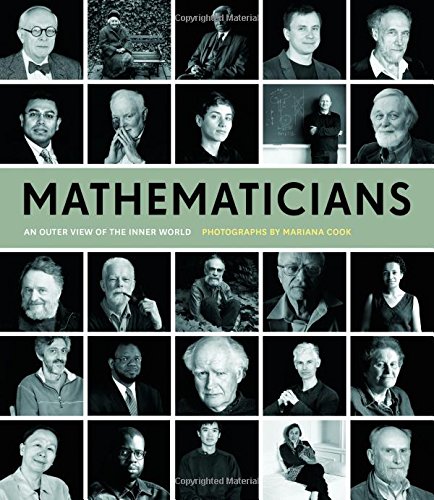
Mathematicians is a remarkable collection of ninety-two photographic portraits, featuring some of the most amazing mathematicians of our time. Acclaimed photographer Mariana Cook captures the exuberant and colorful personalities of these brilliant thinkers and the superb images are accompanied by brief autobiographical texts written by each mathematician. Together, the photographs and words illuminate a diverse group of men and women dedicated to the absorbing pursuit of mathematics.The compelling black-and-white portraits introduce readers to mathematicians who are young and old, fathers and daughters, and husbands and wives. They include Fields Medal winners, those at the beginning of major careers, and those who are long-established celebrities in the discipline. Their candid personal essays reveal unique and wide-ranging thoughts, opinions, and humor, as the mathematicians discuss how they became interested in mathematics, why they love the subject, how they remain motivated in the face of mathematical challenges, and how their greatest contributions have paved new directions for future generations. Mathematicians in the book include David Blackwell, Henri Cartan, John Conway, Pierre Deligne, Timothy Gowers, Frances Kirwan, Peter Lax, William Massey, John Milnor, Cathleen Morawetz, John Nash, Karen Uhlenbeck, and many others.Conveying the beauty and joy of mathematics to those both within and outside the field, this photographic collection is an inspirational tribute to mathematicians everywhere.
User’s Reviews
Editorial Reviews: Review “[T]he insights in . . . [this book] will inspire mathematicians and scientists to come.”—Eric L. Altschuler, Nature”Mathematicians: An Outer View of the Inner World presents 92 photographic portraits by Mariana Cook, with an introduction by Robert Clifford Gunning, and an afterword by Brandon Fradd. The book’s concept is simple and elegant: On each right-hand page is a portrait of a mathematician, printed in rich and black and white, and on the facing left-hand page is an autobiographical essay by the subject of the photograph. The portraits are carefully composed and lighted, with a certain formality to them.”—Brian Hayes, American Scientist”The idea of a collection of portraits of mathematicians seems on the face of it as irrational as the square root of two. Intellectually opaque, the practice of higher mathematics is visually null. It can be understood, at least by a few people, but that doesn’t mean it can be seen. . . . Precisely because we can’t glimpse the world mathematicians see, the prospect of glimpsing the faces of those who can becomes all the more intriguing.”—Mark Feeney, Boston Globe”To convey their interior lives, photographer Cook has produced an elegant volume of striking, insightful, black-and-white portraits of 92 mathematicians, each accompanied by autobiographical reflections by the subjects. . . . It is difficult to say who will enjoy browsing the book most: professional mathematicians glad to see old friends, students looking for role models, or interested lay readers curious to learn if a career in a highly abstract pursuit reveals itself on the faces of its practitioners.” ― Choice”[T]his book from Princeton University Press offers 92 large black-and-white studio photographs of mathematicians, each faced by a page of text, 400 to 900 words, in which the featured mathematician talks about himself and his work. . . . There is a quite extraordinary variety of backgrounds, confirming one’s intuition that of all talents, the mathematical one may be most helpful in lifting genius out of obscurity.”—John Derbyshire, National Review Online”Mariana Cook has photographed everyone from Francis Crick to Barack and Michelle Obama but has chosen to turn her lens on a slightly more obscure subject for this collection of black-and-white portraits of mathematicians. She photographed 92 in all, some just beginning their careers, others Fields Medal winners with their fame secure. Accompanying the images are personal essays in which each subject reflects on the obsessions, disappointments, and relationships that continue to endear them to their profession. What emerges is a sincere and candid look inside an often insular field.” ― Seed Magazine”Mathematicians is a hardcover book of photos that centers around 92 well-established mathematicians. It is a work of art that presents, through each of the glossy images (which are printed on excellent quality paper), an autobiographical note on the left, and a large, black and white photograph of a mathematician on the right side. The beautiful portraits, along with the short essays, help the reader to establish a brief emotional connection with each mathematician, as you become privy to the ‘outer view of their inner world.’ . . . Stunning photography and intimate essays make for a great work of art. . . . The affordable price and large format of this book make it a coffee table piece that every geek should have.” ― Math-Blog.com”This book implements a new approach . . . take ninety-two large black-and-white photographs of mathematicians and pair them with accompanying personal reflections by those pictured. The end result of this is a very rare commodity indeed: a coffee-table book about mathematicians. . . .We are treated to memories of parents, schoolteachers, college professors, advisors, and senior colleagues and shown how such people all have roles to play in the nurturing of mathematical talent. This book sends a clear message that competent teachers at all levels are necessary for the health of our profession.”—Todd Eisworth, Notices of the AMS”This book conveys the beauty and joy of mathematics to readers outside the field as well as those in it. These pictures and their texts are an inspiration, and a perfect gift for those who love mathematics as well as for those who think they can’t do it!” ― L’Enseignement Mathematique Review “The startling contrast between lined faces and lively minds suggests that the passionate pursuit of mathematics is an ideal formula for aging gracefully, even joyfully.”―Sylvia Nasar, author of A Beautiful Mind”Mariana Cook has gathered a wonderful collection of reflective essays by some of the most celebrated living mathematicians and she has captured the essence of these interesting people through her photographs. It was a pleasure to read about the lives and thoughts of these mathematicians whom I have respected for so long. I foresee many mathematicians and mathematics students consuming these morsels with delight.”―David Richeson, author of Euler’s Gem: The Polyhedron Formula and the Birth of Topology From the Inside Flap “The startling contrast between lined faces and lively minds suggests that the passionate pursuit of mathematics is an ideal formula for aging gracefully, even joyfully.”–Sylvia Nasar, author of A Beautiful Mind”Mariana Cook has gathered a wonderful collection of reflective essays by some of the most celebrated living mathematicians and she has captured the essence of these interesting people through her photographs. It was a pleasure to read about the lives and thoughts of these mathematicians whom I have respected for so long. I foresee many mathematicians and mathematics students consuming these morsels with delight.”–David Richeson, author of Euler’s Gem: The Polyhedron Formula and the Birth of Topology From the Back Cover “The startling contrast between lined faces and lively minds suggests that the passionate pursuit of mathematics is an ideal formula for aging gracefully, even joyfully.”–Sylvia Nasar, author ofA Beautiful Mind”Mariana Cook has gathered a wonderful collection of reflective essays by some of the most celebrated living mathematicians and she has captured the essence of these interesting people through her photographs. It was a pleasure to read about the lives and thoughts of these mathematicians whom I have respected for so long. I foresee many mathematicians and mathematics students consuming these morsels with delight.”–David Richeson, author ofEuler’s Gem: The Polyhedron Formula and the Birth of Topology About the Author Mariana Cook’s work is exhibited internationally and held in many major collections, including the Museum of Modern Art, the Metropolitan Museum of Art, and the National Portrait Gallery. Her acclaimed books include Couples, Fathers and Daughters, Mothers and Sons, and Generations of Women (all Chronicle). R. C. Gunning is professor of mathematics at Princeton University. Read more
Reviews from Amazon users which were colected at the time this book was published on the website:
⭐This coffee table book has 92 pages of Mariana Cook’s portraits of mathematicians. Each photograph is faced by a page of personal reflections on mathematics. It is an unlikely idea for a beautiful and revealing book, but it succeeds. Brandon Fradd had the idea and underwrote it. Mariana Cook’s engaged her subjects and caught their images beautifully. The mathematicians managed to convey a great deal in a few words. Princeton University Press did the project proud in its design and production.These people are not similar like peas in a pod. True, they are all talented and have notable achievements, but they come from different backgrounds and along diverse paths. For example, Persi Diaconis was a magician before he became a probabilist. Cook captures a look of wry amusement: still bit of a trickster, perhaps? Lennart Carleson looks at us from a gentle slope verdant with ferns and lichens, his dog beside him. In his essay, he disabuses us of common myths: That there are only a few specially talented people who can do mathematics. That it is a wonderful (and constant?) joy to work on mathematics. That all good mathematics is done by the young. Carleson’s proof of Lusin’s conjecture that the Fourier series of square integrable functions converge almost everywhere stands as one of the virtuoso efforts of all time, and that was one of several such contributions of his. The three Browder brothers, Felix, William, and Andrew, are similar in brilliance but their stories and pictures are different. Felix, who received the National Medal of Science in 1999, mentions early struggles with prejudice because their father had been general secretary of the American Communist Party. The other brothers do not mention such struggles. Mariana Cook has captured the people in this collection that I know as they are. For the others, the portrait, the text and I know of their work fit together. Reading the essays, you will find connections between the people, places, and mathematical content mentioned – even though there is diversity here.Harold Kuhn begins his essay, “The longer I live, the more I believe that our lives are controlled by chance events and the actions of others. My own life confirms this. Here is a chronological account.” His essay makes his point. In his final paragraph, Kuhn mentions his favorite results: the formulation of extensive games as trees, The Hungarian method, and pivoting methods for approximating fixed points. I remember my pleasure when I first encountered these. It is nice to read that their inventor is still taking pleasure in them as well.This book should be in every mathematics common room and library. It is a complement to other books about contemporary mathematicians such as Mathematical People by Gerald L. Alexanderson and Donald J. Albers. Together with MAA books on careers in mathematics, these books will help students understand the range of mathematics in research and applied fields.
⭐This is essentially a coffee table book. A collection of Mathematicians (incuding Field’s medallists and other prominent individuals) photographed in ‘black and white’ by a skilled photographer is accompanied by an entry by the Mathematician.I had originally intended to read one or two entries in my spare time but I was engaged by the stories. This cross scection may not be representative. It did, however, provide insights into the formative factors involved in the Mathematician’s journey to becoming professionals in their field. The diversity of geographical, cultural and socioeconimic backgrounds was inspiring. The range of personality traits suggested by the entries was food for thought for me. The importance of family and mentors seemed to be prevalent, A self sustaining passion and curiosity also suggested itself to me.The photographs are interesting and the choices of surroundings and poses by the subjects was interesting.
⭐This is a large, lavishly presented coffee table style book, presenting a collection of 92 mathematicians. Each has a one page glossy black-and-white photograph and a one page piece, usually partly autobiographical and partly describing their relationship to mathematics. As the introduction admits, the choice of mathematicians is “somewhat random”; there is a high percentage of Americans, and many are from Princeton. Certainly the list includes many famous names. Overall, the book is a very pleasant read, and would be enjoyed by anyone with an affinity for mathematics.
⭐Here we have a bunch of interesting people sharing their relationships with mathematics in short essays. You will find striking views of mathematics together with their motivations to go for it as a career. The whole thing is personal even including photos; some essays are also fun and quite inspiring.
⭐This second book is far more expensive than it should be.
⭐Each mathematician, accomplished, perhaps famous, has a full page photograph and a facing page containing a brief autobiography or statement. It can be read in a few hours.Brandon Fradd, a Princeton math major, thought a photo book of Mathematicians would be well-received after seeing “Scientists” by Mariana Cook. Good idea. Her photographs are striking in black and white. Most of the people were from Princeton (not a big surprise), but individuals from Oxford, Cambridge, Harvard, and a few New York and California schools also made the list – 92 professors in total.Each reader/viewer will respond differently to the brief personal essays. Timothy Gowers (I have two of his works) tries to relate his methods to research strategies, the practical rationality of his words shows a cool balance of thought, but Harold Kuhn’s reference to all of his teachers by name and the sacrifices made by his parents, and the role of chance in meeting people was too easy in which to relate. I cried while reading about him. Of course, Andrew Wiles was photographed. His humility, considering that he proved Fermat’s Last Theorem – his childhood dream, was considerable. William Thurston’s text may have been the most important. He stressed the pain of everyday public school instruction in math for himself, but he didn’t allow it to kill his imagination. He tried to show how internal vision and analysis worked together: paragraphs suggesting the joyful magic in doing mathematics.And yes, the correlation between mathematicians and the love of music is highly positively correlated. I didn’t award 5 stars only because, I reserve 5 stars for life changing – this book really isn’t that.
⭐A sublime photographic still life of the world of mathematicians at a recent moment, ranging from historic figures like Hirzebruch and Milnor to Maryam Mirzakhani, the first woman to win the Fields Medal (and now tragically deceased).
Keywords
Free Download Mathematicians: An Outer View of the Inner World in PDF format
Mathematicians: An Outer View of the Inner World PDF Free Download
Download Mathematicians: An Outer View of the Inner World 2009 PDF Free
Mathematicians: An Outer View of the Inner World 2009 PDF Free Download
Download Mathematicians: An Outer View of the Inner World PDF
Free Download Ebook Mathematicians: An Outer View of the Inner World