

Ebook Info
- Published: 2008
- Number of pages:
- Format: PDF
- File Size: 8.81 MB
- Authors: Schwartz
Description
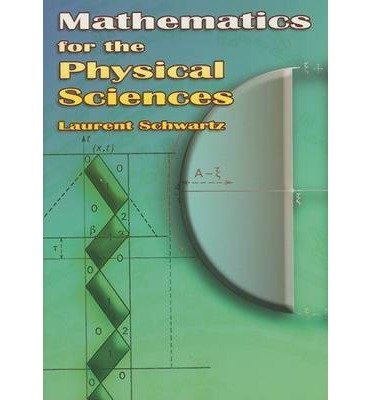
Mathematics for Physical Sciences (08) by Schwartz, Laurent – Mathematics [Paperback (2008)]
User’s Reviews
Reviews from Amazon users which were colected at the time this book was published on the website:
⭐Although this book has standard chapters like “The Wave and Heat Conduction Equations”; “Foruier tTRansform”; “Laplace Transform”; “The Gamma Function”; “Bessel Functions”, the mathematical language used in this book is not really geared towards physicists. This book is not so readable. I would not recommend this book for non-math graduate students.
⭐Initially, I rated this book as four stars, I have since changed that rating–to five stars: As the more I use this textbook, the more I like it ! Preface: “The previous knowledge necessary for the book to be read profitably corresponds to the current first-year university course.” Perhaps, 1966, that may have been true, and–for all I know it may still hold true, needless to say, with only that background as prerequisite, the text will prove quite challenging. Now, while studying this text, I consulted two others: Analysis, Manifolds, and Physics (Choquet, chapter six) and Introduction to the Theory of Distributions (Halperin and Schwartz). Thus, Schwartz–while brilliant–is best utilized as enrichment.What lies ahead ?(1) Preliminaries occupy chapter one: infinite series and integration. For preparation, study chapter one of Sokolnikoff and Redheffer. Note: Exercise 1-8 (page 68,6 9), learn of Feynman and ‘his technique’ for evaluating integrals. Induction, this is a prime motivation throughout Schwartz’ textbook.(2) If you were able to complete chapter one, the remaining content of the book will be easier to digest. Still, it will be challenging. With second chapter begins elementary theory of distributions. If you have a copy of Halperin & Schwartz study it first (a thirty-page-survey). Topology is inserted into the discussion at various junctures (examples: page 99,183). The exercises are a treasure: Glance at page 106, #2-21, this exercise shows relationship between complex variable theory to distributions.(3) Happily, exercises are arranged in order of increasing difficulty. Hints are provided (not answers, though).Study the examples carefully, they are indicative of the types of manipulations and proofs needed for the exercises. Integration-by-parts and induction are utilized throughout (for instance, page 131). Familiarity with inequalities is paramount (page 195; bottom of page 63, “consider the inequality.” Partial Fractions–remember those ? You need them, also (page 129).(4) Connections are made between probability theory and distributions (pages 117 and 123). Many other applications are sprinkled throughout the exposition. Examples: electrostatics, newtonian potential, sound (page 251), waves in various dimensions (page 288, The Notes). You will be introduced to integral equations (page 130) and so-called special functions (Bessel, Gamma, Hermite: especially, chapters eight and nine).You strengthen your skills in complex variables and contour integration (page 184, or page 227). Everything is here for a purpose.(5) Another distinction is the section on Fourier transforms in several variables (pages 200 to 204). Beautiful material !Keep a copy of Weinberger handy: Partial Differential Equations. That may be the number one prerequisite, or, collateral reading. Note: Terminology, ‘stationary wave motion’ recalls ‘separation-of-variables.’ (page 271).(6) Allow me to conclude my review. I could continue, but, I fear the review would grow without bound.This text–or, more appropriately, this reference–is packed full of fascinating material. The exercises are a rich source of inspiration. Physical applications are here, abstraction, too. It is a very demanding book. On the other hand, careful study will be amply rewarded. This is a book which will win you over (physicists and mathematicians) if you orient your thought accordingly. Highly recommended for enrichment.
⭐Escrita pelo proprio Laurent Schwartz, este livro trata dos conceitos introdutorios da teoria das distribuicoes, suas aplicacoes em series e transformadas de Fourier. O livro alem disso possui diversos exemplos e exercicios ao final de cada capitulo. Ele serve como um primeiro passo no aprendizado destas grandezas matematicas — ao lado deste considero tambem o excelente Folland de analise de Fourier — para depois o(a) leitor(a) mergulhar em textos mais sofisticados como Gelfdand e Shilov, ou Vladimirov.
⭐
Keywords
Free Download Mathematics for Physical Sciences (08) by Schwartz, Laurent – Mathematics [Paperback (2008)] in PDF format
Mathematics for Physical Sciences (08) by Schwartz, Laurent – Mathematics [Paperback (2008)] PDF Free Download
Download Mathematics for Physical Sciences (08) by Schwartz, Laurent – Mathematics [Paperback (2008)] 2008 PDF Free
Mathematics for Physical Sciences (08) by Schwartz, Laurent – Mathematics [Paperback (2008)] 2008 PDF Free Download
Download Mathematics for Physical Sciences (08) by Schwartz, Laurent – Mathematics [Paperback (2008)] PDF
Free Download Ebook Mathematics for Physical Sciences (08) by Schwartz, Laurent – Mathematics [Paperback (2008)]