

Ebook Info
- Published: 2008
- Number of pages: 372 pages
- Format: PDF
- File Size: 2.38 MB
- Authors: Kim Plofker
Description
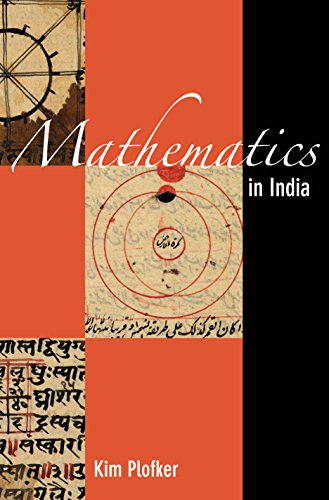
Based on extensive research in Sanskrit sources, Mathematics in India chronicles the development of mathematical techniques and texts in South Asia from antiquity to the early modern period. Kim Plofker reexamines the few facts about Indian mathematics that have become common knowledge–such as the Indian origin of Arabic numerals–and she sets them in a larger textual and cultural framework. The book details aspects of the subject that have been largely passed over in the past, including the relationships between Indian mathematics and astronomy, and their cross-fertilizations with Islamic scientific traditions. Plofker shows that Indian mathematics appears not as a disconnected set of discoveries, but as a lively, diverse, yet strongly unified discipline, intimately linked to other Indian forms of learning. Far more than in other areas of the history of mathematics, the literature on Indian mathematics reveals huge discrepancies between what researchers generally agree on and what general readers pick up from popular ideas. This book explains with candor the chief controversies causing these discrepancies–both the flaws in many popular claims, and the uncertainties underlying many scholarly conclusions. Supplementing the main narrative are biographical resources for dozens of Indian mathematicians; a guide to key features of Sanskrit for the non-Indologist; and illustrations of manuscripts, inscriptions, and artifacts. Mathematics in India provides a rich and complex understanding of the Indian mathematical tradition. **Author’s note: The concept of “computational positivism” in Indian mathematical science, mentioned on p. 120, is due to Prof. Roddam Narasimha and is explored in more detail in some of his works, including “The Indian half of Needham’s question: some thoughts on axioms, models, algorithms, and computational positivism” (Interdisciplinary Science Reviews 28, 2003, 1-13).
User’s Reviews
Reviews from Amazon users which were colected at the time this book was published on the website:
⭐I was about to purchase this book but was fortunately able to look at a copy before doing so. The author, with almost no professional comprehension of the intricacies of Sanskrit grammar and linquistic theory, attempts to comment rather erratically on the connection between the abstract, symbolic nature of Paniniyan grammatical nomenclature and Indian mathematical categories.What is truly puzzling is that this is supposed to be a text wholly devoted to Indian mathematics–but she herself, in one chapter, claims there is not enough “space” to expatiate on a rather important topic.Her arguments and assertions never really evolve–nor does she bother to back up her assertions with any relevant cross-references. I am fully prepared to accept that the decimal system of Indian place value notation originated in China–but the author herself admits there is no real evidence for such a claim, yet feels comfortable proposing it as serious enough to devote a torpid half-page to. Worse, she makes no effort to comprehend any argument as to why such a system would be indigenous to Indian mathematical development (despite evidence to the contrary).Reading, one gets the constant feeling that she stumbled upon the idea of writing this book rather haphazardly and then decided it wasn’t such a a good idea after all.
⭐This book is yet another western attempt to portray Vedic astronomy and mathematics as vague, ahistorical , unscientific, and borrowed. All AIT opponents are summarily dismissed as “Hindu Nationalist (p. 2).” The author’s complete ignorance of archaeological facts is evidenced by the statement “…Indus cultural sites do not contain remains of characteristic Indo-European goods such as horses or chariots (p. 7.).” The reader is assured (p. 5) that Vedic Sanskrit has “unmistakably descended” from the reconstructed Proto Indo-European, never mind that reconstructed languages are not historical facts, but merely a tool of linguistic research. The author admits that “there is no known evidence, textual or otherwise, that indisputably proves any of these dates (like 3000 BCE) to be impossible for the composition of Vedic works, (p. 35, paranthesis added),” but they must be rejected as they do not fit in with the imperialist and Eurocentric reconstructions of what Vedic history should be. A very scientific approach for someone who claims to be a mathematician and claims to have written a book about it. Here is another comical argument (p. 42)–“The suggestion of a Mesopotamian origin thus furnishes a coherent and plausible explanation for at least some of the features of Indian mathematical astronomy at the close of the Vedic period. On the other hand, there is nothing in these similarities that necessarily has to be accounted for by transmission, and there are no indisputable traces such as Akkadian loan-word technical terms in Sanskrit texts.” Duh?!.
⭐This a a scholar book on the field, by a master on the topic. Isn`t a book for naive readers, but everyone that is seriously interested inmath`s history will apreciate it.
Keywords
Free Download Mathematics in India in PDF format
Mathematics in India PDF Free Download
Download Mathematics in India 2008 PDF Free
Mathematics in India 2008 PDF Free Download
Download Mathematics in India PDF
Free Download Ebook Mathematics in India