

Ebook Info
- Published: 1980
- Number of pages: 118 pages
- Format: PDF
- File Size: 7.71 MB
- Authors: John C. Oxtoby
Description
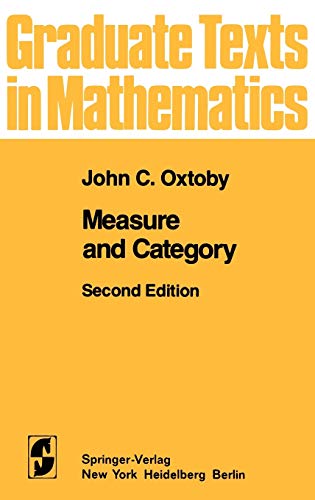
In this edition, a set of Supplementary Notes and Remarks has been added at the end, grouped according to chapter. Some of these call attention to subsequent developments, others add further explanation or additional remarks. Most of the remarks are accompanied by a briefly indicated proof, which is sometimes different from the one given in the reference cited. The list of references has been expanded to include many recent contributions, but it is still not intended to be exhaustive. John C. Oxtoby Bryn Mawr, April 1980 Preface to the First Edition This book has two main themes: the Baire category theorem as a method for proving existence, and the “duality” between measure and category. The category method is illustrated by a variety of typical applications, and the analogy between measure and category is explored in all of its ramifications. To this end, the elements of metric topology are reviewed and the principal properties of Lebesgue measure are derived. It turns out that Lebesgue integration is not essential for present purposes-the Riemann integral is sufficient. Concepts of general measure theory and topology are introduced, but not just for the sake of generality. Needless to say, the term “category” refers always to Baire category; it has nothing to do with the term as it is used in homological algebra.
User’s Reviews
Reviews from Amazon users which were colected at the time this book was published on the website:
⭐Great seeler – came quickly and as described. Thx
⭐This is a book first published in the 70’s and it has the advantage of being easy reading and short. It presents to the student with little background (a course of real analysis or calculus is all that is required, together with some familiarity with set theoretic reasoning) some of the classical and powerful results of measure and set theory and analysis in an elegant and modern way. It explores in a diversity of ways the analogies of measure and category and the uses of Baire and Borel’s theorems. I believe it is one of the best introductions of measure theory that can be found in the literature.
⭐This short book is an interesting account of measure theory and how it relates to topology. The topics are the standard ones that one would find in a book on the subject, and the book is a real pleasure to read. Its length motivates one to finish the book and the book is very applicable to the theory of dynamical systems and the theory of large deviations. It could be used as a textbook on measure theory or foundations of analysis if one supplemented it with problem sets and some outside reading. A good book.
Keywords
Free Download Measure and Category: A Survey of the Analogies between Topological and Measure Spaces (Graduate Texts in Mathematics, 2) 2nd Edition in PDF format
Measure and Category: A Survey of the Analogies between Topological and Measure Spaces (Graduate Texts in Mathematics, 2) 2nd Edition PDF Free Download
Download Measure and Category: A Survey of the Analogies between Topological and Measure Spaces (Graduate Texts in Mathematics, 2) 2nd Edition 1980 PDF Free
Measure and Category: A Survey of the Analogies between Topological and Measure Spaces (Graduate Texts in Mathematics, 2) 2nd Edition 1980 PDF Free Download
Download Measure and Category: A Survey of the Analogies between Topological and Measure Spaces (Graduate Texts in Mathematics, 2) 2nd Edition PDF
Free Download Ebook Measure and Category: A Survey of the Analogies between Topological and Measure Spaces (Graduate Texts in Mathematics, 2) 2nd Edition