

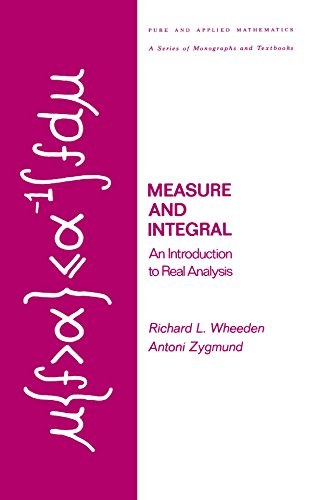
Ebook Info
- Published: 1977
- Number of pages: 288 pages
- Format: PDF
- File Size: 17.93 MB
- Authors: Richard Wheeden
Description
This volume develops the classical theory of the Lebesgue integral and some of its applications. The integral is initially presented in the context of n-dimensional Euclidean space, following a thorough study of the concepts of outer measure and measure. A more general treatment of the integral, based on an axiomatic approach, is later given.Closely related topics in real variables, such as functions of bounded variation, the Riemann-Stieltjes integral, Fubini’s theorem, L(p)) classes, and various results about differentiation are examined in detail. Several applications of the theory to a specific branch of analysis–harmonic analysis–are also provided. Among these applications are basic facts about convolution operators and Fourier series, including results for the conjugate function and the Hardy-Littlewood maximal function.Measure and Integral: An Introduction to Real Analysis provides an introduction to real analysis for student interested in mathematics, statistics, or probability. Requiring only a basic familiarity with advanced calculus, this volume is an excellent textbook for advanced undergraduate or first-year graduate student in these areas.
User’s Reviews
Reviews from Amazon users which were colected at the time this book was published on the website:
⭐this is a great, clearly written book that excels as a book to learn analysis from. the book takes a ground up approach, starting with only the positive real line and generalizing from there. being presented in the most simple context where all the abstraction is stripped away, the essence of the arguments is laid bare and thus the proofs are as understandable as possible. then, once the arguments are made and the intuition is in place, the book proceeds to generalize the results to more abstract circumstances. thus making the motivation for using more powerful tools clear.this style can be compared to that of rudin’s classic book, which is largely a disaster to learn out of. for instance, rudin’s book oscillates between C and R for whatever gives the most slick, but often least insightful proof. this is fine, and even enjoyable once you understand the subject, but is terrible to learn from for most people. there isn’t a better book to learn measure theory and integration out of than this book
⭐very good condition is indeed very good
⭐The book in fact is well written. But in my opinion this is not the best book of the area. Kolmogorov, Fomin’s book is better (Rudin’s books as well). Lieb and Loss’ book (Analysis) of AMS series is also better than this one.The book is well organized but since it’s a bit old book, the notations are kind of heavy.BTW the quality of the material of the book is not the best. It starts to dived in parts just even after a week one uses it.
⭐I will preface this review by saying that I am a geophysicist, not a mathematician. I purchased this book as the textbook for a “Real and Abstract Analysis” class. The treatment of the subject material is complete and concise. However, I think it’s too concise for someone who hasn’t been trained to think in the manner of a mathematician. I do keep the book and reference it occasionally though, and the material has improved my understanding of statistics and numerical optimisation.
⭐Love it
⭐This is a good book. It starts with proving things for measures on the reals and then generalizes to measure spaces.
⭐4 stars, which actually means 4.5. I don’t rate it the maximum, because I think it lacks a couple of things to be perfect.The pros:1. the theory is built from the very ground up to the “ante-room”, so to speak, of further and more advanced developments in abstract measure theory and functional analysis, in a deeply logical and clear way with the highest economy of words and of thought. From this viewpoint, for example, I don’t see the fact of setting the theory in the R^n environment as a weakness: on the contrary, since it results from a deliberate choice of the authors, it actually ends up in an element of strength, because the reader/learner can take all the time he/she needs to become familiar with the “exact integration” approach of Lebesgue (which is *completely* different from Riemann’s), and to visualize how things are going by using the familiar multivariable environment of R^n.In other words: the reader can take all the time he/she needs to learn to swim, before he/she actually has to swim on the much longer and more difficult track of abstract measure theory (as a branch of functional analysis). I believe such a gradual approach to be better than a direct one, where from the very first page you are thrown into abstract measure theory, with the risk of being almost completely unable to understand what all that stuff is about.2. The almost perfect way in which the authors build the theory and logically argument actually makes the book a fantastic school to learn the deep essence of the axiomatic method. This is its greatest strength, in my opinion: that is, the fact that in carefully going through the definitions, lemmas, theorems and corollaries (and in fact *working out* them) you can actually learn what the essence of correct mathematical thinking is. As long as I can remember, there are only a couple of other books, at the same level of this one, which are as good: i.e., Rudin 1 & 2 (the “Principles” and “R&C Analysis”) and Einar Hille’s “Lectures on Ordinary Differential Equations” (too bad it’s definitely out of print. It would be such a great thing to have it reprinted in some economic edition).The cons:1. The Theorem of Integration by Substitution isn’t demonstrated at all, with the possible exception of a particular case in the problems. Since it is a fundamental result and since its demonstration can be very enlightening from a geometric point of view, I think this is a weakness.2. The part about Indefinite Integral and Differentiation (Vitali’s Covering Lemma, and all the results deriving from it) isn’t on the same level of the preceding chapters, and isn’t as clear and well built as it is on Royden’s “Real Analysis” (another great book): maybe because in the latter it fits naturally into the rest of the book (which is, in the first chapters where the theory is built from the foundations, intrinsically one-dimensional) as a necessary development of what comes before, while in Wheeden-Zygmund it seems to be forced in a book which, until that point, had been developing in an intrinsically multi-dimensional way: and this cannot happen at no cost.Everything considered, it’s worth its price (which, btw, is a little too high for a book of less than 300 pages 😉 )
⭐If Amazon allowed half-star increments, I’d rate it 3.5 stars.The book has a nice amount of material and is generally fairly straightforward in presentation, but there are a few instances where the authors definitely chose brevity over clarity. It often feels that the book could have benefitted from a better editor, in the sense that content is densely crammed onto each page in a way that makes it difficult to scan quickly when you need to look something up, and which a little more care in organizing paragraphs and layout could have completely alleviated. It may seem like a minor gripe, but there is some good stuff in the book, and being able to parse what is there quickly would not only improve the book as a reference, but would also help the student who is first reading through have a better sense of just what the authors are doing in some passages. In other words, the content is very good, but the readability is sometimes lacking.My main problem with the book is that is is extremely poorly bound, as are many books published by CRC. My copy has fallen apart during a one-semester course. In fact, the very first time I opened the book to read, I lost the first page from Chapter 1, and pages have fallen out ever since. I’ve never had a book come apart like this, even old, thick ones that I’ve used heavily. On the positive side, though, using the pages that fall out as bookmarks is a convenient way to have quick access to important theorems and exercises.
⭐Original and good quality printing
Keywords
Free Download Measure and Integral: An Introduction to Real Analysis (Chapman & Hall/CRC Pure and Applied Mathematics Book 308) 1st Edition in PDF format
Measure and Integral: An Introduction to Real Analysis (Chapman & Hall/CRC Pure and Applied Mathematics Book 308) 1st Edition PDF Free Download
Download Measure and Integral: An Introduction to Real Analysis (Chapman & Hall/CRC Pure and Applied Mathematics Book 308) 1st Edition 1977 PDF Free
Measure and Integral: An Introduction to Real Analysis (Chapman & Hall/CRC Pure and Applied Mathematics Book 308) 1st Edition 1977 PDF Free Download
Download Measure and Integral: An Introduction to Real Analysis (Chapman & Hall/CRC Pure and Applied Mathematics Book 308) 1st Edition PDF
Free Download Ebook Measure and Integral: An Introduction to Real Analysis (Chapman & Hall/CRC Pure and Applied Mathematics Book 308) 1st Edition