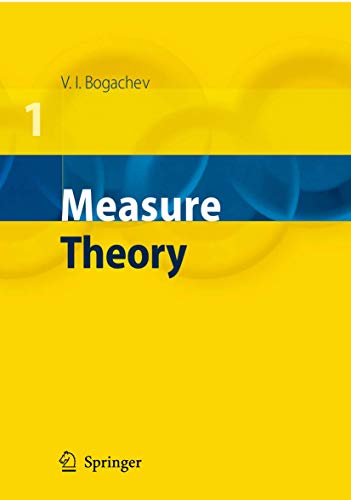
Ebook Info
- Published: 2007
- Number of pages: 1092 pages
- Format: PDF
- File Size: 5.57 MB
- Authors: Vladimir I. Bogachev
Description
This book giving an exposition of the foundations of modern measure theory offers three levels of presentation: a standard university graduate course, an advanced study containing some complements to the basic course, and, finally, more specialized topics partly covered by more than 850 exercises with detailed hints and references. Bibliographical comments and an extensive bibliography with 2000 works covering more than a century are provided.
User’s Reviews
Editorial Reviews: Review From the reviews: “The main thrust of the very detailed account of this subject by Bogachev in two volumes making up approximately 1100 pages, with 2038 references listed, is a scholarly rendering of its many sided view, some highlights of which will be commented on here. … The treatment is reader friendly and I would recommend that each graduate real analysis student own both volumes … and they make a good reference set to keep on ones shelf.” (Malempati M. Rao, Zentralblatt MATH, Vol. 1120 (22), 2007) “Volume one contains the modern foundations of measure and integration theory … . I should mention that the problems are accessible to students―some of the exercises are especially recommended for students … . The monograph excels by its clear, scholarly style and the wealth of … historical comments and references. … For any library and researchers in mathematical analysis or probability theory these … are a must-have―for the mathematical literature this is a wonderful addition.” (René L. Schilling, Mathematical Reviews, Issue 2008 g) “This is a remarkably comprehensive treatise on modern, as well as classical, measure theory and integration. … This is an excellent and impressive monograph, which I can strongly recommended to researchers in analysis and probability, to university teachers as well as to students. I am convinced that this … volume treatise cannot be missing from university libraries and the shelves of mathematicians interested in measure and integration.” (EMS Newsletter, December, 2008) From the Back Cover Measure theory is a classical area of mathematics that continues intensive development and has fruitful connections with most other fields of mathematics as well as important applications in physics. This book gives a systematic presentation of modern measure theory as it has developed over the past century and offers three levels of presentation: a standard university graduate course, an advanced study containing some complements to the basic course (the material of this level corresponds to a variety of special courses), and, finally, more specialized topics partly covered by more than 850 exercises. Bibliographical and historical comments and an extensive bibliography with 2000 works covering more than a century are provided. Volume 1 is devoted to the classical theory of measure and integral. Whereas the first volume presents the ideas that go back mainly to Lebesgue, the second volume is to a large extent the result of the later development up to the recent years. The central subjects of Volume 2 are: transformations of measures, conditional measures, and weak convergence of measures. These topics are closely interwoven and form the heart of modern measure theory. The target readership includes graduate students interested in deeper knowledge of measure theory, instructors of courses in measure and integration theory, and researchers in all fields of mathematics. The book may serve as a source for many advanced courses or as a reference. About the Author Vladimir Bogachev was born in Moscow in 1961. He got the PhD at Moscow State University in 1986 and he got the degree of Doctor of Sciences in 1990. Since 1986 Vladimir Bogachev has worked at the Department of Mechanics and Mathematics of Moscow State University. The main fields of his research are measure theory, nonlinear functional analysis, probability theory, and stochastic analysis. He is a well-nown expert in measure theory, probability theory, and the Malliavin calculus, and the author of more than 100 scientific publications. His monograph “Gaussian Measures’’ (AMS, 1998) has become a widely used source. Vladimir Bogachev hs been an invited speaker and a lecturer at many international conferences and several dozen universities and mathematical institutes over the world. Scientific awards: a medal of the Academy of Sciences of the USSR and the Award of the Japan Society of Promotion of Science. Read more
Reviews from Amazon users which were colected at the time this book was published on the website:
⭐I have spent time with both volumes of this two volume work. Bogachev presents everything in the language of measure theory, and thus talks about measurable functions rather than random variables. The language of probability theory is slick like an Apple computer, but it hides some inner workings that stare you in the face when you work using the language of measure theory. A probability votary might assert that one shouldn’t think about the objects that do not explicitly appear in probability theory. Bogachev covers both more things than other books I have seen and gives more detailed proofs. Many results that are part of mathematical folklore are proved here, like consequences and equivalent statements of equi-integrability/uniform integrability and the Dunford-Pettis theorem; relations between different types of convergence; and the symmetric difference metric on the quotient of a sigma-algebra by the null sets. Also, the theorems are stated with quite general conditions, for example not assuming that we are working with a probability measure when it is enough to work with a sigma-finite measure and not assuming that a metric space is Polish when it is enough that it be separable. In the second volume there is a good exposition of the Borel sigma-algebra of a topological space. Bogachev defines the product of measure spaces and proves the Kolmogorov consistency theorem, which has an especially tractable form for products of Polish spaces.The first volume also has substantial material on differentiability of functions. It has the best proof of the Denjoy-Young-Saks theorem that I’ve found in a textbook, that the set of points where an arbitrary function on an interval is differentiable is a Borel set. The Dini derivatives used as tools for this.
⭐This is one of the best books I have read in analysis. It is more of a survey of important results than a textbook. The presentation is very clear, and one can find a wide range of results on various topics in analysis and measure theory. A few results are not proven in the book, but the author points out the papers/books where we can find the proof of the result.I strongly recommend this book to everyone who is looking for a survey book on Analysis and Measure theory.
Keywords
Free Download Measure Theory (2 Volume Set) 2007th Edition in PDF format
Measure Theory (2 Volume Set) 2007th Edition PDF Free Download
Download Measure Theory (2 Volume Set) 2007th Edition 2007 PDF Free
Measure Theory (2 Volume Set) 2007th Edition 2007 PDF Free Download
Download Measure Theory (2 Volume Set) 2007th Edition PDF
Free Download Ebook Measure Theory (2 Volume Set) 2007th Edition